Rethinking Dementia Diagnosis: What the New Alzheimer’s Association Guidelines Change in Clinical Practice
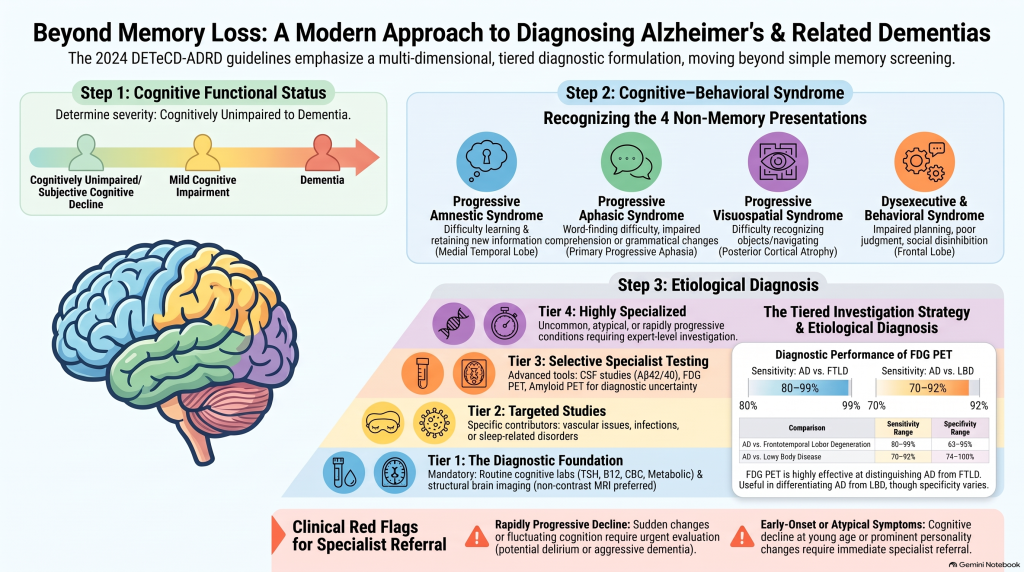 From memory screening and exclusion of reversible causes to neuropsychological profiling, clinical formulation, and biological diagnosis
Dementia diagnosis has traditionally followed a familiar clinical pathway. A patient or family member reports memory difficulties, the clinician performs a brief cognitive screening test, orders blood investigations to exclude potentially reversible causes, and obtains brain imaging when indicated.
If the clinical presentation is typical, a diagnosis of probable Alzheimer’s disease or another form of dementia may be made. Further investigations are often reserved for patients with unusual symptoms or diagnostic uncertainty.
This approach remains clinically useful. However, advances in cognitive neuroscience, neuropsychology, neuroimaging, and molecular biomarkers have exposed its limitations.
The Alzheimer’s Association’s DETeCD-ADRD clinical practice guideline provides a more structured approach to the diagnostic evaluation of suspected Alzheimer’s disease and related disorders.
The guideline was developed following a review of 7,374 publications, with 133 meeting the inclusion criteria. It contains 19 recommendations covering evaluation, testing, counseling, and diagnostic disclosure.
Although accepted in September 2024 and published in Alzheimer’s & Dementia in 2025, its recommendations reflect an evolving diagnostic landscape in which clinical assessment and biological markers increasingly complement one another.
The important question is not whether traditional dementia assessment should be abandoned. Rather, it is how established clinical practice can be refined to provide a more accurate and individualized diagnosis.
1. From diagnosing dementia to developing a three-level diagnostic formulation
Perhaps the most important conceptual development in the guideline is its recommendation to distinguish three separate aspects of diagnosis.
Traditionally, clinical documentation may conclude with a diagnosis such as probable Alzheimer’s dementia or vascular dementia.
Although useful, such a diagnosis may not adequately describe the patient’s cognitive profile, functional abilities, or degree of certainty regarding the underlying disease.
The DETeCD-ADRD guideline recommends a three-step formulation.
First: What is the patient’s cognitive functional status?
The clinician determines whether the patient is cognitively unimpaired, has subjective cognitive decline, mild cognitive impairment, or dementia.
This assessment considers not only cognitive test performance but also the impact of symptoms on everyday functioning.
Second: What is the cognitive–behavioural syndrome?
The clinician identifies the pattern of cognitive impairment.
The predominant difficulty may involve memory, language, executive function, visuospatial abilities, behaviour, or a combination of these domains.
Third: What is the likely underlying etiology?
The clinician determines which disease or combination of conditions is responsible for the syndrome.
Possible etiologies include Alzheimer’s disease, frontotemporal lobar degeneration, Lewy body disease, vascular pathology, and other neurological or medical conditions.
These three levels are related but are not interchangeable.
What changes in practice?
Consider a patient who presents with difficulty organizing finances, planning daily activities, and managing medications.
A conventional assessment might establish that the person has dementia and consider Alzheimer’s disease as a possible diagnosis.
A more detailed formulation might instead describe mild dementia with predominantly executive dysfunction, followed by a differential diagnosis that includes Alzheimer’s disease, vascular cognitive impairment, and frontotemporal degeneration.
This distinction has practical consequences.
The cognitive syndrome guides subsequent investigations, while the functional assessment guides care planning. The etiological formulation determines whether further imaging or molecular testing is likely to be useful.
Importantly, this three-level approach formalizes principles already familiar to dementia specialists. Its contribution is to make the formulation explicit, systematic, and applicable across clinical settings.
2. From memory-centred screening to multidomain cognitive assessment
Memory impairment remains an important feature of Alzheimer’s disease, but the guideline emphasizes that dementia should not be approached as a disorder of memory alone.
Different neurodegenerative diseases affect different brain regions and cognitive networks.
Furthermore, Alzheimer’s pathology itself can produce different clinical presentations depending on the distribution of disease.
The guideline recognizes progressive amnestic, aphasic, visuospatial, dysexecutive, behavioural, and other cognitive syndromes.
Why this matters clinically
A patient with a predominantly language-based presentation may have primary progressive aphasia.
A patient experiencing difficulty recognizing objects, reading, or navigating familiar surroundings may have a posterior cortical syndrome.
Another individual may present with impaired judgment, planning, or behavioural regulation.
These patients may have relatively preserved memory during the early stages of their illness.
A diagnostic pathway focused predominantly on memory complaints may therefore delay recognition of atypical presentations.
The guideline encourages clinicians to identify the most prominently affected cognitive domain before drawing conclusions about the underlying pathology.
However, it does not suggest that every patient requires an extensive neuropsychological battery. Brief validated cognitive instruments remain appropriate during the initial evaluation.
The change is in how screening results are interpreted: as part of a broader assessment rather than as a complete description of cognitive functioning.
3. From a screening score to a meaningful neuropsychological profile
A major practical emphasis of the guideline is the role of comprehensive neuropsychological evaluation.
In many clinical settings, cognitive assessment is primarily based on instruments such as the Mini-Mental State Examination (MMSE) or Montreal Cognitive Assessment (MoCA).
These instruments provide useful information about global cognitive functioning and can help identify patients requiring further evaluation.
However, a single score cannot adequately characterize every cognitive syndrome.
A patient may score within normal limits despite experiencing significant difficulties with complex activities.
Conversely, poor performance may reflect educational differences, language barriers, sensory impairment, psychiatric symptoms, or other factors that complicate interpretation.
The guideline’s Recommendation 14 specifically addresses these situations.
It recommends neuropsychological evaluation when office-based cognitive assessment is insufficiently informative, particularly when symptoms reported by the patient or caregiver are inconsistent with screening results or when the clinical presentation is complex.
The recommendation has a Strength of Recommendation A.
What does comprehensive neuropsychological assessment add?
A neuropsychological evaluation examines the pattern of performance across multiple cognitive domains rather than relying primarily on a global score.
The guideline specifies assessment of learning and memory, attention, executive function, visuospatial function, and language.
In particular, memory assessment should include delayed free recall, cued recall, and recognition.
These measures can help distinguish between different mechanisms of cognitive impairment.
For example, poor spontaneous recall with relatively preserved recognition may suggest a different pattern of impairment from poor performance across free recall, cued recall, and recognition.
Such findings must be interpreted alongside attention, language, clinical history, and other relevant factors. Neither pattern independently establishes a particular disease.
A comprehensive evaluation also examines preserved abilities.
Identifying cognitive strengths may help clinicians recommend compensatory strategies, environmental modifications, and individualized rehabilitation.
The important nuance
The guideline does not make comprehensive neuropsychological testing mandatory for every person with suspected dementia.
Many patients with a typical clinical presentation can receive an appropriate diagnosis through detailed history, examination, validated screening, routine investigations, and structural imaging.
Formal neuropsychological evaluation becomes particularly valuable when the initial assessment does not adequately establish functional status, characterize the syndrome, or clarify the differential diagnosis.
This is a more targeted recommendation than simply replacing every bedside cognitive examination with an extensive test battery.
4. From excluding reversible causes to identifying multiple contributors
A familiar component of dementia evaluation is the investigation of potentially reversible causes.
Thyroid dysfunction, vitamin B12 deficiency, medication effects, infections, and other medical conditions may contribute to cognitive impairment.
The guideline retains the importance of identifying these conditions but introduces an important refinement.
Rather than assuming that the evaluation is primarily a search for a reversible explanation, clinicians should recognize that several factors may contribute simultaneously to cognitive impairment.
A patient with Alzheimer’s disease may also have obstructive sleep apnea, depression, vitamin B12 deficiency, cerebrovascular disease, or medication-related cognitive adverse effects.
Treating these contributors may improve symptoms and functioning without reversing the underlying neurodegenerative process.
The guideline specifically cautions that describing routine investigations simply as tests for reversible causes can be misleading.
Mixed pathology is particularly important in older adults
The guideline notes that most individuals older than 80 years with cognitive impairment have more than one type of brain pathological change.
Alzheimer’s pathology may coexist with vascular injury, Lewy body pathology, or other neurodegenerative changes.
This means that the presence of one pathology does not necessarily exclude another.
A patient with Alzheimer’s disease may have additional executive dysfunction from cerebrovascular injury. Another may have significant sleep disturbance or psychiatric symptoms that worsen cognitive functioning.
Recognizing these contributors is important because some may be amenable to treatment or risk reduction.
The clinical objective therefore shifts from identifying a single explanation to developing a comprehensive formulation of the factors contributing to the patient’s difficulties.
5. From using MRI primarily to exclude structural lesions to interpreting patterns of neurodegeneration
Structural neuroimaging has long been part of dementia assessment.
Traditionally, one of its major purposes was to identify alternative explanations such as brain tumours, hydrocephalus, cerebrovascular lesions, or other structural abnormalities.
The guideline emphasizes an additional role: identifying regional patterns of brain atrophy that may support a particular clinical diagnosis.
For example, medial temporal and temporoparietal atrophy may support a clinical hypothesis of Alzheimer’s disease.
Frontal or anterior temporal atrophy may support consideration of frontotemporal degeneration.
MRI can also demonstrate cerebrovascular injury and microhemorrhages, which may influence both diagnosis and treatment decisions.
The guideline recommends structural brain imaging for patients with an established cognitive–behavioural syndrome, with MRI preferred when available and not contraindicated. CT is an alternative when MRI cannot be obtained.
What changes in practice?
The MRI report should ideally be interpreted in relation to the patient’s clinical and cognitive profile.
A patient with a predominantly language-based syndrome may require particular attention to asymmetrical temporal or frontal abnormalities.
A patient with a visuospatial syndrome may require examination of posterior cortical regions.
However, regional atrophy does not independently establish a molecular diagnosis.
The clinical syndrome, neuropsychological findings, and imaging abnormalities must be integrated.
This is especially important because normal or relatively preserved structural imaging does not necessarily exclude early neurodegenerative disease.
6. From a single diagnostic pathway to personalized, tiered investigations
The availability of increasingly sophisticated investigations creates another challenge: deciding which tests are necessary for an individual patient.
The guideline recommends a tiered approach rather than ordering all available investigations.
Tier 1 includes routine laboratory investigations and structural brain imaging.
Further investigations are selected according to the clinical presentation, risk factors, findings from initial testing, and the degree of diagnostic uncertainty.
Higher-tier investigations may include FDG PET, cerebrospinal fluid analysis, amyloid PET, EEG, specialized laboratory studies, or genetic testing.
The guideline explicitly discourages an indiscriminate approach to diagnostic testing.
The role of FDG PET
FDG PET evaluates regional cerebral glucose metabolism and may help characterize patterns of brain dysfunction.
It can provide useful information when Alzheimer’s disease, frontotemporal degeneration, Lewy body disease, or another neurodegenerative disorder remains in the differential diagnosis.
However, FDG PET is not a direct marker of a specific molecular pathology.
It is most useful when the results are likely to resolve a meaningful diagnostic uncertainty.
The guideline also cautions against its use for determining etiology in severe dementia with widespread impairment, because diffuse hypometabolism may be insufficiently discriminating.
The practical change is not that every patient should undergo PET imaging. It is that advanced imaging should answer a specific clinical question.
7. From probable clinical diagnosis to biological confirmation when necessary
Perhaps the most widely discussed development in Alzheimer’s disease diagnosis is the increasing role of molecular biomarkers.
Historically, a diagnosis of probable Alzheimer’s dementia was largely based on the characteristic clinical syndrome, progression, examination, and supportive investigations.
Biomarkers now allow clinicians to identify evidence of amyloid and tau pathology during life.
CSF amyloid-beta and phosphorylated tau measurements, along with amyloid PET, can increase diagnostic confidence in selected patients.
This is particularly relevant when the clinical presentation is atypical or when molecular confirmation is required for consideration of anti-amyloid treatment.
However, the guideline makes an important distinction between a confident clinical diagnosis and biological confirmation.
A typical clinical presentation, appropriate investigations, and supportive MRI findings may provide sufficient confidence for routine clinical management.
Molecular confirmation is not required in every patient.
It becomes particularly relevant when the result will meaningfully influence diagnosis or treatment decisions.
A positive biomarker does not explain everything
Another important nuance concerns the interpretation of positive amyloid biomarkers.
Amyloid pathology becomes increasingly common with age and may coexist with other diseases.
Consequently, identifying cerebral amyloid does not necessarily establish that Alzheimer’s disease is the principal cause of every cognitive symptom.
The clinical presentation and the possibility of mixed pathology remain important.
Biomarkers complement the clinical formulation; they do not eliminate the need for it.
What about blood biomarkers?
The guideline recognizes the potential of blood-based biomarkers, including phosphorylated tau and amyloid-related measures.
However, its recommendations reflect the evidence available when it was finalized in 2024.
At that time, the authors emphasized the need for further validation across diverse clinical populations and did not recommend blood biomarkers as stand-alone diagnostic tests in routine practice.
The field has continued to evolve, and the precise clinical role of individual assays requires consideration of newer evidence and applicable guidance.
The enduring principle is that molecular tests should be interpreted within an established clinical and cognitive framework.
8. From considering psychiatric symptoms as mimics to integrating them into dementia assessment
The guideline has particular relevance for psychiatrists.
Depression, anxiety, apathy, psychosis, and changes in personality may be the presenting symptoms of a neurodegenerative disorder.
At the same time, primary psychiatric disorders can produce substantial cognitive difficulties.
These possibilities are not mutually exclusive.
Depression may coexist with Alzheimer’s disease. Apathy may represent a manifestation of neurodegeneration rather than a primary mood disorder. Psychosis or fluctuating cognition may raise questions about Lewy body disease, delirium, medication effects, or other conditions.
The guideline emphasizes a comprehensive assessment of cognition, neuropsychiatric symptoms, and neurological functioning.
It also recommends specialist evaluation when prominent behavioural disturbances, atypical cognitive abnormalities, rapid progression, or fluctuating symptoms complicate the presentation.
What changes for psychiatric practice?
The central question should not be limited to whether a patient has depression or dementia.
It should include whether the psychiatric symptoms are primary, secondary to neurological disease, contributing to cognitive impairment, or occurring alongside a neurodegenerative condition.
Longitudinal history, collateral information, cognitive profiling, medication review, and appropriate investigations help clarify these possibilities.
This approach is particularly valuable in patients presenting with late-onset behavioural changes or progressive deterioration in everyday functioning.
9. From diagnosis as an endpoint to diagnosis as the foundation for care
Another important aspect of the guideline is its emphasis on communication and diagnostic disclosure.
The evaluation does not end when a clinician establishes that the patient has dementia.
Patients and care partners need an explanation of the cognitive syndrome, likely underlying disease, degree of diagnostic certainty, expected course, and available management options.
The discussion should also address safety, future care needs, psychosocial support, and the patient’s personal priorities.
The guideline emphasizes honest and compassionate communication while considering the patient’s understanding and capacity to participate in decision-making.
A comprehensive neuropsychological assessment can contribute to this process by identifying preserved abilities and areas requiring support.
For example, a patient with substantial memory impairment but relatively preserved language and procedural abilities may benefit from a different compensatory approach than someone with prominent executive dysfunction.
The purpose of cognitive profiling is therefore not merely diagnostic classification.
It can also inform practical interventions that help preserve independence and quality of life.
10. What should actually change in routine dementia clinics?
The DETeCD-ADRD guideline does not require every clinic to adopt expensive molecular investigations or provide comprehensive neuropsychological testing to every patient.
Its more important contribution is a structured diagnostic philosophy.
Several practical changes follow from this approach.
First, memory clinics should evaluate cognitive, behavioural, and functional changes rather than restricting assessment to forgetfulness.
Second, clinical documentation should distinguish functional status, cognitive syndrome, and likely etiology.
Third, brief cognitive screening should remain an initial assessment tool, with comprehensive neuropsychological evaluation used when greater diagnostic clarification is needed.
Fourth, structural neuroimaging should be interpreted alongside the clinical and neuropsychological profile.
Fifth, additional investigations should be selected according to the diagnostic question rather than ordered routinely without a clear indication.
Finally, the diagnostic process should lead to an individualized care plan that addresses cognitive functioning, psychiatric symptoms, medical contributors, caregiver needs, and future planning.
These principles are especially relevant in healthcare systems where specialist services, neuropsychological assessment, advanced imaging, and molecular biomarkers may not be equally accessible.
The guideline provides a framework for using available resources systematically while identifying patients who may benefit from further specialist evaluation.
Conclusion
The evolution of dementia diagnosis is not simply a transition from clinical assessment to biomarkers.
It is a transition from broadly classifying cognitive impairment to developing a more comprehensive understanding of the individual patient’s condition.
The DETeCD-ADRD guideline reinforces the importance of detailed clinical evaluation while giving greater structure to cognitive–behavioural formulation, neuropsychological assessment, targeted investigations, and biological confirmation.
Its recommendations do not replace established clinical practice. They refine it.
For clinicians, the central lesson is that a dementia diagnosis should explain more than whether a patient has memory impairment.
It should describe which cognitive functions are affected, how those difficulties influence daily life, what disease processes may be responsible, and how that understanding can guide treatment and support.
The future of dementia care lies in integrating clinical expertise, neuropsychological profiling, appropriate investigations, and individualized management rather than relying on any single test or diagnostic label.
Comprehensive Dementia and Memory Assessment in Chennai
Dr. Srinivas Rajkumar T is a Senior Consultant Psychiatrist at Apollo Hospitals, Chennai, with an MD in Psychiatry from AIIMS, New Delhi.
He provides comprehensive assessment and management for individuals experiencing memory difficulties, attention problems, behavioural changes, and other cognitive concerns.
His approach integrates detailed clinical evaluation, standardized cognitive testing, neuropsychological profiling, and appropriate investigations to identify the nature of cognitive difficulties and develop individualized treatment plans.
ATTN Clinic – Attention. Understood.
Apollo Clinic (Opp. Phoenix Market City), Velachery, Chennai.
Appointments: +91 85951 55808
Email: srinivasaiims@gmail.com
Website: www.srinivasaiims.com
Original reference: Dickerson BC, Atri A, Clevenger C, et al. The Alzheimer’s Association clinical practice guideline for the Diagnostic Evaluation, Testing, Counseling, and Disclosure of Suspected Alzheimer’s Disease and Related Disorders (DETeCD-ADRD): Executive summary of recommendations for specialty care. Alzheimer’s & Dementia. 2025;21:e14337. https://doi.org/10.1002/alz.14337