Dementia with Lewy Bodies: Why Memory Loss Is Not Always the First Sign of Dementia
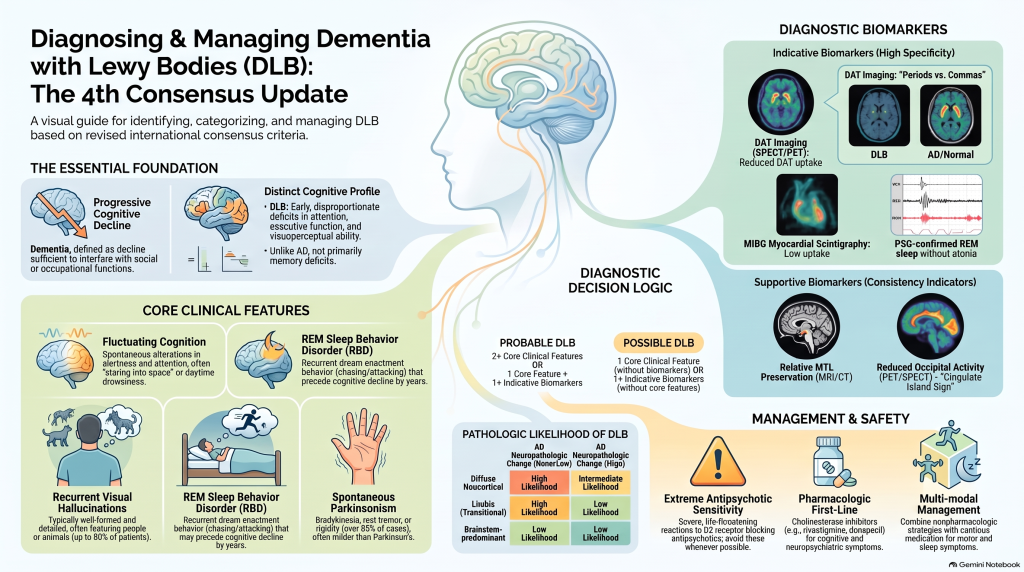 Understanding the Fourth Consensus Report and its implications for diagnosis, neuropsychological assessment, brain imaging, and psychiatric management
Dementia is commonly associated with progressive memory loss. However, some patients initially present with visual hallucinations, fluctuating attention, disturbed sleep, or changes in movement rather than significant forgetfulness.
These patients may have dementia with Lewy bodies (DLB), an important neurodegenerative disorder that is frequently mistaken for Alzheimer’s disease.
The Fourth Consensus Report of the Dementia with Lewy Bodies Consortium, published in Neurology in 2017, provides a structured approach to recognizing, diagnosing, and managing this condition.
The report introduced important refinements to earlier diagnostic criteria, particularly by giving greater importance to REM sleep behaviour disorder and specific diagnostic biomarkers.
For psychiatrists, neurologists, and memory clinics, its central message is that identifying dementia is only the beginning. Understanding the pattern of cognitive, behavioural, motor, and sleep disturbances is essential for accurate diagnosis and safe treatment.
1. Why dementia with Lewy bodies is frequently missed
The diagnosis of DLB can be challenging because its symptoms overlap with several other conditions.
A patient presenting with cognitive decline may initially be diagnosed with Alzheimer’s disease. Another presenting with hallucinations may be considered to have a primary psychiatric disorder.
Patients with movement abnormalities may be evaluated for Parkinson’s disease, while those with fluctuating attention may be suspected of having delirium.
These presentations are not necessarily incorrect observations. The difficulty arises when individual symptoms are considered separately rather than as part of a broader neurological syndrome.
The consensus report notes that DLB remains underrecognized and that many patients are misdiagnosed, commonly as having Alzheimer’s disease.
One reason is that prominent memory impairment may not occur during the early stages of DLB.
Instead, difficulties with attention, executive function, and visuospatial processing may be more pronounced.
Recognizing this distinction is particularly important when a patient has substantial everyday cognitive difficulties despite relatively preserved performance on conventional memory testing.
2. What changed in the revised diagnostic criteria?
The Fourth Consensus Report refined the earlier 2005 criteria by separating clinical features from diagnostic biomarkers.
Clinical features are classified as either core or supportive. Biomarkers are classified as indicative or supportive.
This distinction matters because not every symptom or investigation carries the same diagnostic significance.
The report also removed the previous category of suggestive features and reassigned its components.
REM sleep behaviour disorder became a core clinical feature. Reduced dopamine transporter uptake became an indicative biomarker, while severe antipsychotic sensitivity became a supportive clinical feature.
These changes provide a more explicit framework for combining clinical observations with investigations.
The four core clinical features
The revised criteria identify four core features.
1. Fluctuating cognition
Patients may experience pronounced variations in attention and alertness.
They may appear relatively attentive during one part of the day but become confused, drowsy, or difficult to engage at another time.
Family members may describe episodes of staring, disorganized speech, or periods during which the patient seems mentally absent.
These fluctuations can resemble delirium, making longitudinal history and collateral information particularly important.
2. Recurrent visual hallucinations
Visual hallucinations in DLB are often well formed and detailed.
Patients may report seeing people, children, animals, or other recognizable figures.
The individual’s response may vary. Some patients recognize that the experience is unusual, while others believe that the perceived figures are real.
The consensus report describes recurrent complex visual hallucinations in up to 80% of patients with DLB.
3. REM sleep behaviour disorder
REM sleep behaviour disorder (RBD) involves abnormal movements or vocalizations during dreaming, associated with loss of the normal muscle atonia of REM sleep.
Patients may shout, kick, punch, or act out their dreams.
Importantly, RBD may precede cognitive symptoms by several years.
4. Spontaneous parkinsonism
Patients may develop bradykinesia, rigidity, or resting tremor.
Unlike the diagnostic definition of Parkinson’s disease, the DLB criteria require documentation of only one of these cardinal motor features.
The motor abnormalities should be spontaneous rather than attributable to antidopaminergic medication or another identifiable cause.
3. REM sleep behaviour disorder: An important clue before dementia develops
One of the most significant changes in the 2017 criteria was the elevation of RBD to a core clinical feature.
The report cites a study in which RBD occurred in 76% of autopsy-confirmed DLB cases compared with 4% of non-DLB cases.
This supports the diagnostic importance of a history of dream enactment.
A patient presenting with memory difficulties may not volunteer a history of abnormal sleep behaviour. Often, a spouse or bed partner provides the most useful information.
Clinicians should therefore ask specifically about movements during sleep, shouting, falling out of bed, and injuries related to dream enactment.
However, not every episode of abnormal movement during sleep represents RBD.
Obstructive sleep apnea, confusional awakenings, and periodic limb movements may produce similar complaints.
When the diagnosis is uncertain, specialist sleep evaluation or polysomnography may be necessary.
The practical implication is that a sleep history should be a routine component of the assessment when Lewy body disease is suspected.
4. Why neuropsychological assessment is particularly important in DLB
The consensus report highlights the limitations of relying exclusively on brief global cognitive screening.
The MMSE and MoCA are useful for characterizing overall cognitive impairment. However, a comprehensive neuropsychological assessment can identify the distinctive pattern of deficits associated with DLB.
The typical profile involves disproportionate difficulties with attention, executive function, and visual processing relative to memory and naming.
This has important implications for differentiating DLB from typical Alzheimer’s disease.
Attention and executive function
Patients with DLB may experience difficulties maintaining attention, shifting between tasks, processing information quickly, or responding consistently.
Tests assessing processing speed, divided attention, and alternating attention can help characterize these impairments.
The consensus report identifies Stroop tasks, trail-making tests, phonemic fluency, and computerized reaction-time measures as useful examples.
However, a single abnormal test cannot establish DLB. Performance must be interpreted in the context of the broader clinical presentation.
Visuospatial and visuoperceptual function
Visuospatial and perceptual difficulties may occur early in DLB.
Patients may have difficulty copying figures, interpreting complex visual information, judging spatial relationships, or recognizing incomplete visual forms.
The report identifies figure-copying tasks, block design, line-orientation tests, and perceptual discrimination tasks as potentially useful.
These abnormalities are clinically relevant because patients may struggle with navigation, dressing, or interpreting their environment despite relatively preserved verbal memory.
Memory function
Memory impairment can occur in DLB, particularly as the disease progresses.
However, it may be less prominent than attention, executive, or visuospatial impairment during the early stages.
The consensus report recommends evaluating memory through appropriate story recall, verbal learning, and other memory measures.
A crucial consideration is that poor memory performance may sometimes be influenced by slowed processing or retrieval demands.
The clinical interpretation therefore requires an assessment of the mechanisms contributing to poor test performance, rather than simply recording whether memory is impaired.
What does this change in clinical practice?
The question should not merely be whether a patient has cognitive impairment.
It should be which cognitive domains are disproportionately affected and whether the resulting pattern supports a particular clinical syndrome.
Comprehensive neuropsychological evaluation helps characterize these differences and provides a more informative foundation for subsequent investigations.
The report also acknowledges that no DLB-specific neuropsychological battery had been established at the time of publication. The value lies in selecting and interpreting appropriate multidomain assessments.
5. Understanding the new diagnostic framework: Probable versus possible DLB
The Fourth Consensus Report provides explicit criteria for combining clinical features and indicative biomarkers.
Probable DLB can be diagnosed when two or more core clinical features are present, regardless of whether indicative biomarkers are available.
It can also be diagnosed when one core clinical feature is accompanied by at least one indicative biomarker.
Possible DLB may be diagnosed when only one core clinical feature is present without indicative biomarker evidence.
It may also be diagnosed when an indicative biomarker is present without any core clinical features.
Importantly, probable DLB should not be diagnosed on the basis of biomarkers alone.
Dementia remains an essential requirement for the diagnosis of DLB under these criteria.
This framework supports a more selective approach to investigation.
For example, a patient with dementia, recurrent well-formed visual hallucinations, and spontaneous parkinsonism may meet the clinical criteria for probable DLB without requiring advanced molecular imaging.
In another patient with dementia and only one core feature, an indicative biomarker may provide the additional evidence needed to support a probable diagnosis.
The purpose of investigations is therefore to resolve meaningful diagnostic uncertainty rather than to replace clinical assessment.
6. Dopamine transporter imaging: When clinical examination is insufficient
Dopamine transporter imaging evaluates the integrity of the presynaptic dopaminergic system.
Reduced dopamine transporter uptake in the basal ganglia is an indicative biomarker of DLB.
The consensus report cites a sensitivity of 78% and specificity of 90% for differentiating DLB from Alzheimer’s disease.
This investigation may be particularly useful when a patient has dementia with equivocal parkinsonian features or when the differential diagnosis remains uncertain.
However, reduced uptake is not exclusive to DLB. Other neurodegenerative movement disorders may produce abnormal findings.
Similarly, normal dopamine transporter imaging does not completely exclude DLB.
The investigation should therefore be interpreted alongside the clinical history, neurological examination, and other findings.
7. Cardiac MIBG imaging and polysomnography
The consensus report identifies two additional indicative biomarkers.
Cardiac MIBG scintigraphy assesses cardiac sympathetic innervation, which may be reduced in Lewy body disease.
However, interpretation can be complicated by conditions such as diabetes, ischemic heart disease, heart failure, peripheral neuropathy, and certain medications.
An abnormal result must therefore be interpreted cautiously.
Polysomnography provides a different form of evidence by identifying REM sleep without the normal muscle atonia.
The report emphasizes that polysomnographic confirmation of REM sleep without atonia in a patient with dementia and a history of RBD provides strong evidence supporting Lewy body disease.
These investigations are particularly useful when the clinical presentation raises suspicion but does not provide sufficient diagnostic confidence.
8. Can MRI and FDG PET help distinguish DLB from Alzheimer’s disease?
Structural and functional neuroimaging can contribute useful information, but the consensus report distinguishes supportive imaging findings from indicative biomarkers.
MRI: Relative preservation of the medial temporal lobes
Patients with typical Alzheimer’s disease often demonstrate medial temporal lobe atrophy, particularly involving the hippocampus.
In DLB, these structures may be relatively preserved.
The MRI comparison in Figure 1 on page 4 illustrates this difference.
However, preservation of the medial temporal lobes is not sufficiently specific to establish DLB.
Furthermore, a patient with DLB may also have Alzheimer’s pathology, producing greater medial temporal atrophy.
FDG PET: Occipital hypometabolism
FDG PET may demonstrate reduced glucose metabolism in the occipital cortex in DLB.
The report also describes the cingulate island sign, which involves relative preservation of posterior cingulate metabolism compared with surrounding regions.
Figure 4 on page 7 illustrates the contrasting metabolic patterns in Alzheimer’s disease and DLB.
These findings may support the clinical diagnosis but are classified as supportive rather than indicative biomarkers in the 2017 criteria.
The distinction is important: imaging patterns contribute to diagnostic confidence, but they should not be treated as definitive evidence of Lewy body pathology.
9. Quantitative EEG: An interesting but supportive diagnostic tool
An especially interesting aspect of the consensus report is its discussion of quantitative EEG.
The authors describe characteristic abnormalities involving posterior slow-wave activity, particularly pre-alpha and theta frequencies.
These abnormalities may fluctuate periodically and correlate with clinically observed cognitive fluctuations.
The report cites studies suggesting that certain posterior EEG patterns have substantial discriminatory potential when comparing DLB with Alzheimer’s disease.
However, EEG is classified as a supportive biomarker rather than an indicative biomarker.
This is an important distinction.
Although quantitative EEG may provide objective information about altered brain activity, the report does not establish it as an independent diagnostic test for DLB.
Its potential value lies in contributing additional information when interpreted alongside clinical features, neuropsychological findings, and other investigations.
The reported diagnostic performance of specific research-derived EEG patterns should not be assumed to apply to all commercially available QEEG devices, protocols, or patient populations.
10. Why distinguishing DLB from Alzheimer’s disease changes treatment
Accurate diagnosis has consequences beyond diagnostic classification.
Patients with DLB may experience significant sensitivity to antipsychotic medications.
The consensus report identifies severe antipsychotic sensitivity as a supportive clinical feature and emphasizes caution when prescribing these medications.
This is particularly relevant because visual hallucinations, delusions, agitation, and behavioural disturbances may be prominent presenting symptoms.
A patient with previously unrecognized DLB who receives antipsychotic treatment may experience serious adverse reactions.
The management approach must therefore consider both the potential benefits of treatment and the particular vulnerabilities associated with the disorder.
Cholinesterase inhibitors
The consensus report identifies evidence supporting rivastigmine and donepezil for cognitive symptoms in DLB.
These medications may improve cognition, global functioning, and activities of daily living.
They may also improve certain neuropsychiatric symptoms, including apathy and visual hallucinations.
The evidence for memantine is less clear, although it may have benefits in selected patients.
Managing hallucinations and behavioural symptoms
Not every visual hallucination requires antipsychotic treatment.
The clinical approach should consider the patient’s distress, safety, environmental factors, and possible medical or medication-related contributors.
The report recommends avoiding antipsychotics whenever possible because of the potential for serious sensitivity reactions and the broader risks associated with their use in dementia.
It notes that low-dose quetiapine is commonly used, but evidence for efficacy in DLB was limited. Clozapine has evidence in Parkinson’s disease psychosis, but its efficacy and tolerability in DLB had not been established in the report.
These distinctions reinforce the importance of individualized specialist assessment rather than automatically treating hallucinations as a primary psychiatric disorder.
Managing motor symptoms
Levodopa may improve parkinsonian symptoms in some patients.
However, the response may be less pronounced than in Parkinson’s disease, and dopaminergic treatment may worsen psychosis.
The report therefore recommends cautious introduction and gradual adjustment when treatment is necessary.
The management of DLB frequently requires balancing cognitive, psychiatric, and motor symptoms rather than treating each independently.
11. DLB and Parkinson’s disease dementia: Why timing matters
DLB and Parkinson’s disease dementia share several clinical and pathological features.
Both are associated with Lewy body disease, and both may involve cognitive impairment, parkinsonism, hallucinations, and other non-motor symptoms.
The distinction is traditionally based on the temporal relationship between dementia and motor symptoms.
DLB is diagnosed when dementia develops before or concurrently with parkinsonism.
Parkinson’s disease dementia is diagnosed when dementia develops in the context of well-established Parkinson’s disease.
For research purposes, the consensus report retains the one-year rule to distinguish these conditions.
However, the authors acknowledge that this temporal cutoff is arbitrary and based on expert consensus rather than a distinct biological boundary.
This illustrates an important limitation of clinical diagnostic categories: conditions classified separately for practical purposes may share substantial underlying pathology.
12. What should change in routine memory and psychiatric practice?
The Fourth Consensus Report has several practical implications.
First, clinicians should not rely exclusively on memory complaints when evaluating possible dementia. Attention, executive function, visuospatial abilities, sleep, movement, and neuropsychiatric symptoms require systematic assessment.
Second, collateral history is particularly important. Cognitive fluctuations and dream enactment may be more apparent to family members than to the patient.
Third, neuropsychological assessment should characterize the pattern of impairment rather than merely generate a global cognitive score.
Fourth, diagnostic investigations should be selected according to the clinical question. Dopamine transporter imaging, cardiac MIBG scintigraphy, polysomnography, MRI, FDG PET, and EEG provide different types of information and have different diagnostic roles.
Finally, psychiatric management should account for the potential sensitivity of patients with DLB to antipsychotic and other centrally acting medications.
These recommendations support an integrated approach involving psychiatry, neurology, neuropsychology, sleep medicine, and other relevant specialties.
Conclusion
Dementia with Lewy bodies illustrates why dementia diagnosis cannot be reduced to identifying memory impairment.
A patient may initially present with fluctuating cognition, visual hallucinations, dream enactment, or movement abnormalities while retaining relatively preserved memory.
Recognizing this pattern can change the differential diagnosis, the investigations selected, and the treatment approach.
The Fourth Consensus Report provides a structured framework that integrates clinical features with appropriately weighted diagnostic biomarkers.
Its emphasis on attention, executive function, visuospatial processing, sleep history, and neuropsychiatric assessment remains particularly relevant to comprehensive dementia evaluation.
The most important clinical lesson is that accurate dementia diagnosis requires understanding how different cognitive and neurological systems are affected, rather than relying on a single symptom, screening score, or investigation.
Comprehensive Memory and Cognitive Assessment in Chennai
Dr. Srinivas Rajkumar T is a Senior Consultant Psychiatrist at Apollo Hospitals, Chennai, with an MD in Psychiatry from AIIMS, New Delhi.
He provides comprehensive psychiatric and cognitive assessments for individuals experiencing memory difficulties, attention problems, behavioural changes, hallucinations, and other concerns related to cognitive functioning.
His approach integrates detailed clinical evaluation, standardized cognitive testing, neuropsychological profiling, and appropriate investigations to help identify the nature of cognitive difficulties and guide individualized management.
ATTN Clinic – Attention. Understood.
Apollo Clinic (Opp. Phoenix Market City), Velachery, Chennai.
Appointments: +91 85951 55808
Email: srinivasaiims@gmail.com
Website: www.srinivasaiims.com
Original reference: McKeith IG, Boeve BF, Dickson DW, et al. Diagnosis and management of dementia with Lewy bodies: Fourth consensus report of the DLB Consortium. Neurology. 2017;89:88–100.
Related posts:
- Dementia Series: Understanding Frontotemporal Dementia (FTD) – A Disease That Alters Personality and Language
- Post-Retirement Rapid Cognitive Decline: Why It Happens and How to Prevent It
- The Retirement Cognitive Crash: Early Warning Signs Families Should Never Ignore
- Geriatric Care : How to Care for an Elderly Person With Dementia at Home