When Psychosis Is More Than a Psychiatric Illness: How Cognitive Assessment Helps Identify Dementia
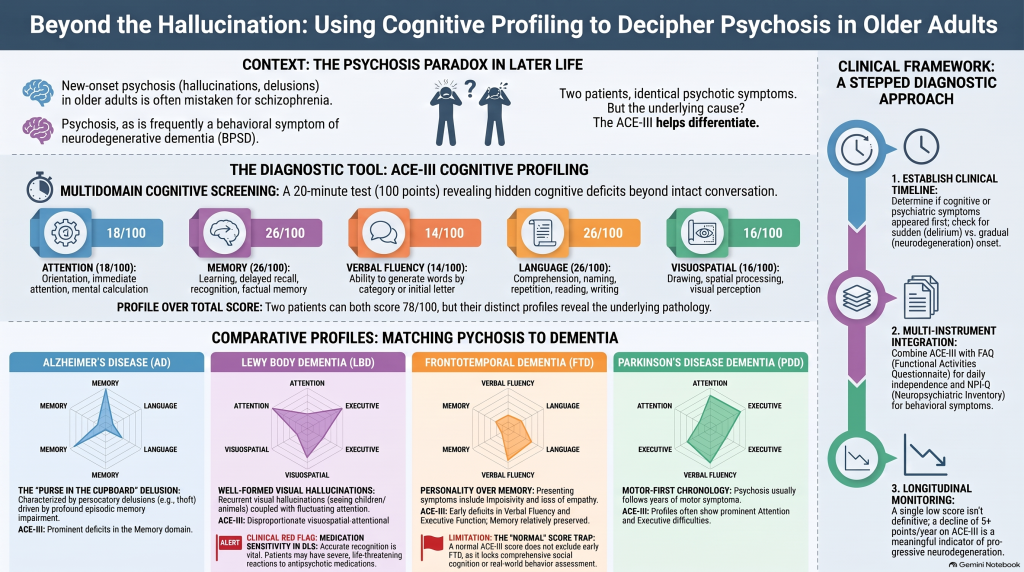 Understanding hallucinations, delusions, and cognitive changes in Alzheimer’s disease, Lewy body dementia, frontotemporal dementia, and other neurodegenerative disorders.
A 72-year-old woman begins accusing her daughter of stealing money. She repeatedly checks her cupboard and insists that someone has entered her home.
Her family initially wonders whether she has developed a psychiatric illness.
However, further questioning reveals that she has also been forgetting recent conversations, misplacing belongings, and repeatedly asking the same questions.
Another patient, a 68-year-old man, reports seeing children playing in his living room. He describes the children clearly, although nobody else can see them. His family also notices that he has become unusually sleepy during the day, occasionally seems confused, and has started acting out his dreams.
A third patient, aged 55, develops suspiciousness, inappropriate social behavior, and unusual beliefs. His family initially suspects a psychiatric disorder, but they also notice progressive changes in his personality, judgment, and ability to manage responsibilities.
All three patients have psychotic symptoms, but the underlying causes may be very different.
The first presentation may raise concern for Alzheimer’s disease with psychotic symptoms. The second suggests considering dementia with Lewy bodies. The third warrants evaluation for frontotemporal dementia, alongside psychiatric and other possible causes.
These examples illustrate an important principle: Hallucinations and delusions describe symptoms. They do not, by themselves, establish the underlying diagnosis.
A 2026 narrative review by Anna Barczak, published in Healthcare, explores how the Addenbrooke’s Cognitive Examination III (ACE-III) can help clinicians recognize different cognitive profiles in patients with psychosis and suspected neurodegenerative disease.
ace 3 psychosis.pdf
The review highlights an approach that is particularly relevant to psychiatrists, neurologists, geriatricians, neuropsychologists, patients, and caregivers: understanding psychosis requires looking beyond psychiatric symptoms to examine the accompanying pattern of cognitive change.
1. What Is Psychosis, and Why Does It Matter in Dementia?
Psychosis is a clinical syndrome involving disturbances in how a person perceives or interprets reality.
Two important manifestations are hallucinations and delusions.
A hallucination is a perception-like experience occurring without a corresponding external stimulus. For example, a person may see someone standing in the room when nobody is present.
A delusion is a fixed belief that is not adequately explained by the person’s cultural or religious background and remains resistant to contrary evidence.
For example, a person may firmly believe that family members are stealing their belongings despite repeated evidence to the contrary.
Psychotic symptoms occur in several psychiatric conditions, including schizophrenia, bipolar disorder, and major depressive disorder with psychotic features.
However, psychosis can also occur in dementia, delirium, neurological illnesses, medication-related conditions, and other medical disorders.
In dementia, psychotic symptoms belong to the broader group of behavioral and psychological symptoms of dementia, commonly abbreviated as BPSD.
The uploaded review reports that psychosis can affect a substantial proportion of people with dementia, with prevalence varying considerably across dementia types, disease stages, and study methods. Some studies report rates as high as 63%.
Psychosis in dementia is associated with greater distress, increased caregiver burden, functional decline, and higher rates of institutional care.
ace 3 psychosis.pdf
These associations make early recognition clinically important.
For families, hallucinations and delusions can be among the most distressing symptoms of dementia.
For clinicians, the challenge is determining whether psychosis represents a primary psychiatric disorder, a manifestation of neurodegeneration, an acute medical condition, or a combination of these factors.
2. Why Psychosis in Older Adults Requires a Different Diagnostic Approach
Consider a person who develops schizophrenia in early adulthood and has experienced intermittent psychotic episodes for several decades.
Now consider a 75-year-old who has never experienced psychosis but suddenly begins reporting that strangers are entering the house.
The second presentation raises a broader range of diagnostic possibilities.
New-onset psychosis in later life warrants careful assessment for medical, neurological, medication-related, sensory, and neurodegenerative contributors.
Important questions include:
When did the psychotic symptoms begin?
Was the onset sudden or gradual?
Have memory, language, attention, or judgment also changed?
Are the symptoms persistent or fluctuating?
Has the person developed difficulties with everyday activities?
Are there associated changes in sleep, movement, vision, or alertness?
Has the person recently started or changed any medications?
A sudden onset of confusion, particularly with fluctuating attention or altered consciousness, should prompt urgent assessment for delirium and other acute medical conditions.
A slowly progressive history of behavioral and cognitive changes may raise concern for an underlying neurodegenerative process.
Neither age nor the presence of hallucinations is sufficient to establish dementia.
The diagnosis depends on understanding the complete clinical picture.
3. The Missing Piece: Cognitive Profiling
Many patients presenting with psychosis undergo a detailed psychiatric assessment.
Their hallucinations, delusions, mood symptoms, sleep, behavior, and previous psychiatric history are evaluated.
However, cognitive functioning may receive less attention, particularly when the patient appears conversationally intact.
This creates an important diagnostic problem.
A person with early dementia may communicate reasonably well while experiencing selective difficulties in memory, attention, language, executive functioning, or visuospatial processing.
A brief global cognitive score may not fully reveal these difficulties.
This is where cognitive profiling becomes useful.
Rather than asking only whether cognition is impaired, cognitive profiling examines which abilities are affected and which remain relatively preserved.
For example, two patients may obtain similar total cognitive scores.
One may have pronounced memory impairment with relatively preserved visuospatial functioning.
The other may have significant visuospatial and attentional impairment with comparatively preserved memory.
Although the overall scores are similar, the clinical implications of these patterns may differ.
The ACE-III provides a structured way to examine these differences.
4. What Is the Addenbrooke’s Cognitive Examination III?
The Addenbrooke’s Cognitive Examination III, commonly called ACE-III, is a multidomain cognitive screening instrument.
It typically takes approximately 20 minutes to administer and provides a total score out of 100.
Unlike instruments that provide relatively limited information about individual cognitive domains, ACE-III evaluates five major areas of cognitive functioning.
The five cognitive domains
|
Cognitive domain
|
Maximum score
|
What it evaluates
|
| — | — | — |
|
Attention
|
18
|
Orientation, immediate attention, and mental calculation
|
|
Memory
|
26
|
Learning, delayed recall, recognition, and factual memory
|
|
Verbal fluency
|
14
|
Ability to generate words by category or initial letter
|
|
Language
|
26
|
Comprehension, naming, repetition, reading, and writing
|
|
Visuospatial abilities
|
16
|
Drawing, spatial processing, and visual perception
|
|
Total
|
100
|
Overall cognitive performance
|
These domains allow clinicians to examine the distribution of cognitive strengths and weaknesses rather than relying exclusively on the total score.
ace 3 psychosis.pdf
For example, a person with a low memory score but relatively preserved visuospatial performance may have a different clinical profile from someone with prominent visuospatial impairment and cognitive fluctuations.
Importantly, ACE-III is a screening and cognitive profiling instrument, not a standalone diagnostic test for Alzheimer’s disease or any other dementia subtype.
Its results must be interpreted alongside clinical history, functional assessment, examination, and other investigations.
5. Why the ACE-III Total Score Is Not Enough
Imagine that two patients obtain an ACE-III total score of 78/100.
Patient A loses most of their marks in memory.
Patient B loses marks predominantly in visuospatial abilities, attention, and verbal fluency.
The total scores are identical, but the cognitive profiles are different.
In Patient A, the clinician may investigate a memory-predominant syndrome.
In Patient B, a different pattern of cognitive network dysfunction may need to be considered.
The same principle applies to patients with psychotic symptoms.
A person experiencing delusions alongside prominent episodic memory impairment may require a different diagnostic evaluation from someone experiencing recurrent visual hallucinations alongside visuospatial dysfunction and fluctuating attention.
The ACE-III total score identifies the overall level of performance.
The individual domain scores help characterize the pattern.
The clinical value of cognitive assessment lies not only in how much cognition has declined, but also in understanding which functions have declined.
However, domain patterns provide diagnostic clues rather than disease-specific fingerprints. Different conditions can produce overlapping profiles, and the reliability of a profile depends on the patient’s clinical state, education, language, and test performance.
6. Alzheimer’s Disease: Memory Impairment and Delusions of Theft
Alzheimer’s disease is commonly associated with progressive episodic memory impairment.
In its typical memory-predominant presentation, individuals initially have difficulty learning and retaining new information.
They may forget recent conversations, appointments, and events.
As the condition progresses, language, orientation, executive functioning, and visuospatial abilities may also become affected.
Why delusions of theft can occur
Consider a woman who places her purse inside a cupboard but later cannot remember doing so.
When she searches for the purse and cannot find it, she may conclude that someone has stolen it.
If this experience happens repeatedly, she may develop a persistent belief that family members or caregivers are stealing her possessions.
This example illustrates how memory impairment can contribute to the development of a delusional explanation.
Not every accusation of theft is delusional, however. Families and clinicians must first consider whether an object has actually been misplaced, moved, or taken.
The 2026 review reports that delusions are generally more common than hallucinations in Alzheimer’s disease. Reported psychotic symptoms include persecutory beliefs and misidentification syndromes.
Psychosis more commonly emerges during moderate or advanced disease, although exceptions occur.
ace 3 psychosis.pdf
What might ACE-III reveal?
In a typical memory-predominant Alzheimer’s presentation, the ACE-III may show relatively prominent impairment in the memory domain.
Delayed recall and learning difficulties may be particularly noticeable.
Language and verbal fluency may become increasingly affected as the disease progresses.
Attention and visuospatial abilities may be relatively preserved early in some patients.
This pattern can support the clinical formulation of an amnestic syndrome.
It does not establish Alzheimer’s pathology by itself.
What caregivers should understand
If a loved one repeatedly accuses family members of stealing, arguing about the accusation may not resolve the underlying problem.
The person may genuinely be unable to remember where they placed an object.
A calm response, assistance locating the item, consistent storage locations, and appropriate environmental modifications may reduce distress.
The priority should be understanding and addressing the person’s experience rather than attempting to win an argument.
7. Dementia With Lewy Bodies: Visual Hallucinations, Fluctuating Attention, and Visuospatial Impairment
Dementia with Lewy bodies (DLB) is particularly important when an older adult develops recurrent visual hallucinations.
A person may describe seeing children, animals, unfamiliar people, or other well-formed images.
Some individuals retain insight initially and recognize that the experiences may not be real.
Others become convinced that the people or animals they see are physically present.
The clinical pattern
DLB is associated with several characteristic features:
Recurrent visual hallucinations.
Fluctuations in attention and alertness.
Parkinsonian motor symptoms.
REM sleep behavior disorder, in which a person may physically act out dreams.
Cognitive impairment, often involving attention, executive functioning, and visuospatial processing.
These features do not necessarily appear simultaneously.
A person may develop sleep-related symptoms or hallucinations before the full cognitive syndrome becomes apparent.
What might ACE-III reveal?
The review describes a pattern of relatively prominent visuospatial and attentional impairment in DLB.
Patients may struggle with drawing tasks, spatial judgments, or other visually based activities.
Attention may fluctuate between assessments or even during the same consultation.
Episodic memory may be relatively less impaired than in typical Alzheimer’s disease at comparable stages.
The combination of recurrent visual hallucinations, cognitive fluctuations, and disproportionate visuospatial-attentional impairment can strengthen clinical suspicion of DLB.
ace 3 psychosis.pdf
Why recognizing DLB matters for treatment
People with DLB may experience significant adverse reactions to antipsychotic medications.
These can include worsening Parkinsonism, sedation, confusion, and potentially severe sensitivity reactions.
Consequently, accurate recognition of DLB has direct implications for treatment safety.
Medication decisions require individualized specialist assessment, including evaluation of symptom severity, medical contributors, existing medications, and potential risks.
For caregivers, a new pattern of recurrent visual hallucinations accompanied by fluctuations in alertness or dream-enactment behavior should prompt a comprehensive medical and cognitive evaluation.
8. Parkinson’s Disease Dementia: When Movement Problems Are Followed by Cognitive and Psychiatric Symptoms
Parkinson’s disease is primarily recognized for motor symptoms such as tremor, rigidity, and slowness of movement.
However, some individuals develop cognitive impairment as the disease progresses.
Psychotic symptoms may also occur, particularly visual hallucinations.
These experiences can range from fleeting perceptions of something passing at the edge of vision to complex hallucinations involving people or animals.
Medication effects, sleep disturbances, visual impairment, and disease-related changes may contribute.
What might ACE-III reveal?
The review describes a cognitive profile in Parkinson’s disease dementia (PDD) characterized by prominent attention and executive difficulties.
Verbal fluency may be reduced.
Visuospatial impairment may also occur.
Memory difficulties may partly reflect inefficient retrieval rather than a predominant storage deficit, although the pattern varies between individuals.
The cognitive profile should be interpreted alongside the history and chronology of Parkinsonian motor symptoms.
The timing of established Parkinson’s disease relative to the development of dementia is an important part of distinguishing PDD from DLB.
ace 3 psychosis.pdf
Why this matters for patients and families
Hallucinations in someone with Parkinson’s disease should not automatically be interpreted as schizophrenia or another primary psychiatric disorder.
A careful evaluation should consider the progression of Parkinson’s disease, cognitive changes, medication exposure, sleep, vision, and possible acute medical causes.
Any adjustment to Parkinson’s medication or treatment for hallucinations should be supervised by the treating clinician.
9. Frontotemporal Dementia: When Personality and Behavior Change Before Memory
Frontotemporal dementia (FTD) is especially relevant when behavioral or personality changes dominate the clinical presentation.
Unlike typical Alzheimer’s disease, early memory impairment may not be the most prominent feature.
Some individuals develop impulsivity, disinhibition, apathy, repetitive behaviors, or reduced empathy.
Others develop progressive language difficulties.
Because these symptoms can resemble psychiatric illness, FTD may initially be evaluated in psychiatric settings.
A possible clinical presentation
Consider a 58-year-old professional who was previously responsible and socially appropriate.
Over two years, his family notices that he has become impulsive, makes inappropriate comments, loses interest in responsibilities, and develops unusual beliefs.
His memory for recent events appears relatively preserved.
However, his ability to organize activities, make decisions, and behave appropriately in social situations has deteriorated.
This presentation warrants evaluation for several possible causes, including a frontotemporal neurodegenerative syndrome.
What might ACE-III reveal?
In behavioral variant FTD, verbal fluency and executive functioning may be disproportionately affected.
Memory and visuospatial performance may be relatively preserved early in some individuals.
However, a normal or near-normal ACE-III score does not exclude early behavioral variant FTD.
The examination does not comprehensively assess every aspect of social cognition, inhibition, or real-world behavior.
Detailed caregiver history, behavioral assessment, neuroimaging, and longitudinal observation remain essential.
The importance of language variants
Frontotemporal disorders can also present predominantly with language impairment.
In semantic variant primary progressive aphasia, naming and understanding word meanings are prominently affected.
In nonfluent/agrammatic primary progressive aphasia, effortful speech, grammatical impairment, or apraxia of speech may dominate.
The pattern of language performance can help characterize these syndromes, although ACE-III alone cannot establish the precise clinical or pathological subtype.
10. When Psychosis Is the First Symptom of Frontotemporal Dementia
An especially interesting aspect of the review concerns genetic forms of FTD.
Some individuals with FTD associated with C9orf72 repeat expansions may present with prominent psychiatric symptoms.
These can include delusions, hallucinations, unusual beliefs, and behavioral changes.
In some cases, psychiatric symptoms appear before substantial cognitive impairment becomes evident.
Such presentations can resemble schizophrenia-spectrum disorders.
However, the presence of psychosis does not establish a genetic form of FTD, and most individuals presenting with psychosis do not have this condition.
Clinicians may consider genetic and neurodegenerative evaluation when the broader history raises concern, particularly in the presence of progressive behavioral changes, relevant family history, or other characteristic neurological findings.
The review emphasizes the importance of examining cognition, behavior, symptom progression, neuroimaging, and appropriate genetic investigations rather than relying exclusively on the nature of the psychotic symptoms.
ace 3 psychosis.pdf
11. Vascular Cognitive Impairment: When Cognitive Changes Follow Cerebrovascular Disease
Not all cognitive impairment is caused by a primary neurodegenerative disorder.
Cerebrovascular disease can affect cognition through strokes, small-vessel disease, and other vascular mechanisms.
The resulting cognitive pattern depends partly on the location and extent of brain injury.
Some individuals develop prominent executive dysfunction and slowed thinking.
Others experience memory, attention, language, or visuospatial difficulties.
Psychotic symptoms may also occur, although their presentation is variable.
What might ACE-III reveal?
The review describes vascular dementia as producing heterogeneous cognitive profiles.
Performance may be uneven across domains.
Attention, executive functioning, and processing speed may be affected, while the degree of memory impairment varies.
A history of abrupt deterioration or stepwise changes can raise concern for vascular contributions.
Neuroimaging is important for evaluating the location and burden of cerebrovascular disease.
ACE-III can help document the cognitive consequences, but it cannot independently establish vascular pathology.
12. Mild Cognitive Impairment and Psychosis: Why Follow-Up Matters
Mild cognitive impairment (MCI) refers to objective cognitive decline that does not substantially interfere with independent everyday functioning.
Some individuals with MCI also experience neuropsychiatric symptoms, including depression, anxiety, apathy, and occasionally psychotic symptoms.
The development of persistent psychotic symptoms in later life may warrant investigation for an underlying neurodegenerative process.
However, psychosis in a person with MCI does not mean that progression to dementia is inevitable.
The diagnosis and prognosis depend on the complete clinical context.
What can cognitive assessment contribute?
ACE-III may identify selective impairment in memory, attention, language, or visuospatial functioning even when the total score is relatively preserved.
The pattern can provide a baseline for future comparison.
Repeat assessment can help determine whether the cognitive difficulty remains stable, improves, or progresses.
A progressive change in cognition and everyday functioning is more informative than an isolated abnormal score.
In patients with psychosis and possible MCI, longitudinal assessment is particularly important because both psychiatric symptoms and early neurodegenerative disease can influence cognitive performance.
13. Can ACE-III Differentiate Dementia From Schizophrenia?
This is an important clinical question, but the answer requires caution.
Cognitive impairment is not exclusive to dementia.
Schizophrenia and other primary psychotic disorders can also involve difficulties in attention, working memory, learning, processing speed, and executive functioning.
Some cognitive difficulties may be longstanding or may precede the onset of psychotic symptoms.
Acute psychosis, mood symptoms, sleep deprivation, medications, and reduced engagement can additionally affect performance during testing.
Therefore, an abnormal ACE-III score does not establish dementia.
Likewise, a normal ACE-III score does not exclude an early neurodegenerative disorder.
What helps distinguish the conditions?
The most informative factors include the age and circumstances of symptom onset, previous psychiatric history, cognitive trajectory, pattern of impairment, and changes in daily functioning.
For example, a person with longstanding schizophrenia may have experienced cognitive difficulties for many years.
Another person may develop new, progressive memory impairment and functional decline after decades of relatively stable functioning.
The second situation warrants investigation for a possible additional neurocognitive disorder.
The review suggests that syndrome-consistent cognitive patterns, particularly when they progress over time, may support neurodegenerative diagnostic reasoning.
However, the evidence specifically validating ACE-III for distinguishing primary psychosis from neurodegenerative psychosis remains limited.
It should be used as one component of a comprehensive assessment rather than as a definitive test.
ace 3 psychosis.pdf
ace 3 psychosis.pdf
14. Mini-ACE: A Shorter Cognitive Screening Option
Not every patient can comfortably complete a 20-minute cognitive assessment.
A patient may be acutely distressed, fatigued, medically unwell, or unable to sustain attention for an extended period.
The Mini-Addenbrooke’s Cognitive Examination (M-ACE) provides a shorter screening option.
It takes approximately 5–10 minutes and produces a total score out of 30.
The instrument samples attention, memory, verbal fluency, and visuospatial abilities.
It can be useful as an initial assessment in busy clinical settings.
However, it provides less detailed cognitive profiling than the full ACE-III.
An abnormal Mini-ACE result may indicate the need for a more comprehensive assessment.
A normal score should not automatically exclude neurodegeneration when clinical concerns remain.
The review proposes a stepped approach in which brief screening is followed by multidomain assessment when indicated.
ace 3 psychosis.pdf
15. Why Cognitive Assessment Must Be Combined With Functional and Behavioral Evaluation
Cognitive testing answers only part of the diagnostic question.
A person may demonstrate measurable impairment while continuing to live independently.
Another individual may experience significant difficulties with finances, medications, driving, or household responsibilities.
These differences matter when determining whether the person has mild cognitive impairment or dementia.
Psychotic symptoms also require assessment in their own right.
Their severity, frequency, associated distress, and effect on the patient and caregiver cannot be adequately measured by ACE-III.
A comprehensive evaluation therefore benefits from several complementary instruments.
ACE-III
Assesses cognitive performance across attention, memory, fluency, language, and visuospatial abilities.
Functional Activities Questionnaire (FAQ)
Assesses everyday instrumental activities, such as managing finances, shopping, and other complex tasks.
Neuropsychiatric Inventory Questionnaire (NPI-Q)
Characterizes behavioral and psychological symptoms, including hallucinations, delusions, agitation, mood changes, and associated caregiver distress.
Clinical Dementia Rating (CDR)
Supports assessment of dementia severity through cognitive and functional information.
These instruments address different clinical questions.
Using them together provides a more complete understanding of the person’s cognition, behavior, and independence.
The review’s proposed assessment pathway, illustrated in Figure 1 on page 11, combines initial cognitive screening, ACE-III profiling, functional assessment, neuropsychiatric evaluation, appropriate investigations, and longitudinal follow-up.
ace 3 psychosis.pdf
16. The Importance of Repeated Cognitive Assessment
A single cognitive assessment provides information about performance at one point in time.
However, performance can be influenced by many temporary factors.
Poor sleep, acute psychosis, depression, anxiety, medication effects, sensory impairment, and delirium can all affect cognitive test results.
Consequently, one low score does not necessarily indicate progressive neurodegeneration.
Repeated testing can provide information about the direction and pattern of change.
Three possible trajectories
Progressive decline: Repeated assessments demonstrate worsening performance, particularly within clinically relevant cognitive domains. This may increase concern for an evolving neurodegenerative disorder.
Relative stability: Cognitive performance remains broadly stable over time. This may be compatible with a longstanding psychiatric or other nonprogressive condition, although it does not exclude every form of neurodegeneration.
Improvement: Performance improves after treatment of depression, resolution of delirium, medication adjustment, or another intervention. This may indicate that a potentially reversible contributor was affecting the original assessment.
These are interpretive patterns, not definitive diagnostic rules.
The review summarizes longitudinal research suggesting that ACE-III can detect cognitive changes over time.
One included study reported average declines of approximately 7–9 points per year in its neurodegenerative dementia cohort, with changes of five or more points considered clinically meaningful in that study.
These figures should not be applied as universal progression rates or diagnostic thresholds for individual patients. Disease subtype, baseline severity, testing interval, practice effects, and other factors must be considered.
ace 3 psychosis.pdf
17. Important Limitations of ACE-III
ACE-III is clinically useful, but its limitations deserve equal attention.
First, the examination is a screening instrument rather than a comprehensive neuropsychological battery.
It cannot fully characterize every aspect of executive functioning, social cognition, memory processing, or perceptual function.
Second, cognitive performance is influenced by education, language, cultural background, sensory abilities, and previous cognitive achievement.
A score that is concerning in one person may have a different significance in another.
This is particularly relevant in multilingual populations such as India, where educational exposure and language proficiency vary widely.
Validated language versions and appropriate normative references should be used whenever available.
Third, early behavioral variant frontotemporal dementia may present with substantial behavioral change despite relatively preserved ACE-III performance.
Fourth, in advanced dementia, impairment may become widespread across cognitive domains, making the original syndrome-specific pattern difficult to identify.
Finally, mixed neuropathology is common enough to complicate interpretation. A person may have Alzheimer’s pathology alongside vascular disease or Lewy body pathology.
No single cognitive profile reliably identifies all underlying pathological processes.
The review specifically acknowledges limited longitudinal evidence in psychosis-related neurodegeneration, heterogeneous study designs, variable cut-off values, and a need for larger validation studies.
ace 3 psychosis.pdf
18. What Does This Mean for Caregivers?
When a loved one begins experiencing hallucinations or delusions, the immediate focus is understandably on the unusual beliefs or perceptions.
However, observing the accompanying cognitive changes can provide valuable information.
Families can consider the following questions:
Has the person started forgetting recent events?
Do they struggle to find words or understand conversations?
Have they developed difficulty locating objects or navigating familiar surroundings?
Does their alertness fluctuate noticeably?
Have their personality, empathy, or judgment changed?
Have they become slower or less organized in everyday activities?
Have they developed unusual sleep behaviors or movement difficulties?
Are they becoming more dependent on others?
When did these changes begin, and how have they progressed?
Documenting specific examples can help clinicians establish the timeline and characterize the presenting syndrome.
Avoid repeatedly arguing with a person about hallucinations or delusions.
Instead, consider whether the experience is causing distress or creating a safety concern.
A calm, reassuring response and assessment for environmental or medical contributors may be more useful than confrontation.
If psychotic symptoms develop suddenly, particularly with confusion, fever, altered alertness, or new neurological symptoms, seek urgent medical evaluation.
19. A Practical Diagnostic Framework for Clinicians
For clinicians evaluating psychosis with suspected cognitive impairment, a structured approach can help integrate the relevant information.
The following framework is a practical synthesis of the review’s proposed assessment pathway.
Step 1: Establish the clinical timeline
Determine whether cognitive or psychiatric symptoms appeared first.
Identify the earliest change and establish whether the course is acute, progressive, fluctuating, or stepwise.
Step 2: Evaluate acute and potentially treatable contributors
Consider delirium, medication effects, sensory impairment, mood disorders, sleep disturbances, metabolic abnormalities, and other relevant medical or neurological conditions.
Step 3: Characterize the psychotic symptoms
Document the type of hallucinations or delusions, associated insight, distress, behavioral consequences, and any fluctuations.
Step 4: Obtain collateral history
Explore changes in memory, language, attention, personality, judgment, daily functioning, movement, and sleep.
Step 5: Perform multidomain cognitive assessment
Use an appropriate screening instrument such as ACE-III or Mini-ACE based on the patient’s clinical condition and assessment needs.
Step 6: Interpret the cognitive profile
Examine the individual domain scores and qualitative performance rather than relying solely on the total score.
Consider whether the observed pattern is consistent with the clinical history.
Step 7: Assess everyday functioning and neuropsychiatric symptoms
Use appropriate instruments such as the FAQ, NPI-Q, and CDR when indicated.
Step 8: Integrate appropriate investigations
Consider laboratory investigations, structural neuroimaging, and relevant biomarkers according to the clinical presentation.
Step 9: Establish a longitudinal plan
Repeat cognitive and functional assessments when clinically indicated, using comparable methods and interpreting changes in context.
The final formulation should integrate the psychiatric presentation, cognitive profile, neurological findings, functional status, and available biological evidence.
20. The Future: Cognitive Profiles, Brain Networks, and Digital Assessment
The most interesting implication of multidomain cognitive assessment is that different patterns of impairment can provide information about the functional brain networks affected by disease.
Memory-predominant impairment may suggest involvement of medial temporal memory networks.
Visuospatial and attentional difficulties may suggest dysfunction of posterior cortical and attention networks.
Executive and fluency impairment may reflect disruption of frontal and frontostriatal systems.
These relationships are probabilistic rather than anatomically exclusive.
Cognitive tests generally assess multiple interacting processes, and a low score cannot be translated directly into a diagnosis of dysfunction in one specific brain region.
Nevertheless, a network-based interpretation can help clinicians formulate more precise questions for further assessment.
The review also discusses the potential role of digital assessment, automated scoring, visual representations of cognitive profiles, and explainable artificial intelligence.
Such approaches may eventually help clinicians recognize patterns of domain-specific impairment and monitor changes over time.
However, these applications require external validation, transparent methods, and careful integration with clinical judgment.
They should not replace direct patient assessment or be used to make unsupported disease-specific diagnoses.
ace 3 psychosis.pdf
Conclusion: The Diagnosis Lies Beyond the Hallucination
Psychosis in an older adult is not automatically schizophrenia.
Nor does every hallucination or delusion indicate dementia.
The diagnostic task is to understand the symptom in the context of the person’s complete cognitive, behavioral, neurological, and functional history.
Memory-predominant impairment accompanying delusions may raise concern for a typical Alzheimer’s disease presentation.
Recurrent visual hallucinations, cognitive fluctuations, and visuospatial-attentional impairment may prompt evaluation for dementia with Lewy bodies.
Progressive changes in personality, judgment, and executive functioning may raise concern for a frontotemporal syndrome.
These patterns can guide diagnostic reasoning, but none is sufficient to establish the underlying disease independently.
ACE-III helps clinicians move beyond a single cognitive score by identifying strengths and weaknesses across multiple cognitive domains.
When combined with detailed history, caregiver observations, functional assessment, neuroimaging, appropriate biomarkers, and longitudinal follow-up, it can contribute to a more informed clinical formulation.
The essential question is not simply whether the patient has psychosis or cognitive impairment.
It is:
What is the relationship between the patient’s psychotic symptoms, cognitive changes, behavioral changes, and underlying brain dysfunction?
Understanding that relationship is central to more accurate diagnosis, safer treatment, and individualized care.
About the Author
Dr. Srinivas Rajkumar T
Senior Consultant Psychiatrist
MD Psychiatry — AIIMS New Delhi
Dr. Srinivas Rajkumar T is a Senior Consultant Psychiatrist with clinical interests in Depression, Treatment-Resistant Depression, Anxiety, OCD, ADHD, Cognitive Assessment, and Interventional Psychiatry.
He provides psychiatric evaluation and cognitive assessment for individuals experiencing memory difficulties, changes in behavior, hallucinations, delusions, and other symptoms that may require differentiation between psychiatric and neurocognitive disorders.
His clinical approach emphasizes understanding each patient’s cognitive and behavioral profile, identifying potentially treatable contributors, and integrating clinical findings with appropriate investigations to develop individualized management plans.
Patients and families concerned about changes in memory, personality, judgment, or unusual perceptions can seek a comprehensive evaluation to better understand the nature of these difficulties and identify appropriate treatment and support.
Apollo Clinic — Velachery, Chennai
Opposite Phoenix Market City
Appointments: +91 85951 55808
Email: srinivasaiims@gmail.com
Reference
Barczak A. The Utility of Addenbrooke’s Cognitive Examination III (ACE-III) in Differentiating Neurodegenerative Disorders with Psychotic Symptoms: A Narrative Review. Healthcare. 2026;14(10):1313.
DOI: 10.3390/healthcare14101313
This article is an educational adaptation of the narrative review, with additional clinical explanations and illustrative examples. The examples are hypothetical unless otherwise stated. The review synthesizes existing literature rather than reporting a new prospective diagnostic validation study.