rTMS in Autism: What Does the Evidence Actually Show?
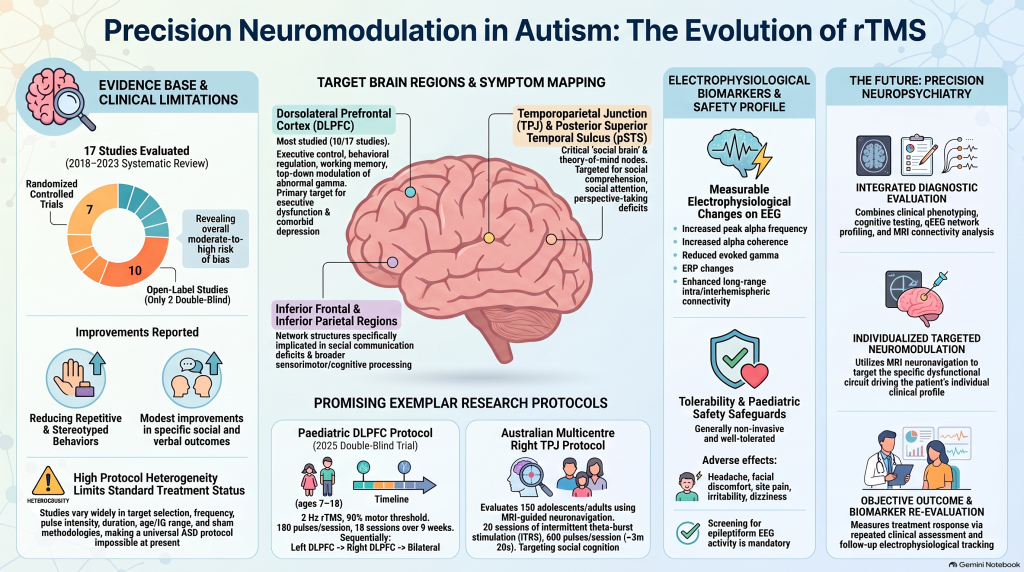 Repetitive transcranial magnetic stimulation (rTMS) is being increasingly studied in autism spectrum disorder (ASD), particularly as neuroscience moves from a purely symptom-based model toward network-based neuromodulation.
The rationale is biologically plausible: ASD has been associated with differences in synaptic plasticity, excitation–inhibition balance, cortical oscillations and large-scale functional connectivity. rTMS can non-invasively modify cortical excitability and influence connected brain networks, making it an attractive research tool for targeting specific functional domains.
However, rTMS for the core features of autism remains investigational, not an established standard treatment.
What does the current evidence show?
A 2024 systematic review examined 17 TMS treatment studies published between 2018 and 2023. Seven were randomised controlled trials and ten were open-label studies. Only two were double-blind, and many studies had a moderate-to-high risk of bias. Nevertheless, improvements were reported across domains such as repetitive behaviour, stereotyped behaviour and some social and verbal outcomes. rtms autism review
The major limitation is heterogeneity. Studies differed substantially in:
- stimulation target,
- frequency and intensity,
- number of pulses,
- duration of treatment,
- participant age and IQ,
- outcome measures,
- sham methodology.
Protocols included low-frequency rTMS, high-frequency rTMS, intermittent theta-burst stimulation (iTBS), continuous TBS and combined-frequency approaches. rtms autism review
This makes it difficult to speak of a single “rTMS protocol for autism.”
DLPFC: the most studied target
The dorsolateral prefrontal cortex (DLPFC) remains the most commonly studied cortical target. In the systematic review, 10 of the 17 studies stimulated the DLPFC, with six using bilateral stimulation. rtms autism review
The DLPFC is involved in executive control, working memory, behavioural regulation, attention and top-down modulation of other networks. Some autism studies have also linked DLPFC stimulation with changes in abnormal gamma oscillatory activity.
A 2025 double-blind sham-controlled trial protocol takes this approach further in children and adolescents aged 7–18 years. The proposed treatment is:
2 Hz rTMS, 90% motor threshold, 180 pulses/session, 18 sessions over 9 weeks, sequentially targeting the left DLPFC, right DLPFC and then both hemispheres. rTMS Autism
EEG, neuropsychological measures and biomarkers are incorporated before and after treatment, reflecting a shift toward biologically informed neuromodulation.
Beyond the DLPFC: targeting the “social brain”
Recent studies are increasingly exploring regions involved more directly in social cognition.
Targets include the:
temporoparietal junction (TPJ), posterior superior temporal sulcus (pSTS), inferior parietal lobule (IPL) and inferior frontal regions. rtms autism review
A large Australian multicentre protocol targets the right temporoparietal junction, an important node in social cognition and theory-of-mind networks.
The trial proposes 20 sessions of intermittent theta-burst stimulation over four weeks in 150 adolescents and adults with ASD. rTMS Protocol
Each iTBS session delivers 600 pulses and lasts only about 3 minutes 20 seconds, using MRI-guided neuronavigation to identify the target. rTMS Protocol
This represents an important conceptual change:
Instead of stimulating the same region for every autistic individual, future treatment may target the network most relevant to the individual’s functional difficulty.
Different symptoms may require different targets
Current theoretical frameworks increasingly suggest phenotype-specific targeting.
For example:
DLPFC may be more relevant to executive dysfunction or comorbid depression.
TPJ/pSTS may be more relevant to theory of mind, social comprehension and social attention.
Inferior frontal regions may be relevant to social communication.
The 2024 review explicitly highlights these different target–symptom relationships. rtms autism review
This makes more biological sense than assuming that a single stimulation protocol should treat every dimension of autism.
EEG may become particularly important
One of the most interesting findings is that rTMS studies have demonstrated measurable electrophysiological changes, including:
increased peak alpha frequency, increased alpha coherence, reduced evoked gamma activity, changes in ERPs and alterations in functional connectivity. rtms autism review
Some studies also reported improved long-range intra- and interhemispheric connectivity and changes in network organisation after stimulation. rtms autism review
This creates an important future possibility:
Clinical phenotype → cognitive assessment → EEG/qEEG network profile → stimulation target → rTMS/TBS → repeat EEG and clinical assessment.
At present, however, qEEG is not validated as a standalone method for selecting an autism rTMS protocol.
Its more promising role may be as a physiological biomarker for understanding network dysfunction and monitoring treatment response.
What about safety?
TMS is generally considered non-invasive and reasonably well tolerated, but it is not risk-free. Previous autism studies have reported adverse effects such as headache, facial discomfort, irritability, stimulation-site pain and dizziness. rtms autism review
In paediatric research protocols, seizure history and epileptiform EEG activity are carefully screened, and treatment is delivered under structured safety monitoring. rTMS Autism
This is especially important because optimal stimulation parameters and long-term effects in the developing brain remain incompletely understood.
Where is the field going?
The most important shift is from:
“rTMS for autism”
to
“rTMS for a specific dysfunctional network in a specific individual.”
The future of autism neuromodulation is likely to combine:
clinical phenotyping + cognitive testing + EEG/qEEG + MRI connectivity + neuronavigation + objective treatment-response measures.
That is the move from empirical stimulation toward precision neuropsychiatry.
A note from my clinical practice
In my practice in Chennai, I focus on structured, technology-assisted neuropsychiatric assessment, integrating clinical evaluation with tools such as cognitive testing, CPT and qEEG where appropriate. For patients and families interested in neuromodulation, the aim is not to offer rTMS as a blanket “treatment for autism,” but to understand the specific symptom profile, comorbidities, cognitive difficulties and neurophysiological findings before discussing whether any neuromodulation approach is scientifically reasonable.
For autism, ADHD and other neurodevelopmental presentations, I particularly favour objective assessment alongside careful clinical formulation, rather than relying on either symptom checklists or brain-based measures alone.