Why Is My Eyelid Twitching? Understanding Eye Myokymia, Blepharospasm and the Brain
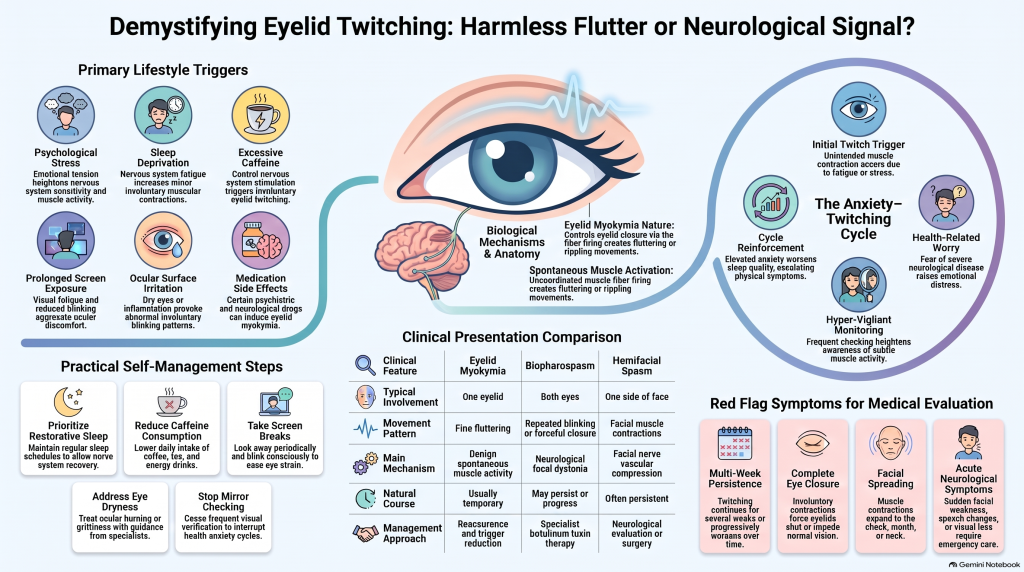 It often begins unexpectedly. You are reading a book, working on your computer, or having a conversation when you notice a peculiar flutter beneath one eye. The eyelid seems to move on its own, almost as though a tiny muscle has developed a mind of its own.
You look in the mirror, but the movement may be barely visible. A few minutes later, it disappears. Then, without warning, it returns.
For some people, the twitching becomes more noticeable during stressful periods, after a sleepless night, or following several hours in front of a computer screen.
Naturally, questions arise. Is something wrong with my nerves? Could this be a sign of a neurological illness? Is stress causing it? Should I be worried?
The reassuring answer is that most eyelid twitching is harmless and temporary. However, not every involuntary eyelid movement is the same. Understanding the differences can help us recognise when reassurance is sufficient and when neurological evaluation becomes important.
What Exactly Is Eyelid Twitching?
The eyelids are controlled by a sophisticated network involving the brain, facial nerves, and muscles surrounding the eyes.
The primary muscle responsible for closing the eyelids is the orbicularis oculi, supplied by the facial nerve, also called the seventh cranial nerve.
During normal blinking, this muscle contracts briefly and in a coordinated manner. However, when small groups of muscle fibres become spontaneously active, an individual may experience fluttering, rippling, or repetitive movements of the eyelid.
The commonest form of this phenomenon is called eyelid myokymia.
Myokymia refers to fine, involuntary, wave-like muscular contractions. It typically affects one eyelid, particularly the lower eyelid, although the upper eyelid may also be involved.
The movements are generally mild, do not force the eye shut, and do not interfere with vision.
Episodes may last seconds or minutes and recur intermittently over several days.
Although the precise mechanisms are incompletely understood, eyelid myokymia is usually a benign phenomenon rather than evidence of serious neurological disease.
Why Do Eyelids Twitch?
Several factors are commonly associated with eyelid myokymia.
1. Stress and emotional tension
Psychological stress is one of the most frequently reported triggers.
During periods of heightened emotional arousal, individuals may become more susceptible to involuntary muscle activity. Stress can also affect sleep, increase caffeine consumption, and heighten awareness of bodily sensations.
For example, someone preparing for an examination, managing demanding professional responsibilities, or experiencing personal difficulties may begin noticing repeated eyelid twitching.
It is important to understand that this is not necessarily evidence of a psychiatric disorder. The movement is real, involuntary, and physiological.
2. Sleep deprivation
Insufficient sleep is another common contributing factor.
The nervous system depends on adequate sleep for optimal functioning, and fatigue can increase the likelihood of minor involuntary muscular activity.
People working irregular shifts or spending late nights on computers may be particularly familiar with this experience.
3. Excessive caffeine consumption
Coffee, tea, energy drinks, and other caffeine-containing beverages stimulate the nervous system.
In susceptible individuals, excessive caffeine intake may contribute to eyelid twitching.
Reducing caffeine intake, especially during stressful or sleep-deprived periods, may help.
4. Prolonged screen exposure
Extended computer or smartphone use is associated with eye fatigue, reduced blinking, and symptoms of ocular dryness.
These factors may contribute to eye irritation and the perception of twitching.
However, prolonged screen use should be regarded as a potential contributing factor rather than a proven direct cause of neurological dystonia.
5. Dry eyes and ocular irritation
Dry eye disease, irritation, or inflammation may also provoke abnormal blinking or eyelid discomfort.
Patients may simultaneously experience burning, a gritty sensation, redness, or excessive watering of the eyes.
Treating the underlying ocular condition can sometimes reduce the associated eyelid symptoms.
6. Medication-related effects
Certain medications have occasionally been associated with eyelid myokymia, including some drugs used in neurological and psychiatric practice.
A careful medication history is relevant when symptoms develop after starting or changing treatment.
However, patients should not stop prescribed medication independently merely because eyelid twitching has appeared.
Not Every Eyelid Twitch Is Myokymia
A clinically important distinction exists between three neurological presentations.
Eyelid myokymia: The common, usually harmless twitch
This is generally a fine, fluttering movement affecting a small area of one eyelid.
It may be associated with fatigue, stress, caffeine, or irritation and usually resolves spontaneously.
Most patients do not require extensive neurological investigations.
Blepharospasm: When blinking becomes involuntary
Blepharospasm is a different neurological condition.
It is a form of focal cranial dystonia, characterised by involuntary contractions of muscles responsible for closing the eyelids.
Unlike ordinary myokymia, blepharospasm typically involves both eyes and may produce excessive blinking, squeezing, or forceful eyelid closure.
Some patients find that bright sunlight, reading, or visually demanding activities aggravate their symptoms.
In more severe cases, the eyelids may close involuntarily to such an extent that reading, walking outdoors, or driving becomes difficult.
Importantly, the patient’s eyesight may otherwise be normal. The difficulty arises because the eyelids cannot remain open reliably.
Blepharospasm is not simply anxiety or a psychological habit. It is an established neurological movement disorder.
Botulinum toxin injections administered by appropriately trained specialists are an effective, established treatment for many patients.
Hemifacial spasm: When one side of the face contracts
Hemifacial spasm is another neurological condition that can initially resemble eyelid twitching.
It typically begins around one eye but may gradually involve the cheek, corner of the mouth, and other muscles on the same side of the face.
The contractions may be intermittent or sustained.
One important mechanism is compression or irritation of the facial nerve by a nearby blood vessel.
Unlike ordinary eyelid myokymia, hemifacial spasm generally warrants neurological assessment, and MRI may be recommended to examine the facial nerve and exclude structural causes.
Treatment may involve botulinum toxin injections. In selected patients, microvascular decompression surgery can provide sustained relief.
How Can You Tell the Difference?
| Feature | Eyelid Myokymia | Blepharospasm | Hemifacial Spasm |
|---|---|---|---|
| Typical involvement | One eyelid | Both eyes | One side of the face |
| Movement | Fine fluttering | Repeated blinking or forceful closure | Facial muscle contractions |
| Main mechanism | Usually benign spontaneous muscle activity | Neurological dystonia | Facial nerve hyperexcitability, often due to vascular compression |
| Natural course | Usually temporary | May persist or progress | Often persistent |
| Usual management | Reassurance and trigger reduction | Specialist treatment, often botulinum toxin | Neurological evaluation and targeted treatment |
These features help guide diagnosis, although clinical examination is necessary when the presentation is atypical.
Is Eyelid Twitching a Sign of Brain Disease?
This is one of the commonest concerns among patients.
A minor, isolated eyelid twitch is very rarely a manifestation of serious neurological disease.
Conditions such as multiple sclerosis or certain brainstem disorders can occasionally produce abnormal facial movements, but these diagnoses should not be assumed simply because a patient experiences eyelid twitching.
When such disorders are responsible, additional neurological abnormalities or atypical features are often present.
Routine MRI, EEG, and extensive laboratory investigations are generally unnecessary for typical isolated eyelid myokymia.
The decision to investigate should depend on the clinical history and neurological examination.
The Anxiety–Twitching Cycle
From a psychiatric perspective, another phenomenon deserves attention.
A minor physical symptom can sometimes become the focus of disproportionate worry.
A person notices an eyelid twitch and begins monitoring it repeatedly.
Each recurrence raises another question: Why is this happening? Is it getting worse? What if it never stops?
This heightened vigilance may increase awareness of even subtle muscular activity.
Anxiety can also interfere with sleep or encourage greater caffeine consumption, potentially worsening the original trigger.
A cycle may emerge:
Twitching → Worry → Increased monitoring → Greater awareness of twitching → More worry.
This does not mean that the twitch is imaginary or that anxiety is always its cause.
Rather, the psychological response to an otherwise harmless symptom can sometimes make the experience more distressing.
In these situations, appropriate medical reassurance, improved sleep, stress reduction, and reducing excessive symptom checking may be beneficial.
When health-related anxiety becomes persistent or begins interfering with daily life, psychological intervention may also be appropriate.
What Can You Do About Eyelid Twitching?
For uncomplicated eyelid myokymia, a few practical steps are often sufficient.
Prioritise sleep. Maintain a consistent sleep schedule and allow adequate time for rest.
Reduce excessive caffeine. Consider temporarily reducing coffee, strong tea, and energy drinks, particularly if twitching follows increased consumption.
Take breaks from screens. During prolonged computer work, periodically look away from the screen and consciously blink normally to reduce eye fatigue.
Address dry eyes. If you experience burning, irritation, or grittiness, consult an eye-care professional for assessment and appropriate treatment.
Manage stress. Regular physical activity, relaxation techniques, and structured breaks can help improve general physiological and emotional well-being.
Avoid repeatedly checking the twitch. Constantly looking in the mirror or testing whether the movement has stopped can increase preoccupation without improving the underlying condition.
Avoid self-medication. Magnesium supplements, vitamin preparations, or muscle relaxants are not routinely necessary for uncomplicated eyelid twitching unless a specific medical indication is identified.
Most importantly, remember that ordinary eyelid myokymia commonly settles without any specific medication.
When Should You See a Doctor?
Medical evaluation is advisable when:
- Twitching persists beyond a few weeks or progressively worsens.
- The eyelid repeatedly closes completely or becomes difficult to open.
- Movements spread to the cheek, mouth, or other facial muscles.
- The eyelid becomes persistently droopy.
- Redness, swelling, discharge, or significant eye irritation develops.
- The problem interferes with reading, driving, work, or other everyday activities.
Sudden facial weakness, difficulty speaking, new double vision, sudden visual loss, or other acute neurological symptoms require urgent medical assessment.
Depending on the symptoms, evaluation may involve an ophthalmologist, neuro-ophthalmologist, neurologist, or movement-disorders specialist.
What Does Eyelid Twitching Teach Us About the Brain?
Perhaps the most fascinating aspect of eyelid twitching is how such a small movement can reveal the complex relationship between neurological control, bodily sensations, and emotional experience.
We rarely notice the intricate coordination required to blink thousands of times throughout the day.
Yet a tiny involuntary contraction can suddenly draw our attention to a movement that normally takes place without conscious effort.
In most instances, the explanation is reassuringly simple: a temporary, benign muscular phenomenon influenced by fatigue, stimulation, or irritation.
In a smaller proportion of cases, the movement reflects a more specific neurological disorder such as blepharospasm or hemifacial spasm.
The clinical challenge is to distinguish harmless symptoms from those requiring further evaluation, while also understanding the emotional significance the symptoms may acquire for an individual.
Conclusion: A Small Twitch Does Not Always Mean a Serious Problem
Eyelid twitching is common, and most episodes are temporary and harmless.
Stress, inadequate sleep, caffeine, and ocular irritation may contribute to ordinary eyelid myokymia.
Persistent forceful eyelid closure, twitching involving other facial muscles, or additional neurological symptoms deserve medical attention because they may suggest a different condition.
The most useful response is neither to ignore every symptom nor to become excessively alarmed by a minor twitch.
Instead, understand the symptom, address common triggers, and seek appropriate evaluation when the clinical pattern warrants it.
Sometimes, a twitching eyelid is simply a reminder that the body needs rest. At other times, it is a neurological signal that deserves closer attention. Knowing the difference matters.
About the Author
Dr. Srinivas Rajkumar T
MBBS | MD Psychiatry (AIIMS, New Delhi) | DNB Psychiatry | MBA (HHSM)
Consultant Psychiatrist, Chennai
Assistant Professor of Psychiatry, Sree Balaji Medical College & Hospital
Understanding the Relationship Between Brain, Mind and Behaviour
Neurological symptoms do not always occur in isolation. They may influence sleep, concentration, emotional well-being, occupational performance, and confidence.
For some patients, an involuntary movement is merely a temporary physical inconvenience. For others, persistent symptoms can lead to considerable anxiety, fear of serious illness, or changes in everyday behaviour.
At my psychiatric practice, I emphasise a comprehensive, evidence-informed approach that considers the relationship between neurological functioning, psychological well-being, and the individual’s personal experience of illness.
My clinical interests include anxiety disorders, obsessive-compulsive disorder, sleep disturbances, cognitive functioning, and neuropsychiatric conditions.
Psychiatric assessment can be helpful when physical symptoms are accompanied by persistent health anxiety, excessive symptom monitoring, sleep disruption, or significant emotional distress.
Where neurological disorders are suspected, appropriate evaluation by an ophthalmologist or neurologist remains essential. Psychiatric care can complement specialist neurological treatment by addressing associated psychological difficulties.
The objective is not merely to reduce distress, but to help patients understand their symptoms, restore confidence, and improve their overall quality of life.
Consult Dr. Srinivas Rajkumar T
Psychiatric Consultation and Neuropsychiatric Assessment
Apollo Clinic, Velachery, Chennai
Online consultations may be available.
Website: https://srinivasaiims.com
Evidence-informed psychiatric care with attention to the individual behind the symptoms.
References and Further Reading
- American Academy of Ophthalmology. What Is an Eyelid Spasm or Twitching Eyelid? Updated August 13, 2026.
https://www.aao.org/eye-health/diseases/eyelid-spasm-twitch - American Academy of Ophthalmology, EyeWiki. Eyelid Myokymia. Reviewed September 2026.
https://eyewiki.aao.org/Eyelid_Myokymia - National Eye Institute. Blepharospasm. Updated November 27, 2024.
https://www.nei.nih.gov/eye-health-information/eye-conditions-and-diseases/blepharospasm - Jesuthasan A, et al. Hemifacial spasm: An update on pathophysiology, investigations and management. Journal of Neurology. 2025.
https://doi.org/10.1007/s00415-025-13220-y - Cleveland Clinic. Myokymia: Causes, Symptoms and Treatments. Updated February 14, 2025.
https://my.clevelandclinic.org/health/symptoms/myokymia
Disclaimer: This article is intended for public health education. It does not replace individual medical consultation, examination, or diagnosis.