Thought Broadcasting: Are Your Thoughts Heard, Transmitted, or Shared?
 Revisiting Kurt Schneider’s First-Rank Symptoms of Schizophrenia
In psychiatry, thought broadcasting is traditionally described as the experience that one’s private thoughts are accessible to other people. It is one of the classical first-rank symptoms associated with schizophrenia.
But what exactly does a patient mean when they say, “Other people can know what I am thinking”?
Are their thoughts becoming audible? Are thoughts escaping silently from their mind? Or are other people somehow participating in the very same thoughts?
These are not necessarily identical experiences.
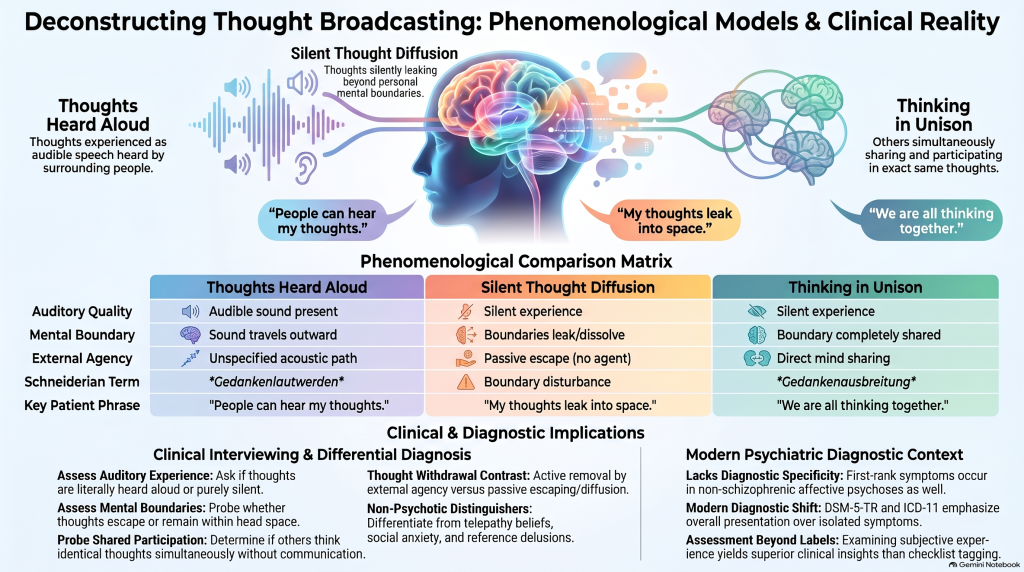
In a fascinating 2003 paper titled Defining Thought Broadcast, psychiatrists Ajaykumar V. Pawar and Sean A. Spence identified three distinct definitions in the psychiatric literature, revealing considerable disagreement even among psychiatrists about what constitutes thought broadcasting.
1. Thoughts Heard Aloud: When Thinking Becomes Audible
In the first definition, the individual experiences their thoughts as though they are being spoken aloud. Because the thoughts appear audible, the person believes others can hear them too.
Clinical illustration:
“Whenever I think something, I can hear my thoughts being spoken. The people sitting next to me can hear them as well.”
This experience overlaps with Gedankenlautwerden, the German term for thoughts becoming audible.
However, an important distinction exists. Kurt Schneider regarded audible thoughts as a separate first-rank symptom. Merely hearing one’s thoughts aloud does not necessarily mean believing that others have access to them.
For this first definition of thought broadcasting, the additional experience of others being able to hear the thoughts is essential.
2. Silent Thought Diffusion: When Thoughts Escape the Mind
The second definition does not involve hearing thoughts aloud.
Instead, the person experiences thoughts as silently escaping or diffusing beyond the boundaries of their mind.
Clinical illustration:
“My thoughts are leaking out of my head. They spread into the surrounding space, even though I cannot hear anything.”
Interestingly, this definition does not necessarily require anyone else to receive or know those thoughts.
The central disturbance is the experience that thoughts are no longer confined within the individual’s mental boundaries.
This needs to be distinguished from thought withdrawal, in which thoughts are experienced as being removed by an external agency.
In silent diffusion, there may be no identifiable external agent taking the thoughts away.
3. Thinking in Unison: When Others Participate in Your Thoughts
Perhaps the most intriguing definition is the third, which closely reflects Schneider’s original description of Gedankenausbreitung, or diffusion of thought.
Here, the individual experiences other people as directly sharing or participating in their thoughts.
The thoughts need not become audible. They need not travel through the air. They need not even be experienced as leaving the person’s head.
Clinical illustration:
“When I think something, the people around me are thinking that exact thought too. We are all thinking it together, without speaking.”
This is fundamentally different from simply believing that another person has discovered one’s thoughts.
The experience concerns a breakdown in the privacy of thinking itself.
Schneider described thoughts that were no longer private but shared directly with other people, potentially extending to an entire community or even the whole world.
It is worth noting that the frequently cited 1959 publication was an English translation of Schneider’s Clinical Psychopathology, not the year in which the underlying phenomenology was first discovered.
Why Is This Distinction Clinically Important?
Consider three patients who all report:
“Everyone knows what I am thinking.”
One may experience their thoughts as audible.
Another may experience their thoughts as escaping from their mind.
A third may believe that other people are simultaneously participating in their thinking.
All three could receive the same label of thought broadcasting, yet their subjective experiences differ substantially.
This highlights a central challenge in psychiatric assessment: identical descriptions do not necessarily represent identical psychopathology.
A careful clinical interview should explore:
- Do you actually hear your thoughts being spoken?
- Do you experience your thoughts as leaving your mind?
- Do you believe others receive or become aware of your thoughts?
- Do you feel others are independently thinking the same thoughts as you, without any communication?
- How certain are you of this experience, and how does it affect your daily life?
The psychiatrist must also distinguish these experiences from ordinary fears of being judged, social anxiety, intrusive thoughts, culturally shared beliefs about telepathy, and delusions of reference.
The aim is to understand the patient’s actual experience rather than prematurely assign a symptom label.
Beyond Schneider: What Does Modern Psychiatry Tell Us?
Schneider’s first-rank symptoms historically occupied a privileged position in diagnosing schizophrenia.
However, subsequent research has challenged their diagnostic specificity.
First-rank symptoms can occur in other psychotic disorders, including affective psychoses, and their presence alone does not establish schizophrenia.
Modern diagnostic frameworks, including DSM-5-TR and ICD-11, place greater emphasis on the overall clinical presentation, symptom combinations, duration, functional consequences, and exclusion of alternative explanations.
Nevertheless, Schneider’s work remains valuable for something that contemporary checklist-based psychiatry can sometimes overlook: the careful examination of subjective experience.
Thought broadcasting is not simply a question of whether other people can supposedly read someone’s mind.
It raises deeper questions about the boundaries between self and other, the ownership and privacy of mental experiences, and the way individuals experience their own thinking.
Conclusion: Phenomenology Before Labels
More than a century after the earliest descriptions of these experiences, thought broadcasting remains a useful example of the complexity of psychiatric phenomenology.
Pawar and Spence’s analysis demonstrates that even experienced psychiatrists may use the same clinical term to describe different experiences.
The distinction between thoughts being heard, thoughts escaping, and thoughts being directly shared is therefore more than an academic curiosity.
It matters for clinical interviewing, documentation, research reliability, and diagnostic formulation.
The task of the psychiatrist is not merely to establish whether thought broadcasting is present, but to understand precisely what the patient experiences.
Because in psychopathology, the difference between what a patient says and what a patient experiences can be the difference between superficial symptom recognition and meaningful clinical understanding.
Key References
- Pawar AV, Spence SA. (2003). Defining thought broadcast: Semi-structured literature review. British Journal of Psychiatry, 183(4), 287–291. https://doi.org/10.1192/bjp.183.4.287
- Schneider K. (1959). Clinical Psychopathology. English translation by MW Hamilton.
- Peralta V, Cuesta MJ. (2023). Schneider’s first-rank symptoms have neither diagnostic value for schizophrenia nor higher clinical validity than other delusions and hallucinations in psychotic disorders. Psychological Medicine, 53(6), 2708–2711. https://doi.org/10.1017/S0033291720003293