Attention Clinic : Comprehensive 360° ADHD Care in Chennai
 Attention Clinic Chennai
Comprehensive 360° ADHD Assessment, Treatment & Therapy for Children and Adults
ADHD is not simply a problem of “poor concentration.”
Attention-Deficit/Hyperactivity Disorder (ADHD) is a neurodevelopmental condition that can affect attention, impulse control, emotional regulation, motivation, organization, working memory, time management and the ability to consistently translate potential into performance.
A bright child may understand everything in class but repeatedly forget homework. A college student may study only under extreme deadline pressure. A successful professional may spend years wondering why routine paperwork, organization and task completion feel disproportionately difficult.
For some people, ADHD is obvious from childhood. For many others—particularly adults with ADHD—the condition remains undiagnosed for years.
The Attention Clinic in Chennai provides a comprehensive, psychiatrist-led approach to ADHD assessment, diagnosis and treatment, integrating clinical psychiatry, psychological assessment, objective attention testing, medication management, ADHD-focused therapy, executive-function strategies and long-term follow-up.
Could It Be ADHD?
ADHD does not look the same in every person.
Some people are visibly hyperactive. Others appear quiet but constantly drift away mentally. Many adults have learned to compensate so well that the underlying difficulty becomes apparent only when academic, occupational or family responsibilities increase.
Common symptoms include:
- Difficulty sustaining attention
- Easily distracted while reading or working
- Frequently forgetting appointments or responsibilities
- Losing belongings
- Careless mistakes despite knowing the material
- Difficulty completing tasks
- Starting multiple projects without finishing them
- Chronic procrastination
- Poor time management
- Difficulty estimating how long tasks will take
- Restlessness or an internally “busy” mind
- Interrupting conversations
- Impulsive decisions
- Difficulty waiting
- Emotional reactivity
- Low frustration tolerance
- Inconsistent academic or occupational performance
A characteristic feature is often inconsistency.
The person may perform exceptionally well when something is novel, interesting, urgent or rewarding—but struggle enormously with routine tasks.
Adult ADHD: Frequently Missed
Many adults reach their 20s, 30s or even 40s before recognizing that longstanding difficulties may represent ADHD.
They may describe themselves as:
“I know what I need to do, but I cannot get myself to start.”
or
“I work extremely well when there is a deadline, but otherwise I keep postponing everything.”
Adult ADHD may present with:
- Chronic procrastination
- Poor organization
- Missed deadlines
- Difficulty maintaining routines
- Career underperformance despite good intelligence
- Frequent switching between tasks
- Difficulty with documentation and administrative work
- Impulsive spending or decisions
- Relationship conflict
- Emotional dysregulation
- Sleep-cycle disturbances
- Repeated burnout
- Excessive dependence on urgency to get things done
Some adults compensate through intelligence, anxiety, perfectionism or working excessively long hours.
Eventually, the compensatory system becomes exhausting.
A structured adult ADHD assessment can help determine whether ADHD is actually present and whether other conditions are contributing.
ADHD in Children and Adolescents
ADHD in childhood does not necessarily mean a child is constantly running around.
A child may instead be:
- Daydreaming during lessons
- Frequently losing stationery or books
- Forgetting instructions
- Making careless mistakes
- Taking unusually long to complete homework
- Performing inconsistently across subjects
- Interrupting teachers or classmates
- Becoming easily frustrated
- Having repeated conflict around studying
- Showing excessive screen dependence
- Struggling with organization
Adolescents may develop a different pattern:
- Last-minute studying
- Irregular sleep
- Academic procrastination
- Excessive gaming or phone use
- Poor planning
- Emotional sensitivity
- Difficulty preparing for competitive examinations
- Inability to sustain routines
The purpose of assessment is not simply to attach a label.
It is to understand why the child is struggling and what can actually be changed.
ADHD Is a Clinical Diagnosis
There is no single blood test, brain scan or questionnaire that independently diagnoses ADHD.
A high-quality ADHD assessment starts with a detailed clinical evaluation.
The psychiatrist examines:
- Current ADHD symptoms
- Childhood symptoms
- Developmental history
- School and college functioning
- Occupational history
- Relationships
- Sleep
- Medical history
- Family psychiatric history
- Substance use
- Digital habits
- Functional impairment
Importantly, the assessment also examines alternative explanations.
Attention difficulties can occur with:
- Anxiety disorders
- Depression
- Bipolar disorder
- Autism spectrum disorder
- OCD
- Learning disorders
- Sleep disorders
- Substance use
- Chronic stress
- Medical conditions
And these conditions can also coexist with ADHD.
This is one reason a comprehensive psychiatric assessment is preferable to relying exclusively on an online questionnaire.
Comprehensive 360° ADHD Assessment
At the Attention Clinic, the objective is to build a clinical picture from multiple sources rather than rely on one test.
Depending upon the individual, evaluation may include:
Detailed Psychiatric Interview
The foundation of diagnosis remains a structured clinical history examining symptoms, developmental onset and real-world impairment.
Standardized ADHD Rating Scales
Age-appropriate ADHD questionnaires can provide structured symptom measurement and may include information from parents, spouses, teachers or other observers where appropriate.
Computerized Attention Testing
Continuous Performance Test–type assessments may provide objective information regarding:
- Sustained attention
- Response consistency
- Impulsivity
- Inhibitory control
- Reaction-time variability
- Attention lapses
These tests do not diagnose ADHD independently but can provide useful additional information.
Executive Function and Cognitive Assessment
Where appropriate, assessment may explore:
- Working memory
- Processing speed
- Planning
- Organization
- Cognitive flexibility
- Attention control
The purpose is not merely to ask, “Does this person have ADHD?”
A more useful question is:
“What exactly is interfering with this person’s functioning, and how do we improve it?”
QEEG-Assisted Assessment Where Clinically Appropriate
In selected individuals, quantitative EEG (QEEG) may be incorporated as an adjunctive neurophysiological assessment.
QEEG does not replace clinical diagnosis and should not be presented as a standalone ADHD test.
Instead, when clinically appropriate, it can provide another layer of objective physiological information that can be interpreted alongside the psychiatric assessment, standardized scales and computerized attention testing.
This reflects the broader philosophy of the Attention Clinic: use objective information where it adds genuine clinical value, without replacing clinical judgment.
ADHD Medication Treatment
For appropriately diagnosed ADHD, medication can produce substantial improvement in core symptoms.
Medication selection is individualized according to factors including:
- Age
- ADHD presentation
- Severity of impairment
- Academic or occupational demands
- Anxiety
- Mood symptoms
- Sleep
- Appetite
- Medical history
- Previous medication response
- Patient and family preferences
Depending upon the individual, stimulant or non-stimulant treatments may be considered.
Treatment does not end when a prescription is written.
Follow-up evaluates whether the person is actually functioning better:
- Is work getting completed?
- Is studying becoming more consistent?
- Are deadlines being met?
- Is impulsivity reducing?
- Is emotional regulation improving?
- Is sleep acceptable?
- Are side effects manageable?
The goal is functional improvement, not simply a lower symptom score.
Medication Alone Is Not Always Enough
ADHD can leave behind years of behavioural patterns.
Someone may have spent a decade:
- Avoiding difficult tasks
- Depending on last-minute pressure
- Developing poor sleep habits
- Losing confidence
- Fighting repeatedly with parents or partners
- Believing they are lazy
- Building ineffective organizational systems
Even when medication improves attention, these patterns may need to be actively changed.
That is where psychological therapy and executive-function intervention become important.
ADHD Therapy with a Clinical Psychologist
Mrs. Tinu Thamby — Senior Clinical Psychologist
The psychological component of the Attention Clinic is provided by Mrs. Tinu Thamby, Senior Clinical Psychologist.
Her work complements psychiatric treatment and can be particularly useful for children, adolescents and adults who require practical strategies for translating improved attention into improved everyday functioning.
Therapeutic work may include:
ADHD Psychoeducation
Understanding ADHD itself can reduce confusion and help individuals recognize why certain tasks are disproportionately difficult.
Executive Function Training
Interventions may focus on:
- Planning
- Prioritization
- Task initiation
- Breaking large tasks into manageable steps
- Time management
- Organization
- Creating external reminder systems
- Managing distractions
- Building sustainable routines
CBT-Based ADHD Therapy
Cognitive and behavioural strategies can address:
- Chronic procrastination
- Avoidance
- Negative self-talk
- Performance anxiety
- Low self-esteem
- Emotional dysregulation
- Repeated experiences of failure
Parent Training and Behavioural Strategies
For childhood ADHD, parents often need practical intervention as much as the child does.
Strategies may include:
- Creating predictable routines
- Positive reinforcement
- Reward systems
- Improving homework structure
- Reducing repeated arguments
- Managing screen time
- Supporting sleep
- Working with school expectations
College and Young-Adult ADHD Support
This may focus on:
- Study planning
- Examination preparation
- Reducing digital distraction
- Time blocking
- Sleep stabilization
- Building independent routines
Adult ADHD Therapy
Adults often need interventions that fit real professional and family responsibilities.
Therapy can address:
- Workplace organization
- Email and documentation overload
- Deadline management
- Household routines
- Emotional regulation
- Relationship communication
- Burnout
- Habit formation
A Psychiatrist + Psychologist Model for ADHD
ADHD often responds best when different components of the problem are addressed together.
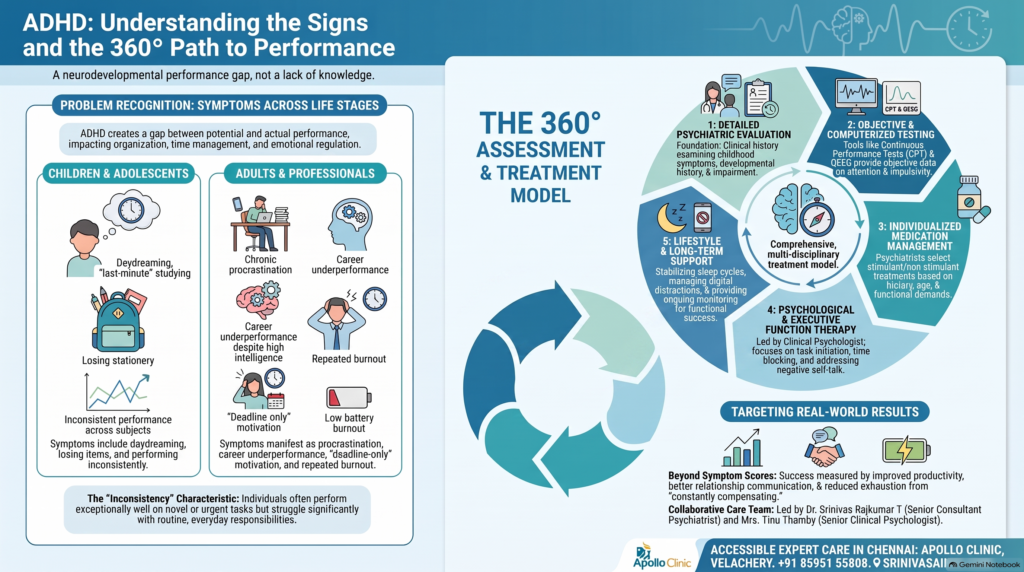
The Attention Clinic therefore follows a 360-degree model:
Clinical diagnosis → Objective assessment where required → Medication where indicated → Psychological therapy → Executive-function intervention → Lifestyle modification → Family support → Long-term monitoring
Not every patient needs every component.
The treatment pathway is individualized.
Sleep, Exercise and Lifestyle Matter
ADHD symptoms can be significantly worsened by poor sleep, irregular routines and excessive digital stimulation.
Lifestyle assessment therefore includes attention to:
- Sleep timing
- Sleep quality
- Exercise
- Screen use
- Caffeine
- Work/study schedules
- Nutrition
- Environmental distractions
Exercise and adequate sleep do not replace ADHD treatment, but they can meaningfully improve attention, mood and executive functioning.
ADHD Treatment Should Target Real Life
Successful ADHD treatment is not simply:
“Can you concentrate better?”
It should eventually translate into:
- Better academic consistency
- Improved productivity
- Fewer missed deadlines
- Better organization
- Reduced procrastination
- Improved emotional regulation
- Better relationships
- More predictable routines
- Greater confidence
- Less exhaustion from constantly compensating
The aim is not to change someone’s personality.
It is to reduce the unnecessary friction ADHD creates in everyday life.
When Should You Consider an ADHD Assessment?
Consider professional evaluation when attention, organization, impulsivity or executive-function difficulties are persistent and causing meaningful impairment.
Particularly consider assessment when someone repeatedly says:
- “I have potential but cannot use it consistently.”
- “I procrastinate until everything becomes an emergency.”
- “I keep forgetting things despite trying hard.”
- “I cannot maintain routines.”
- “My child understands the subject but never completes work.”
- “I have been called careless throughout my life.”
- “I can concentrate for hours on something interesting but not for ten minutes on routine work.”
These patterns warrant evaluation rather than judgment.
Attention Clinic – Chennai
The Attention Clinic provides ADHD-focused care for:
Children • Adolescents • College Students • Working Professionals • Adults
Services include:
ADHD Assessment
Adult ADHD Evaluation
Child & Adolescent ADHD Assessment
Psychiatrist Consultation for ADHD
ADHD Medication Management
Computerized Attention Testing / CPT
Executive Function Assessment
QEEG-Assisted Assessment Where Indicated
ADHD-Focused Psychological Therapy
Executive Function Strategies
Parent Guidance
Long-Term ADHD Follow-Up
ADHD Care at Apollo Clinic, Velachery – Opposite Phoenix Mall
For patients looking for a well-connected ADHD clinic in South Chennai, consultations are available at Apollo Clinic, Velachery, opposite Phoenix Mall.
The location combines the familiarity and infrastructure of the Apollo healthcare ecosystem with a comfortable outpatient setting suitable for detailed psychiatric and psychological consultations.
Being located near Phoenix Marketcity / the Velachery–Guindy corridor also makes the clinic accessible for people travelling from several parts of Chennai, including Velachery, Guindy, Adyar, Taramani, Thiruvanmiyur, Madipakkam, Pallikaranai, Medavakkam and the OMR region.
The consulting environment has been designed to feel professional, calm and contemporary, rather than like a crowded traditional psychiatry OPD—particularly useful for longer ADHD assessments, family discussions and psychological sessions.
About Dr. Srinivas Rajkumar T
Dr. Srinivas Rajkumar T, MD (AIIMS, New Delhi), DNB, MBA (BITS Pilani)
Senior Consultant Psychiatrist
His clinical interests include ADHD, autism spectrum disorders, cognitive disorders, dementia and objective approaches to psychiatric assessment, with particular interest in integrating structured clinical evaluation with computerized cognitive assessment, neurophysiological measures and emerging technologies where clinically appropriate.
He leads the psychiatric component of the Attention Clinic, including ADHD diagnosis, differential diagnosis, medical treatment and longitudinal management.
Psychological therapy and executive-function intervention are provided in collaboration with Mrs. Tinu Thamby, Senior Clinical Psychologist.
Book an ADHD Assessment in Chennai
Attention Clinic
Comprehensive 360° ADHD Care
Dr. Srinivas Rajkumar T
Senior Consultant Psychiatrist
Mrs. Tinu Thamby
Senior Clinical Psychologist
📍 Apollo Clinic, Velachery — Opp. Phoenix Mall, Chennai
📞 Appointments: +91 85951 55808
🌐 srinivasaiims.com
ADHD Assessment • Diagnosis • Medication • CPT • QEEG-Assisted Evaluation • Psychological Therapy • Executive Function Support • Parent Guidance • Long-Term Care