Personalised Treatment Planning in Adult ADHD: Improving Quality of Life and Real-World Functioning
 For many adults, receiving a diagnosis of Attention-Deficit/Hyperactivity Disorder (ADHD) is both a revelation and a relief. Years of being labelled as “lazy,” “careless,” “disorganised,” or “not living up to potential” suddenly make sense.
But a diagnosis is only the beginning.
The most important question is not simply:
“Does this person have ADHD?”
It is:
“How is ADHD affecting this person’s life, and what combination of treatments will help them thrive?”
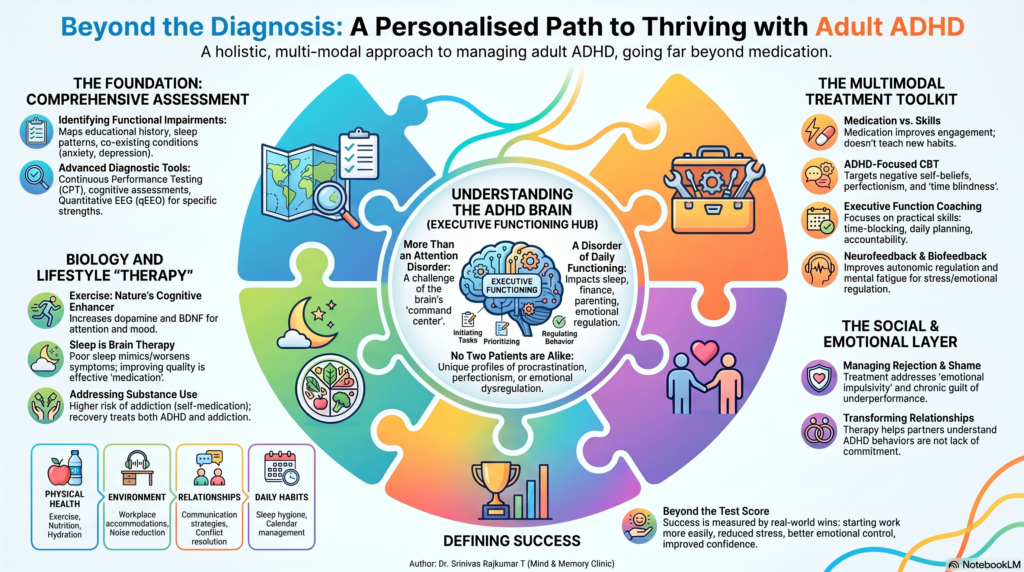
No two adults with ADHD are alike. Some struggle to stay organised despite exceptional intelligence. Others battle emotional impulsivity, chronic procrastination, anxiety, poor sleep, relationship difficulties, or addiction. The symptoms may look similar on paper, but the treatment needs can be remarkably different.
Modern ADHD care has therefore evolved beyond prescribing medication alone. The goal today is personalised treatment planning—designing an individualised programme that addresses the biological, psychological, cognitive, behavioural, and social aspects of ADHD to improve real-world functioning and quality of life.
ADHD Is More Than an Attention Disorder
Despite its name, ADHD is not simply about paying attention.
Most adults with ADHD can concentrate exceptionally well when they are interested, challenged, or working under pressure.
The real challenge lies in executive functioning—the brain’s ability to organise, initiate, prioritise, regulate, and complete goal-directed behaviour.
Executive dysfunction affects almost every aspect of life, including:
- Academic performance
- Career progression
- Financial management
- Household organisation
- Parenting
- Relationships
- Emotional regulation
- Physical health
- Sleep
- Time management
This explains why ADHD is increasingly recognised as a disorder of daily functioning, rather than merely a disorder of attention.
Every ADHD Brain Is Different
There is no “typical” ADHD patient.
Some individuals are primarily inattentive.
Others are impulsive.
Some experience severe emotional dysregulation.
Others struggle mainly with procrastination.
Many are remarkably intelligent and have compensated for years through perfectionism, anxiety, overworking, or last-minute bursts of productivity.
Some develop depression after repeated failures.
Others develop substance use disorders while unknowingly attempting to self-medicate.
A personalised treatment plan begins by understanding the individual—not just the diagnosis.
Comprehensive Assessment Forms the Foundation
An effective treatment plan starts with a detailed evaluation.
This may include:
- Developmental history
- Childhood symptoms
- Functional impairment
- Educational and occupational history
- Sleep assessment
- Screening for anxiety and depression
- Autism spectrum traits
- Learning disorders
- Substance use
- Medical conditions
- Family history
- Standardised ADHD questionnaires
- Cognitive assessment
- Continuous Performance Testing (CPT)
- Quantitative EEG (qEEG) in selected patients
These assessments are not performed simply to “prove” ADHD.
They help us understand:
- Which executive functions are affected
- Individual cognitive strengths
- Compensatory strategies
- Co-existing conditions
- Treatment priorities
- Functional goals
Medication Is Only One Part of Treatment
Medication remains one of the most effective evidence-based treatments for ADHD.
For many adults, stimulant or non-stimulant medication can improve:
- Attention
- Task initiation
- Cognitive endurance
- Working memory
- Organisation
- Impulse control
However, medication alone rarely solves every problem.
Think of medication as improving the brain’s ability to engage—it does not automatically teach new habits, repair damaged relationships, improve sleep, or undo years of maladaptive coping.
Cognitive Behaviour Therapy (CBT)
ADHD-focused CBT helps patients understand the connection between thoughts, emotions, and behaviour.
It targets:
- Procrastination
- Avoidance
- Perfectionism
- Negative self-beliefs
- Time blindness
- Emotional reactions to failure
Patients learn practical strategies to organise tasks, challenge unhelpful thinking patterns, and maintain consistency.
Executive Function Coaching
Many adults know what to do but struggle with how to do it consistently.
Executive function coaching focuses on practical skills, including:
- Time-blocking
- Daily planning
- Prioritisation
- Breaking large tasks into smaller steps
- Calendar management
- Reminder systems
- Accountability strategies
- Building routines
These approaches reduce cognitive overload and make everyday functioning more manageable.
Neurofeedback and Biofeedback
For selected individuals, neurofeedback may be considered as part of a broader treatment programme.
Using real-time EEG signals, neurofeedback aims to help individuals improve attention regulation, self-monitoring, and cognitive control through repeated training sessions. While research is ongoing and results vary between individuals, some patients report improvements in attention, self-regulation, and mental fatigue when neurofeedback is incorporated alongside standard evidence-based treatments.
Similarly, biofeedback, including Heart Rate Variability (HRV) training, can help patients improve autonomic regulation, stress management, emotional control, and resilience. These approaches may be particularly useful for individuals with prominent anxiety, emotional dysregulation, or chronic stress.
Neither neurofeedback nor biofeedback should be viewed as stand-alone treatments, but they may complement medication, psychological therapy, and behavioural interventions in appropriately selected patients.
Exercise: Nature’s Cognitive Enhancer
Exercise is one of the most underutilised treatments for ADHD.
Regular physical activity has been shown to improve:
- Attention
- Executive functioning
- Mood
- Sleep
- Emotional regulation
- Stress tolerance
Aerobic exercise increases the release of dopamine, norepinephrine, brain-derived neurotrophic factor (BDNF), and other neurochemicals that support brain health.
For many adults with ADHD, exercise becomes an important part of long-term symptom management.
The best exercise is the one that can be maintained consistently.
Walking, running, cycling, swimming, strength training, badminton, yoga, or team sports can all contribute to better brain function.
Sleep Is Brain Therapy
Poor sleep can mimic ADHD.
It can also make existing ADHD significantly worse.
Adults with ADHD commonly experience:
- Delayed sleep phase
- Difficulty falling asleep
- Inconsistent sleep schedules
- Restless sleep
- Excessive screen exposure before bedtime
Addressing sleep often improves attention, emotional regulation, memory, and daytime functioning.
Sometimes the most effective intervention is not increasing medication but improving sleep quality.
Nutrition and Lifestyle
Nutrition is rarely the sole cause of ADHD, but lifestyle factors influence how well the brain functions.
Important areas include:
- Regular meal timing
- Adequate protein intake
- Limiting excessive alcohol
- Reducing nicotine dependence
- Appropriate caffeine use
- Maintaining hydration
- Weight management
Healthy lifestyle habits create a stronger foundation for all other treatments.
Managing Addiction and Substance Use
Adults with ADHD have a higher risk of developing substance use disorders than the general population.
Some individuals unknowingly self-medicate with:
- Alcohol
- Nicotine
- Cannabis
- Sedatives
- Stimulants
- Excessive caffeine
Behavioural addictions are also common, including:
- Gaming
- Gambling
- Social media
- Internet use
- Online pornography
- Compulsive shopping
Successful ADHD treatment often reduces the need for these maladaptive coping strategies, but addiction usually requires its own structured treatment plan, including relapse prevention, psychotherapy, family support, and, where appropriate, medication-assisted treatment.
Treating ADHD without recognising addiction—or treating addiction without addressing ADHD—often leads to incomplete recovery.
Emotional Regulation Matters Too
Many adults think ADHD only affects concentration.
In reality, emotional regulation is often one of the greatest challenges.
Patients frequently describe:
- Irritability
- Emotional impulsivity
- Frustration intolerance
- Rejection sensitivity
- Low self-esteem
- Chronic guilt
- Shame related to underperformance
Psychological therapies help patients understand these emotional patterns while developing healthier coping mechanisms.
Relationship Therapy
ADHD rarely affects only the individual.
It affects partners, children, parents, friends, and colleagues.
Common relationship difficulties include:
- Forgetfulness
- Missed commitments
- Poor listening
- Emotional reactivity
- Unequal sharing of responsibilities
- Misunderstandings around motivation
- Conflict over organisation and finances
Without understanding ADHD, partners may interpret these behaviours as carelessness, irresponsibility, or lack of commitment.
Couples therapy and family therapy help improve:
- Communication
- Expectations
- Conflict resolution
- Shared problem-solving
- Parenting strategies
- Emotional connection
Helping both partners understand ADHD often transforms relationships.
Workplace and Academic Support
Many adults spend most of their waking hours at work or studying.
Small adjustments can make a significant difference:
- Structured schedules
- Written instructions
- Calendar systems
- Noise reduction
- Time-blocking
- Flexible work arrangements
- Frequent feedback
- Reasonable accommodations where appropriate
Treatment should always consider the environments in which the patient lives, studies, and works.
Measuring Success
The goal of treatment is not simply better concentration.
Success is measured by improvements in everyday life.
Patients often notice:
- Starting work more easily
- Completing tasks consistently
- Reduced procrastination
- Better time management
- Improved relationships
- Reduced stress
- Better emotional control
- Healthier lifestyle habits
- Greater confidence
- Improved quality of life
These changes matter far more than any single test score.
The Future of ADHD Care Is Personalised
The future of ADHD treatment is not about finding one perfect medication or one perfect test.
It is about understanding the unique individual sitting in front of us.
By integrating careful clinical assessment with psychological therapies, medication, executive coaching, neurofeedback where appropriate, exercise, sleep optimisation, addiction treatment, relationship interventions, and lifestyle medicine, we can create treatment plans that address the whole person—not just the diagnosis.
When treatment is personalised, ADHD management becomes much more than symptom control.
It becomes a pathway towards improved functioning, healthier relationships, greater productivity, and a better quality of life.
About the Author
Dr. Srinivas Rajkumar T
MD Psychiatry (AIIMS, New Delhi)
Senior Consultant Psychiatrist
Mind & Memory Clinic
Apollo Clinic, Velachery, Chennai
Opposite Phoenix Marketcity
Dr. Srinivas has a special interest in Adult ADHD, neuropsychiatry, cognitive assessment, cognitive remediation, neurofeedback, biofeedback, and interventional psychiatry. His approach combines evidence-based clinical assessment with personalised treatment planning that may include medication, psychotherapy, executive function coaching, cognitive testing, Continuous Performance Testing (CPT), qEEG, neurofeedback, lifestyle optimisation, and family interventions. The focus is not merely on reducing ADHD symptoms, but on helping individuals achieve meaningful improvements in real-world functioning, relationships, productivity, and long-term quality of life.
Appointments: +91-8595155808
Email: srinivasaiims@gmail.com