5 Evidence-Based Techniques to Beat Procrastination in Adult ADHD
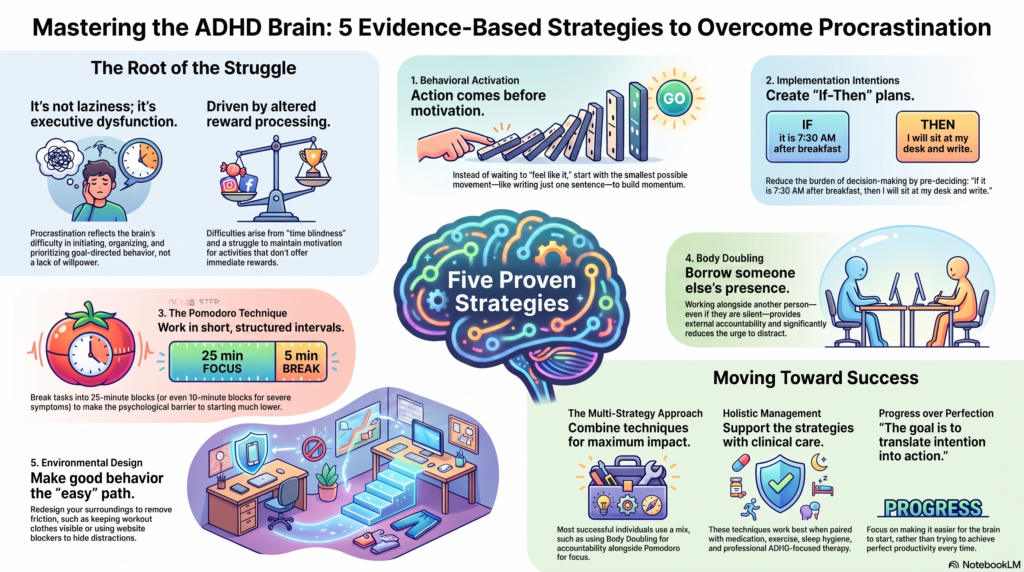 Procrastination is one of the most frustrating symptoms experienced by adults with Attention-Deficit/Hyperactivity Disorder (ADHD). Contrary to popular belief, it is rarely caused by laziness or a lack of willpower. Instead, it reflects difficulties in executive functioning—the brain’s ability to initiate, organise, prioritise, and sustain goal-directed behaviour.
Research has shown that procrastination in ADHD is linked to altered reward processing, impaired task initiation, time blindness, and difficulty maintaining motivation for activities with delayed rewards. Fortunately, several scientifically validated strategies can help overcome these challenges.
Here are five evidence-based techniques that are widely used in ADHD-focused Cognitive Behaviour Therapy (CBT), executive function coaching, and behavioural interventions.
1. Behavioural Activation (Jacobson et al.)
The principle: Action comes before motivation.
One of the biggest mistakes adults with ADHD make is waiting until they “feel motivated.”
Unfortunately, motivation often appears after we begin working—not before.
Behavioural Activation encourages patients to stop negotiating with their brain and simply begin with the smallest possible action.
Instead of saying:
❌ “I need to finish my research paper.”
Try:
- Open the document.
- Read one paragraph.
- Write one sentence.
Once movement begins, the brain gradually builds momentum.
Numerous studies have shown that Behavioural Activation reduces avoidance behaviours and increases engagement with meaningful activities.
Clinical Pearl: Never wait for motivation. Start first. Motivation usually follows.
2. Implementation Intentions (Peter Gollwitzer)
The principle: Plan your behaviour before procrastination begins.
Many goals fail because they are too vague.
“I’ll exercise tomorrow.”
“I’ll study later.”
The brain responds much better to specific behavioural plans known as Implementation Intentions.
Instead of setting a goal, create an If–Then Plan.
If it is 7:30 AM after breakfast, then I will sit at my desk and write for 30 minutes.
These pre-decisions reduce the executive burden of deciding when, where, and how to begin.
Large psychological studies have consistently shown that implementation intentions improve goal completion across health, education, and workplace settings.
Clinical Pearl: Decide today what your future self will do tomorrow.
3. The Pomodoro Technique (Francesco Cirillo)
The principle: Reduce overwhelm by working in short, structured intervals.
The ADHD brain often becomes overwhelmed by large tasks.
Working for “three hours” sounds exhausting.
Working for “25 minutes” feels achievable.
The Pomodoro Technique divides work into manageable blocks:
- 25 minutes of focused work
- 5-minute break
- Repeat four cycles
- Take a longer break
For individuals with severe ADHD, even 10–15 minute work intervals may be more realistic initially.
The objective is not simply productivity—it is making it psychologically easier to start.
Clinical Pearl: Consistency beats intensity.
4. Body Doubling
The principle: Borrow another person’s presence to improve focus.
One of the most effective—and surprisingly simple—strategies for ADHD is Body Doubling.
Work while another person is present.
They do not need to teach you.
They do not even need to speak.
Their presence provides:
- External accountability
- Reduced distraction
- Increased persistence
- Better task initiation
Body doubling can occur:
- At a library
- In a coworking space
- During virtual study sessions
- With a friend on a video call
Many adults with ADHD find that tasks they avoided for days become surprisingly manageable when someone else is quietly working alongside them.
Clinical Pearl: Sometimes the best productivity tool is another human being.
5. Environmental Design (BJ Fogg & Behavioural Science)
The principle: Make good behaviour easy and procrastination difficult.
People often rely on willpower.
Behavioural science tells us that environment usually wins.
Instead of trying to resist distractions, redesign your surroundings.
Examples include:
- Keep your phone in another room while working.
- Use website blockers during study sessions.
- Keep your books on the desk instead of inside a cupboard.
- Prepare tomorrow’s work materials the night before.
- Lay out your exercise clothes before going to bed.
- Use visible calendars and reminder boards.
The easier it is to start, the less opportunity procrastination has to take over.
Clinical Pearl: Successful people often design their environment instead of relying on self-control.
Bringing It All Together
No single technique works for everyone.
The most successful adults with ADHD usually combine several strategies:
- Behavioural Activation to overcome inertia.
- Implementation Intentions to automate task initiation.
- Pomodoro sessions to maintain attention.
- Body Doubling for accountability.
- Environmental Design to reduce distractions and support productive habits.
These strategies become even more effective when combined with evidence-based ADHD treatment, which may include medication, ADHD-focused Cognitive Behaviour Therapy, executive function coaching, structured routines, regular exercise, good sleep hygiene, and management of coexisting anxiety or depression.
Remember, the goal is not perfection.
The goal is to make it easier for your brain to consistently translate intention into action.
About the Author
Dr. Srinivas Rajkumar T
MD Psychiatry (AIIMS, New Delhi)
Senior Consultant Psychiatrist
Mind & Memory Clinic
Apollo Clinic, Velachery, Chennai
Opposite Phoenix Marketcity
Dr. Srinivas has a special interest in Adult ADHD, executive dysfunction, neuropsychiatry, and cognitive rehabilitation. His comprehensive ADHD assessments go beyond symptom checklists to understand each individual’s cognitive profile, real-world functional challenges, and treatment needs. Depending on the clinical situation, management may include medication, ADHD-focused Cognitive Behaviour Therapy (CBT), executive function coaching, cognitive assessment, Continuous Performance Testing (CPT), quantitative EEG (qEEG), neurofeedback, biofeedback, lifestyle optimisation, and family or relationship interventions. His goal is to help patients not only reduce ADHD symptoms but also achieve meaningful improvements in productivity, relationships, emotional well-being, and overall quality of life.
Appointments: +91-8595155808
Email: srinivasaiims@gmail.com