The Relationships We Carry Within: Understanding Object Relations, Enactments, and the Therapeutic Relationship
 Why patients sometimes experience the same therapist as a persecutor, a rescuer, or someone who has profoundly disappointed them
An exploration of object relations theory and Transference-Focused Psychotherapy through the clinical framework of Stern and Yeomans.
Introduction: We Do Not Enter Relationships Alone
Every human relationship involves more than two people.
When a patient enters a psychiatrist’s consultation room, they bring not only their symptoms, personal history, and immediate concerns, but also an internal world populated by representations of themselves and others.
These internal representations are shaped by developmental experiences, attachment relationships, temperament, emotional learning, and subsequent interpersonal encounters.
A therapist may therefore be experienced as caring and understanding during one consultation, yet critical, dismissive, or controlling during another—even when the therapist’s actual behaviour has changed very little.
A patient may initially describe feeling helpless and persecuted, only to become angry, contemptuous, and controlling moments later.
What explains these apparently contradictory experiences?
Object relations theory offers a framework for understanding how people organize their emotional experiences of themselves and others, and how these patterns become activated within relationships.
Transference-Focused Psychotherapy (TFP), developed from Otto Kernberg’s object relations model and elaborated by clinicians including Frank Yeomans, John Clarkin, and Eve Caligor, makes these internal relational patterns central to therapeutic work.
Two particularly useful concepts are:
- Oscillation of object relations dyads: How patients shift between complementary roles within the same internal relationship.
- Layering of object relations dyads: How one relational pattern, often involving anger or persecution, may defend against another involving longing, idealization, or dependency.
Together, these concepts illuminate transference, countertransference, projective identification, and therapeutic enactments.
1. What Is an Object Relations Dyad?
In everyday language, we describe relationships as interactions between two individuals.
Object relations theory introduces an additional dimension: the psychological representations of those individuals.
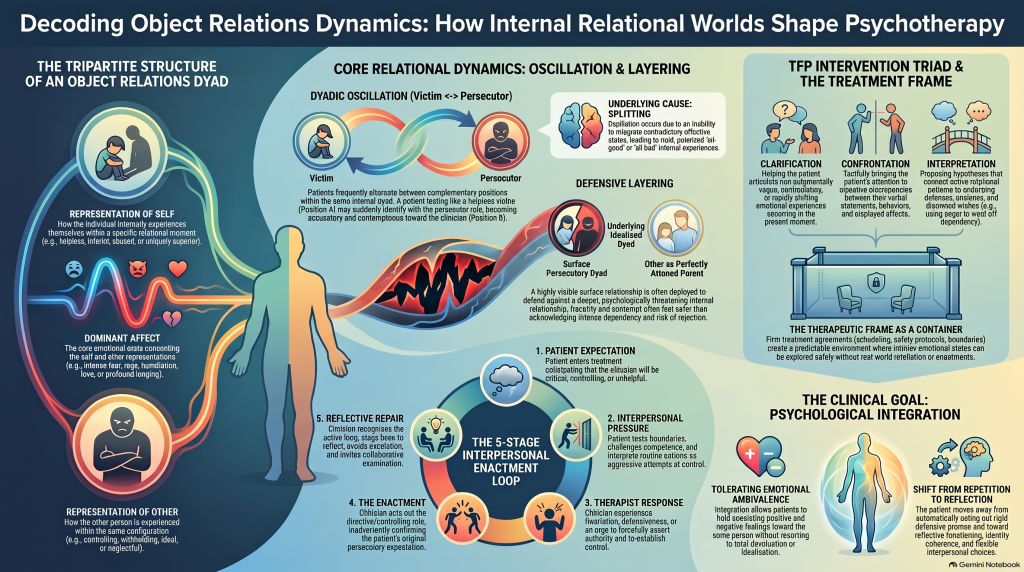
An object relations dyad consists of three interconnected components.
A representation of the self: How the individual experiences themselves within a particular relationship. For example, helpless, inferior, loved, powerful, rejected, or competent.
A representation of the other: How the other person is experienced. They may be perceived as controlling, abandoning, nurturing, critical, idealized, or dependent.
A dominant affect: The emotional experience connecting these two representations, such as fear, anger, longing, love, humiliation, or gratitude.
Consider a patient who feels that their psychiatrist is deliberately withholding help.
The underlying configuration might be:
- Self: Helpless, neglected, powerless.
- Other: Powerful, uncaring, withholding.
- Affect: Fear, resentment, humiliation.
This is not merely a belief that the psychiatrist is unhelpful. It is a complete emotional organization of the relationship.
The patient may experience the situation through this configuration even when the therapist has made a clinically appropriate decision.
Equally important, the patient’s interpretation might sometimes be accurate. Object relations formulations must never become a justification for dismissing legitimate complaints or overlooking actual therapeutic failures.
2. Oscillation: When the Victim Becomes the Persecutor
One of the striking features of primitive object relations is that the individual may rapidly alternate between complementary positions.
Stern and Yeomans illustrate this through a persecutory dyad involving a victim and a persecutor.
Position A: The frightened, inferior victim
The patient experiences themselves as vulnerable, inadequate, or powerless.
The other person is experienced as superior, critical, threatening, or controlling.
The dominant affects are anxiety and fear.
A patient might say:
“You are the doctor. You have all the power. Whatever I say, you will find something wrong with me.”
The psychiatrist is experienced as occupying the persecutory position, while the patient occupies the victim position.
Position B: The angry, superior persecutor
The same patient may subsequently become contemptuous, accusatory, or dismissive.
“You psychiatrists think you know everything. You have no idea what you are doing.”
The self is now experienced as superior and powerful, while the therapist is experienced as inferior, incompetent, or deserving of criticism.
The dominant affects shift toward indignation, contempt, and rage.
What has actually changed?
The relationship has not necessarily changed.
Instead, the patient’s identification within the internal dyad has shifted.
The person who initially experiences themselves as persecuted may subsequently identify with the persecutory position.
The victim and persecutor are not necessarily two separate internal relationships. They can represent complementary positions within the same relational configuration.
This is the essence of oscillation.
The emotional movement is not simply from sadness to anger. It involves a reorganization of the experienced relationship between self and other.
Why does oscillation occur?
Within Kernberg’s theoretical framework, these shifts are associated with difficulties integrating contradictory emotional representations.
Under ordinary circumstances, an individual can recognize that another person may be helpful in some situations and disappointing in others.
Similarly, one can experience oneself as competent in one context and vulnerable in another without losing a coherent sense of identity.
When integration is limited, strongly polarized representations may become activated in different affective states.
The person may struggle to maintain a stable experience of themselves and others across frustration, conflict, separation, or perceived rejection.
This is particularly relevant to the concept of identity diffusion within borderline personality organization.
However, such shifts are not exclusive to personality disorders. Defensive reversals, anger following vulnerability, and changes in perceived interpersonal power can occur across a wide range of clinical and nonclinical situations.
Their diagnostic significance depends on persistence, rigidity, severity, functional impairment, and the broader clinical picture.
3. Splitting: When Contradictory Experiences Cannot Easily Coexist
Splitting is frequently misunderstood as simply seeing people as either good or bad.
Its psychodynamic meaning is more specific.
In Kernberg’s formulation, splitting refers to the defensive separation of contradictory self–object representations, particularly those associated with strongly positive and negative affects.
A person may intellectually understand that the therapist is generally helpful but struggle to retain that emotional understanding during an experience of rejection or disappointment.
During one session, the therapist may be experienced as uniquely understanding.
During another, the same therapist may seem entirely uncaring.
The difficulty lies not necessarily in a lack of intellectual knowledge, but in integrating conflicting emotional experiences into a stable and nuanced representation.
An everyday illustration
Imagine a patient who has experienced several months of productive psychotherapy.
The therapist has consistently attended sessions, listened carefully, and helped the patient understand recurring interpersonal difficulties.
One day, the therapist needs to reschedule an appointment.
The patient experiences this as evidence that the therapist never cared.
The entire history of helpful encounters becomes emotionally inaccessible or loses its significance.
In another emotional state, the patient may again experience the therapist as exceptionally caring.
From an object relations perspective, these shifts may reflect the activation of different internal dyads rather than a balanced appraisal of the relationship.
Importantly, the therapist must still examine whether the scheduling change was handled appropriately. A psychodynamic interpretation should supplement—not replace—attention to the real interpersonal situation.
4. Layering: The Relationship Beneath the Relationship
The second diagram presented by Stern and Yeomans introduces a particularly important clinical concept.
Sometimes the relational configuration most visible in treatment is not the only one operating.
A surface persecutory dyad may defend against an underlying idealized dyad.
The surface persecutory relationship
The patient experiences themselves as an inferior victim and the therapist as a superior persecutor.
The dominant affect is fear or anxiety.
The patient may become preoccupied with whether the therapist is controlling, judgmental, or exploitative.
Alternatively, the patient may reverse the roles and become contemptuous or accusatory.
These dynamics can dominate the clinical encounter.
The underlying idealized relationship
Beneath this persecutory configuration, there may be a very different relational fantasy.
The self is represented as a good, dutiful, deserving child.
The other is represented as a perfectly loving, attentive, validating parent.
The dominant affect is longing.
The patient may wish for a relationship in which they are understood completely, never disappointed, and never required to tolerate ordinary limitations.
This is not simply a desire for empathy or support.
The idealized relationship may involve expectations of perfect attunement, unconditional availability, or freedom from frustration.
Why would the patient defend against something desirable?
Because longing creates vulnerability.
To acknowledge the wish for perfect care may also mean acknowledging dependency, emotional need, fear of disappointment, or the possibility of rejection.
For some patients, particularly those with narcissistic vulnerability, experiencing themselves as dependent can evoke profound shame or humiliation.
The persecutory relationship may therefore be psychologically easier to tolerate than the underlying experience of longing.
Anger can sometimes feel safer than dependency.
Contempt can feel safer than admiration.
Control can feel safer than needing another person.
The apparent rejection of the therapist may, in some cases, defend against an intensely desired relationship with the therapist.
This is a hypothesis to be explored collaboratively through clinical observation, not a universal explanation for anger or therapeutic conflict.
5. Narcissistic Vulnerability: When Dependency Feels Humiliating
The layering model is particularly useful when considering certain narcissistic presentations.
A patient may appear dismissive, superior, demanding, or contemptuous.
The therapist may initially experience the patient as someone who wants to dominate the treatment.
Yet beneath this presentation may be an intense wish to be recognized, admired, understood, or cared for without disappointment.
Accepting help can become psychologically complicated.
If the therapist is experienced as valuable, the patient must confront the possibility that they need something from another person.
That dependency may threaten an idealized self-image of complete independence or superiority.
The patient may consequently devalue the therapist precisely when the relationship becomes emotionally meaningful.
For example, a patient might initially describe the therapist as exceptionally knowledgeable.
After several sessions, the patient begins to feel understood and emotionally attached.
Then, following a relatively minor disappointment, the patient declares that the therapist is incompetent and the treatment is worthless.
A possible formulation is that devaluation protects against dependency and the vulnerability associated with idealization.
But there are alternative explanations: dissatisfaction with treatment, unmet expectations, cultural misunderstandings, financial pressures, or genuine clinical errors.
The formulation becomes useful only when supported by repeated patterns and explored without imposing it upon the patient.
6. Transference: When the Internal World Enters the Consultation Room
Transference is often described as the displacement of feelings from earlier relationships onto the therapist.
While historically important, this description is incomplete.
In contemporary object relations approaches, transference involves the activation of internalized self–other relationships in the therapeutic encounter.
The patient does not simply perceive the therapist as resembling a parent.
The patient may experience themselves and the therapist as occupying complementary roles within an emotionally charged relational configuration.
For example:
- The patient experiences themselves as an abandoned child and the therapist as an unavailable caregiver.
- The patient experiences themselves as a powerless victim and the therapist as a controlling authority.
- The patient experiences themselves as exceptionally deserving and the therapist as an insufficiently admiring other.
- The patient experiences themselves as a dutiful child and the therapist as an idealized, perfectly attuned parent.
These configurations may emerge through words, emotional reactions, expectations, interpersonal behaviour, and responses to therapeutic boundaries.
In TFP, the transference becomes an important source of information about the patient’s internal organization.
Rather than interpreting every emotional response as transference, the therapist examines how recurring patterns unfold in the present therapeutic relationship.
7. Countertransference: The Therapist’s Emotional Experience as Clinical Information
The therapist is not an emotionally neutral recording instrument.
Patients can evoke powerful responses in clinicians.
A psychiatrist may feel unusually protective toward one patient, inexplicably inadequate with another, or irritated and pressured during an otherwise routine consultation.
In contemporary psychodynamic practice, these reactions can sometimes provide information about the interpersonal field.
Consider a patient who repeatedly describes themselves as helpless and misunderstood.
The therapist may feel an urgent need to rescue the patient.
Another patient may repeatedly question the therapist’s competence, leaving the clinician feeling defensive or compelled to demonstrate expertise.
These responses may correspond to roles activated within the patient’s relational world.
However, countertransference is not a direct measurement of the patient’s unconscious mind.
The therapist’s feelings also arise from their own personality, experiences, fatigue, biases, institutional circumstances, and actual interactions with the patient.
Countertransference becomes clinically useful through reflection, not through assuming that every emotional reaction originates in the patient.
Supervision, self-observation, and careful attention to the therapeutic frame are essential.
8. Projective Identification: More Than Attributing Feelings to Someone Else
Projection involves attributing an unwanted feeling, impulse, or characteristic to another person.
Projective identification is a more complex and theoretically contested concept.
In object relations traditions, it can describe an interpersonal process in which a person disowns aspects of their internal experience while relating to another person in ways that may evoke, reinforce, or organize the complementary role.
For example, a patient who experiences the world as controlling may repeatedly challenge therapeutic boundaries.
The therapist may begin feeling unusually authoritarian, rigid, or compelled to assert control.
If the therapist responds by becoming unnecessarily controlling, the interaction may reinforce the patient’s original experience of the therapist as persecutory.
The patient and therapist may then become caught in a self-reinforcing relational pattern.
This does not imply that the patient literally transfers emotions into the therapist.
It is a psychodynamic model for understanding how expectations, defensive processes, interpersonal behaviour, and emotional responses can interact.
The distinction matters because projective identification should not be treated as a proven mechanism of direct emotional transmission.
9. Enactments: When the Internal Drama Becomes an Interpersonal Event
An enactment occurs when an unconscious or insufficiently recognized relational pattern becomes expressed through the interaction between patient and therapist.
The therapist may find themselves participating in a role that resembles the patient’s familiar interpersonal world.
Consider the following hypothetical clinical sequence.
Stage 1: The patient’s expectation
A patient enters treatment expecting authority figures to be critical and controlling.
The therapist is initially experienced as another potentially persecutory authority.
Stage 2: The interpersonal pressure
The patient repeatedly questions whether the therapist is trustworthy.
They challenge recommendations, interpret uncertainty as incompetence, and perceive routine boundaries as attempts at domination.
Stage 3: The therapist’s response
The therapist begins feeling frustrated.
To regain control of the consultation, the therapist becomes increasingly directive.
The clinician may start explaining more forcefully, interrupting the patient, or emphasizing professional authority.
Stage 4: The enactment
The therapist now behaves in a way that resembles the controlling figure the patient anticipated.
The patient feels persecuted.
The therapist feels unjustly attacked.
Both participants become increasingly invested in their positions.
The original internal dyad has become expressed in the therapeutic interaction.
Stage 5: Recognizing the process
A reflective therapist may notice the shift:
“I seem to be becoming increasingly controlling in response to feeling challenged. Perhaps we are both participating in a familiar relational pattern.”
This recognition creates an opportunity to respond differently.
Rather than escalating the struggle, the therapist can explore the interaction and restore a collaborative therapeutic stance.
An enactment is not necessarily evidence of therapeutic incompetence. Such processes may occur even in carefully conducted therapy.
The clinically important issue is whether they are recognized, reflected upon, and repaired.
10. How Transference-Focused Psychotherapy Works With These Dyads
TFP is a structured, manualized psychodynamic psychotherapy originally developed for patients with borderline personality organization and subsequently adapted for other personality pathology.
Its central therapeutic objective is to improve the integration of polarized self and object representations.
The treatment uses the therapeutic relationship as an important setting in which these representations can be observed and understood.
Three techniques are particularly important.
Clarification
The therapist helps the patient articulate experiences that are vague, contradictory, or difficult to understand.
For example:
“Earlier you described feeling frightened that I would criticize you. Now you seem angry because you feel I am not competent to help. Could we examine what changed between those moments?”
The aim is to develop a clearer shared understanding of the patient’s experience.
Confrontation
In TFP terminology, confrontation does not mean hostility or aggressive challenge.
It involves drawing attention to discrepancies or contradictions in the patient’s experience, communication, or behaviour.
For example:
“You have said that you want my help, but you also describe every suggestion I make as an attempt to control you. I wonder how these two experiences fit together.”
The therapist identifies the contradiction without humiliating the patient.
Interpretation
Interpretation attempts to connect the observed relational pattern with its possible psychological meaning.
For example:
“I wonder whether, when you begin to feel that you need my help, that feeling becomes uncomfortable. Experiencing me as controlling might make it easier to reject the relationship than to feel dependent on it.”
Such interpretations are hypotheses.
Their timing, depth, and relevance depend on the patient’s capacity to reflect, the strength of the therapeutic alliance, and the clinical situation.
TFP does not require the therapist to make elaborate interpretations at every session.
In fact, premature interpretations can increase defensiveness, confusion, or rupture.
11. The Importance of the Treatment Frame
Psychodynamic exploration cannot occur safely without an appropriate therapeutic structure.
TFP places considerable emphasis on the treatment contract and therapeutic frame.
These include agreement about treatment goals, attendance, communication, responsibilities, and the management of behaviours that threaten safety or continuity of treatment.
The frame is not merely administrative.
It creates a predictable environment in which intense emotional experiences can be observed without requiring the therapist to respond through rescue, retaliation, or uncontrolled flexibility.
For example, a patient may experience the therapist’s adherence to session boundaries as abandonment.
The therapist must take that emotional experience seriously while also maintaining appropriate professional limits.
The task is neither to dismiss the patient’s distress nor automatically abandon the boundary.
It is to understand the emotional meaning of the boundary while preserving a stable therapeutic relationship.
Where suicidality, severe self-harm, violence, substance intoxication, or other urgent risks are present, immediate safety assessment and appropriate interventions take priority over exploratory interpretation.
12. What Does Integration Actually Mean?
The therapeutic goal is not to eliminate anger, dependency, fear, or idealization.
These are normal human experiences.
The goal is to develop a more integrated and flexible experience of self and others.
A patient who previously experienced the therapist as either perfectly caring or entirely persecutory may gradually become able to recognize:
“I am angry that my therapist could not accommodate my request, but that does not mean the therapist does not care about me.”
Similarly, a patient may learn:
“I can need help from another person without becoming inferior or powerless.”
This represents a significant psychological shift.
The individual becomes more capable of tolerating ambivalence: the coexistence of positive and negative feelings toward the same person.
Integration may support more stable relationships, improved affect regulation, a more coherent sense of identity, and less reliance on rigid defensive patterns.
These changes are clinical goals rather than guaranteed outcomes.
13. Beyond Personality Disorders: Why These Concepts Matter in General Psychiatry
Although TFP has a particular role in the treatment of personality pathology, object relations concepts can help psychiatrists think about difficult interpersonal processes across clinical settings.
Patients with depression may experience help-seeking through internal relationships organized around worthlessness, guilt, or anticipated rejection.
Patients with trauma histories may become particularly sensitive to cues associated with danger, coercion, or betrayal.
Patients with substance use disorders may experience treatment boundaries through complex patterns involving shame, mistrust, dependence, and autonomy.
Patients with chronic illness may struggle with the emotional implications of needing sustained care.
However, similar behaviours can arise from very different mechanisms.
For example, apparent hostility may reflect anxiety, pain, cognitive impairment, psychosis, sensory overload, medication effects, cultural differences, or previous experiences of mistreatment.
A psychodynamic formulation should therefore remain part of a comprehensive biopsychosocial assessment rather than becoming an explanation for every difficult interaction.
The presence of anger, idealization, devaluation, or dependency does not by itself establish a personality disorder.
14. What Does the Scientific Evidence Tell Us?
Object relations theory provides a clinically influential framework, but its different components have varying levels of empirical support.
Research on attachment, emotion regulation, interpersonal expectations, personality functioning, and mental representations provides evidence that people develop relatively enduring patterns of experiencing themselves and others.
Psychotherapy process research also supports the importance of the therapeutic alliance, rupture and repair, and interpersonal processes within treatment.
TFP has been evaluated in clinical studies, including randomized trials involving patients with borderline personality disorder.
These studies have reported improvements in several domains, although findings vary across outcomes and comparisons.
Other structured psychotherapies, including Dialectical Behaviour Therapy, Mentalization-Based Treatment, and Schema Therapy, also have evidence supporting their use in borderline personality disorder.
Current evidence does not establish that TFP is universally superior to these alternatives.
Furthermore, specific psychodynamic constructs such as persecutory dyad oscillation, defensive layering, and projective identification are more difficult to operationalize and test directly.
They should be understood as theoretically informed clinical formulations rather than established biological mechanisms.
A useful distinction is between the evidence supporting a treatment’s clinical effectiveness and the evidence validating every theoretical explanation proposed for how that treatment works.
These are related but separate scientific questions.
15. A Clinical Illustration: Two Relationships in One Consultation
Consider a fictional 28-year-old patient receiving psychotherapy for recurrent interpersonal instability.
During the beginning of a session, the patient appears anxious.
They describe feeling that the therapist is becoming increasingly distant.
The patient says:
“I know you are getting tired of me. Eventually, you will stop seeing me.”
The therapist explores this fear.
A few minutes later, the patient becomes angry:
“Actually, I don’t think you are helping me at all. You just sit there and ask questions.”
The therapist notices an urge to defend their competence.
Rather than responding defensively, the therapist invites the patient to examine the change.
The patient initially insists that nothing has changed.
Gradually, they acknowledge that discussing the possibility of losing the therapist made them feel exposed and helpless.
Criticizing the therapist helped them feel less vulnerable.
Further exploration suggests that the patient has developed an intense wish for a consistently available, understanding figure who would never disappoint them.
That wish is accompanied by fear that needing someone will lead to humiliation or abandonment.
From an object relations perspective, several processes may be occurring.
The patient first occupies the frightened victim position while experiencing the therapist as potentially abandoning or persecutory.
The patient then shifts toward the superior, critical position.
This oscillation may defend against an underlying idealized relationship involving longing for perfect care.
The therapist’s impulse to defend their competence could have contributed to an enactment if acted upon rigidly.
Instead, reflection creates an opportunity for the patient to observe the pattern.
Over time, repeated experiences of recognizing and understanding such shifts may help the patient develop a more integrated experience of themselves and others.
The clinical aim is not to persuade the patient that their fears are irrational.
It is to help them understand how their emotional expectations shape relationships, while also distinguishing these expectations from the therapist’s actual behaviour.
16. The Therapist as Participant and Observer
Perhaps one of the most demanding aspects of psychodynamic psychotherapy is the therapist’s need to occupy two positions simultaneously.
The therapist participates in a real emotional relationship.
At the same time, the therapist must observe the relationship as it unfolds.
A patient’s anger may evoke defensiveness.
A patient’s helplessness may evoke rescue fantasies.
A patient’s idealization may evoke gratification.
A patient’s withdrawal may evoke anxiety or a sense of failure.
The task is not to eliminate these reactions.
It is to recognize them, examine their origins, and avoid automatically converting them into therapeutic action.
The therapist’s emotional experience can become a source of clinical information when held within a reflective framework.
This requires humility.
Not every difficult patient interaction is a projective identification.
Not every therapeutic disagreement is transference.
Not every experience of frustration reveals unconscious resistance.
Sometimes the patient is correctly identifying a problem with treatment.
Sometimes the therapist is tired, distracted, or mistaken.
Good psychotherapy requires the capacity to consider both psychological meaning and external reality.
17. From Repetition to Reflection: The Larger Therapeutic Goal
The central challenge in many persistent interpersonal difficulties is that familiar relational patterns can be repeatedly enacted without being consciously recognized.
A person who expects rejection may behave defensively in ways that distance others.
A person who fears control may enter repeated struggles for dominance.
A person who experiences dependency as humiliation may reject support precisely when it becomes meaningful.
These patterns can become self-reinforcing.
Psychotherapy offers an opportunity to observe them in a relationship that is structured, consistent, and open to reflection.
The therapeutic process gradually transforms an automatically enacted relationship into one that can be examined, understood, and responded to differently.
In this sense, the movement is from repetition toward reflection.
From polarized representations toward integration.
From rigid defensive responses toward greater psychological flexibility.
And from experiencing relationships as predetermined dramas toward recognizing the possibility of new interpersonal experiences.
Conclusion: Sometimes the Conflict Is Not the Whole Story
The two diagrams presented by Stern and Yeomans illustrate a profound clinical principle.
What appears on the surface of a therapeutic relationship may represent only one part of a more complex internal world.
A frightened patient may become a contemptuous patient.
A demanding patient may be defending against a painful longing for care.
A therapist who feels compelled to rescue or retaliate may be approaching an enactment of a familiar relational pattern.
Understanding these processes does not require us to excuse harmful behaviour, ignore actual circumstances, or impose unconscious explanations upon patients.
Instead, it encourages a more nuanced clinical curiosity.
What relationship is being experienced right now?
Which position does the patient occupy within that relationship?
What complementary position is the therapist being invited to occupy?
What emotional experience might this pattern protect against?
And how can the therapeutic encounter create an opportunity for something different?
These questions are central to the relational understanding of psychopathology.
Ultimately, the promise of psychotherapy is not merely to help people understand what happened to them in the past.
It is to help them recognize how the past may continue to organize their present relationships—and gradually develop the freedom to relate differently.