Why Is Smoking So Common in Schizophrenia?
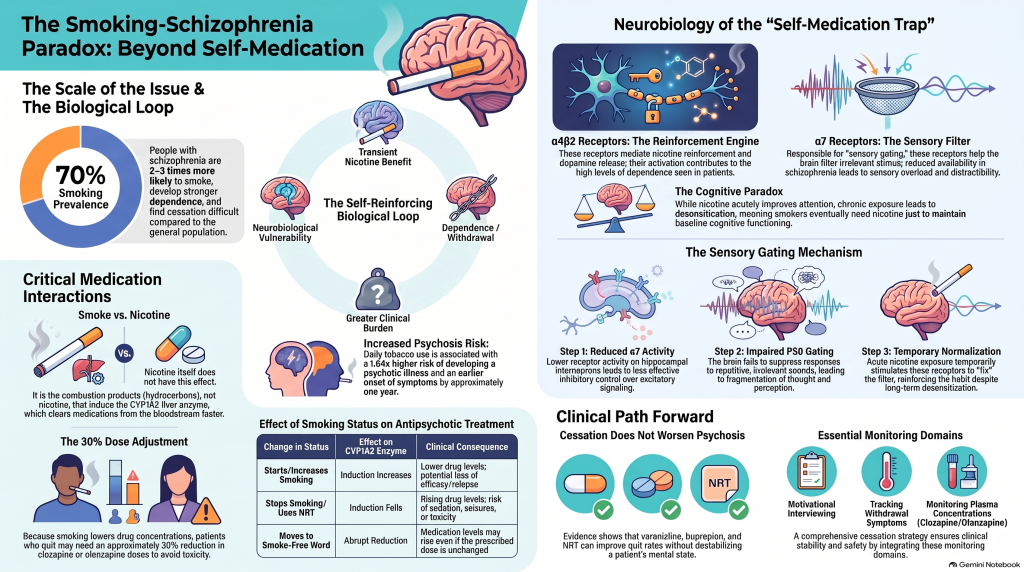 How nicotinic receptors, dopamine, cognition, reward circuits and antipsychotic metabolism interact
Smoking is extraordinarily common among people living with schizophrenia. Contemporary reviews estimate that close to 70% of patients with schizophrenia smoke tobacco, although rates vary substantially by country, sex, treatment setting and period of study. This is approximately two to three times the rate seen in many general-population samples. People with schizophrenia are also more likely to smoke heavily, develop stronger nicotine dependence and find cessation difficult.
For many years, the standard explanation was simple: people with schizophrenia smoke to relieve distress or compensate for cognitive problems. This became known as the self-medication hypothesis.
There is some truth in it—but it is incomplete.
Nicotine can transiently improve attention, sensory filtering and alertness. It can temporarily reduce the discomfort created by nicotine withdrawal. It may partially stimulate nicotinic receptor systems that function abnormally in schizophrenia. However, smoking also strengthens addiction pathways, repeatedly exposes the brain to rapid nicotine peaks, alters dopamine signalling, interferes with the metabolism of important antipsychotics and contributes substantially to cardiovascular, respiratory and cancer-related mortality.
The relationship is therefore not:
Schizophrenia → distress → smoking
It is better represented as a self-reinforcing biological loop:
Neurobiological vulnerability → transient benefit from nicotine → dependence and withdrawal → repeated smoking → greater biological and clinical burden
Smoking, nicotine and nicotinic receptors are not the same thing
Three concepts must be separated.
| Term | Meaning | Clinical relevance |
|---|---|---|
| Nicotine | The addictive psychoactive chemical in tobacco | Activates nicotinic acetylcholine receptors and reinforces repeated use |
| Cigarette smoking | Inhalation of nicotine together with combustion products | Produces addiction, toxic organ damage and important drug interactions |
| Nicotinic acetylcholine receptors | Ion-channel receptors normally activated by acetylcholine | Influence attention, memory, sensory gating, dopamine release and reward |
| Muscarinic receptors | A different family of acetylcholine receptors that signal through G proteins | M1 and M4 receptors are therapeutic targets of xanomeline-based treatment |
Nicotine drives tobacco dependence, but most of the cancer, respiratory disease and systemic toxicity of cigarettes comes from the thousands of chemicals generated by tobacco combustion. Cigarettes deliver nicotine to the brain within seconds, producing rapid reinforcement that is much stronger than the slower nicotine delivery produced by medicinal patches or gum.
This distinction also matters pharmacologically. Nicotine replacement therapy supplies nicotine without tobacco combustion and does not reproduce the complete toxicity or metabolic effects of cigarette smoke.
What happens in the brain after a cigarette?
Inhaled nicotine rapidly enters the bloodstream, crosses the blood–brain barrier and binds to nicotinic acetylcholine receptors, or nAChRs.
These receptors are ligand-gated ion channels. When activated, they alter neuronal excitability and regulate the release of several neurotransmitters, including:
- dopamine;
- glutamate;
- GABA;
- acetylcholine;
- noradrenaline;
- serotonin.
Two receptor populations are particularly relevant to schizophrenia.
| Receptor | Principal relevance | Possible relationship with schizophrenia |
|---|---|---|
| α4β2 nicotinic receptors | Nicotine reinforcement, mesolimbic dopamine release, attention and arousal | May contribute strongly to dependence and the perceived improvement in concentration |
| α7 nicotinic receptors | Sensory gating, hippocampal function, attention, working memory and glutamate–GABA regulation | Reduced expression or availability may contribute to sensory overload and cognitive impairment |
Nicotine initially activates these receptors. With repeated exposure, however, many nicotinic receptors become desensitized: they remain present but respond less normally while nicotine is continuously available. Chronic exposure can also produce compensatory receptor upregulation.
This creates a paradox. A smoker may have more receptor-binding sites but less normal receptor functioning during continuous exposure. When nicotine levels fall, the brain enters withdrawal, producing irritability, anxiety, reduced attention, restlessness and craving. The next cigarette relieves this withdrawal state, which the smoker may experience as improved calmness or cognition.
Thus, part of the apparent benefit of smoking is not enhancement above normal functioning. It is the temporary reversal of a deficit created by nicotine dependence itself.
The α7 receptor and the sensory-gating hypothesis
The α7 nicotinic acetylcholine receptor has attracted particular interest in schizophrenia because of its role in sensory filtering.
The brain is continuously exposed to sounds, sights, bodily sensations and environmental information. Healthy neural circuits reduce the response to repetitive, irrelevant stimuli so that attention can be directed toward what matters. This process is called sensory gating.
One laboratory measure is the P50 auditory evoked potential. Two similar sounds are presented in quick succession. In a normally functioning system, the brain response to the second sound is substantially suppressed. Many people with schizophrenia show reduced suppression, suggesting difficulty filtering repeated sensory information.
This may contribute to experiences such as:
- feeling overwhelmed by environmental stimuli;
- difficulty concentrating in crowded settings;
- distractibility;
- impaired selection of relevant information;
- fragmentation of perception and thought.
Historical genetic and physiological studies linked deficient P50 gating to abnormalities involving CHRNA7, the gene encoding the α7 receptor. More recently, a 2024 PET study of 59 participants found lower hippocampal α7-receptor availability in recent-onset psychosis. Availability was lowest in non-affective psychosis and, within patients, lower availability correlated with more severe positive symptoms and poorer global cognition.
A proposed α7 mechanism
| Step | Proposed neurobiological consequence |
|---|---|
| Reduced α7 activity on hippocampal GABA interneurons | Less effective inhibitory control |
| Reduced inhibition of glutamatergic pyramidal neurons | Excessive or poorly filtered excitatory signalling |
| Impaired sensory gating | Difficulty suppressing irrelevant information |
| Network-level consequence | Distractibility, cognitive fragmentation and possible contribution to psychotic experiences |
| Nicotine exposure | Temporary receptor stimulation and partial normalization in some individuals |
| Repeated smoking | Desensitization, withdrawal and dependence rather than durable correction |
Acute nicotine and some experimental α7 agonists have improved P50 gating or selected cognitive measures in small studies. However, larger trials of α7 agonists and positive allosteric modulators have generally failed to demonstrate consistent, durable improvements in cognition or negative symptoms. The nicotinic abnormality therefore appears biologically relevant, but simply stimulating α7 receptors has not yet become an established schizophrenia treatment.
Nicotine, dopamine and the reward system
Nicotine activates nicotinic receptors within the ventral tegmental area, increasing dopamine transmission to the nucleus accumbens and other components of the mesolimbic reward system.
This produces:
- reinforcement;
- increased motivational salience;
- temporary mood elevation;
- greater alertness;
- stronger learning of smoking-related cues.
The relevance to schizophrenia is important because schizophrenia already involves abnormalities in dopamine signalling, motivational processing and the assignment of salience.
A cigarette may temporarily increase the motivational value of otherwise unrewarding activities. For a patient experiencing anhedonia, avolition or antipsychotic-related emotional dulling, this brief reward signal can feel particularly powerful.
Recent neuroimaging research suggests that smokers with schizophrenia may display a distinctive pattern: heightened responses within reward circuits alongside weaker integration of the delayed negative consequences of smoking. In other words, the immediate reward may be strongly represented, while future risks such as cancer or cardiovascular disease carry insufficient motivational weight at the moment of decision.
This does not mean that patients are unable to understand health information. It means that addiction changes the relative neural value assigned to immediate versus delayed outcomes.
Nicotine and cognitive symptoms
Cognitive deficits are central to schizophrenia and may include impairments in:
- sustained attention;
- processing speed;
- working memory;
- verbal learning;
- executive functioning;
- response inhibition.
Nicotine can acutely improve some attentional measures in smokers and non-smokers. This lends biological plausibility to self-medication, especially when a patient experiences clearer thinking shortly after smoking.
However, several qualifications are essential.
First, improvements tend to be small and short-lived. Second, studies often struggle to separate a genuine cognitive-enhancing effect from relief of withdrawal. Third, chronic smoking is associated with vascular disease, inflammation, oxidative stress and other processes capable of worsening long-term brain health. Fourth, nicotine dependence creates recurrent cycles of withdrawal-related inattention that are temporarily relieved by the next cigarette.
The cognitive paradox
| Immediately after nicotine | During chronic dependence |
|---|---|
| Greater alertness | Recurrent withdrawal-related inattention |
| Temporary improvement in sustained attention | Dependence on nicotine to maintain baseline functioning |
| Possible transient sensory-gating improvement | Receptor desensitization and adaptation |
| Reduced withdrawal irritability | More frequent irritability when nicotine levels fall |
| Brief reward or motivation | Stronger cue-driven craving and habit formation |
Smoking may therefore produce a short-lived cognitive benefit while worsening the stability of cognition across the full day.
Does schizophrenia cause smoking—or can smoking contribute to psychosis?
The direction of causality is one of the most important questions in this field.
Four models are not mutually exclusive.
| Model | Explanation | Supporting observations | Limitation |
|---|---|---|---|
| Self-medication | Patients smoke to reduce cognitive, negative or medication-related symptoms | Nicotine can transiently improve attention and sensory gating | Does not explain why smoking often begins before frank psychosis |
| Shared vulnerability | Genetic and developmental factors increase risk for both schizophrenia and nicotine dependence | Overlapping reward, attention and cholinergic mechanisms are plausible | Difficult to identify which shared factors are causal |
| Smoking contributes to psychosis | Repeated nicotine exposure and smoking-related biological effects increase psychosis risk | Prospective and genetic studies suggest an association with later psychosis | Cannabis, social adversity and prodromal symptoms can confound results |
| Social and treatment environment | Poverty, isolation, boredom, peer smoking and historical psychiatric-institution culture sustain tobacco use | Smoking can provide routine, social contact and time structure | Does not fully explain the receptor and cognitive findings |
A 2015 systematic review and meta-analysis found that daily tobacco use was associated with an increased risk of psychotic illness and an approximately one-year earlier onset of psychosis. More recent evidence continues to support an association: a 2025 analysis reported that current smoking was associated with an elevated schizophrenia risk, with a pooled relative risk of approximately 1.84. These findings do not prove that smoking alone causes schizophrenia, but they challenge the idea that tobacco use is merely a consequence of established illness.
Possible pathways by which smoking could contribute to psychosis include:
- repeated enhancement of mesolimbic dopamine release;
- sensitization of reward and salience circuits;
- neuroinflammation;
- oxidative stress;
- vascular and metabolic effects;
- interactions with adolescent neurodevelopment;
- shared use with cannabis or other substances.
Most smokers never develop schizophrenia. Smoking should therefore be considered a possible contributory risk factor in vulnerable individuals, not a single sufficient cause.
Why smoking can feel calming when nicotine is a stimulant
Patients frequently report that cigarettes reduce tension or anxiety. Nicotine, however, is pharmacologically stimulating and increases sympathetic activity, heart rate and blood pressure.
The apparent calming effect is explained by several processes:
- Relief of withdrawal: nicotine rapidly reverses the irritability and internal tension produced by falling nicotine concentrations.
- Predictable behavioural ritual: leaving a stressful environment, taking slow inhalations and pausing activity can itself feel regulating.
- Attention narrowing: nicotine transiently focuses attention and may reduce awareness of competing stimuli.
- Dopamine reinforcement: reward signalling creates a brief sense of relief or satisfaction.
- Conditioning: repeated pairing of smoking with stress relief causes environmental stress to trigger craving.
This is sometimes called the self-medication trap: the cigarette appears to treat anxiety that previous cigarettes helped create.
Antipsychotic medications and smoking
Smoking has another major clinical effect that is independent of nicotine receptors.
Polycyclic aromatic hydrocarbons produced by tobacco combustion induce the liver enzyme CYP1A2. This accelerates the metabolism of medications that are CYP1A2 substrates, particularly:
- clozapine;
- olanzapine.
Nicotine itself does not produce this enzyme induction. Consequently, switching from cigarettes to nicotine patches, gum or lozenges should pharmacokinetically be treated as stopping smoking.
Clinical consequences of changing smoking status
| Change | Expected pharmacokinetic effect | Possible clinical consequence |
|---|---|---|
| Starts or increases cigarette smoking | Greater CYP1A2 induction | Lower clozapine or olanzapine concentration; possible loss of efficacy |
| Stops or markedly reduces smoking | CYP1A2 activity falls | Rising drug concentration; sedation, dizziness, hypotension, seizures or other toxicity |
| Moves into a smoke-free hospital | Abrupt reduction in smoke exposure | Medication concentration may rise even when the prescribed dose is unchanged |
| Uses nicotine replacement | Nicotine withdrawal is reduced, but CYP1A2 induction from smoke disappears | Drug-level monitoring may still be required |
| Resumes smoking after discharge | CYP1A2 induction returns | Drug concentrations may fall and relapse risk may increase |
A meta-analysis including more than 7,000 clozapine samples found significantly lower clozapine concentrations in smokers. The authors recommended considering an approximately 30% dose reduction when a patient taking clozapine stops smoking, guided by trough concentrations, adverse effects and clinical response rather than by an automatic formula.
Smoking status should therefore be documented at every consultation, admission and discharge. A change in cigarette consumption can be pharmacologically similar to adding or removing an interacting medication.
Does smoking reduce antipsychotic adverse effects?
Nicotine can transiently influence attention and motor circuits, and smoking lowers the concentrations of clozapine and olanzapine. Patients may therefore report less sedation or cognitive dulling while smoking.
This should not be mistaken for evidence that cigarettes are therapeutic.
Lower medication concentrations may also mean poorer antipsychotic efficacy. Furthermore, smoking does not safely treat extrapyramidal symptoms, negative symptoms or cognitive impairment. Any perceived benefit must be weighed against addiction, cardiopulmonary disease, cancer, financial burden and altered medication exposure.
Smoking cessation does not usually destabilize schizophrenia
A historical misconception was that asking patients with schizophrenia to stop smoking would worsen psychosis or remove their only coping mechanism.
Current evidence does not support withholding cessation treatment merely because a patient has schizophrenia. Bupropion, varenicline and nicotine-replacement treatments can improve quit rates when combined with behavioural support. A Cochrane review found that bupropion increased abstinence without worsening patients’ mental state, while subsequent reviews have supported both bupropion and varenicline as reasonable pharmacological options with appropriate monitoring.
What can occur is nicotine withdrawal, which may temporarily produce:
- irritability;
- anxiety;
- insomnia;
- poor concentration;
- restlessness;
- increased appetite;
- low mood.
These symptoms can be confused with psychiatric deterioration. Simultaneously, clozapine or olanzapine concentrations may rise after smoking cessation. Careful planning is therefore preferable to simply instructing a patient to stop.
A safer cessation plan
| Domain | Recommended clinical action |
|---|---|
| Smoking assessment | Record cigarettes per day, time to first cigarette, previous quit attempts and other nicotine products |
| Motivation | Use collaborative, non-judgmental motivational interviewing |
| Pharmacotherapy | Consider varenicline, bupropion or combination nicotine replacement according to individual suitability |
| Behavioural support | Identify cues, routines, social triggers and alternative rewards |
| Psychiatric monitoring | Track psychosis, mood, sleep and withdrawal symptoms |
| Medication monitoring | Review clozapine or olanzapine dose and obtain plasma concentrations where indicated |
| Relapse prevention | Continue support beyond the initial quit date; repeated attempts are expected |
| Physical health | Monitor weight, blood pressure, glucose, lipids and respiratory symptoms |
The most accurate current model
Smoking in schizophrenia is unlikely to have one explanation.
A more complete model combines biological, psychological and social factors:
Inherited and developmental vulnerability
↓
Abnormal α7/α4β2 nicotinic signalling, sensory-gating deficits, cognitive impairment and altered reward processing
↓
Nicotine produces unusually noticeable short-term relief or enhancement
↓
Rapid cigarette delivery strongly reinforces repeated use
↓
Receptor desensitization, tolerance and withdrawal develop
↓
Smoking is repeatedly used to relieve withdrawal and distress
↓
Chronic tobacco exposure increases medical risk and alters antipsychotic metabolism
↓
Greater illness burden, dependence and difficulty quitting
This framework explains why smoking may initially feel useful while becoming progressively harmful.
Clinical takeaways
| Question | Evidence-based answer |
|---|---|
| Are patients with schizophrenia simply choosing to smoke more? | No. Nicotinic-receptor dysfunction, cognition, reward biology, withdrawal and social factors all contribute. |
| Is smoking genuine self-medication? | Partly, but the benefits are transient and much of the relief reflects reversal of nicotine withdrawal. |
| Does nicotine cure a cholinergic deficit? | No. It non-selectively stimulates and then desensitizes multiple receptors and produces dependence. |
| Can smoking contribute to psychosis risk? | Evidence suggests it may increase risk or bring forward onset in vulnerable individuals, although causality is not completely settled. |
| Does quitting worsen schizophrenia? | Not generally, but withdrawal and changing antipsychotic levels require monitoring. |
| What is the most important medication interaction? | Tobacco smoke induces CYP1A2 and lowers clozapine and olanzapine concentrations. |
| Does nicotine replacement have the same interaction? | No. The interaction is caused mainly by combustion products, not nicotine. |
| Should cessation be actively treated? | Yes. Pharmacotherapy plus behavioural support should be integrated into psychiatric care. |
Conclusion
The high prevalence of smoking in schizophrenia is not adequately explained by habit, poor motivation or social disadvantage alone. It reflects a convergence of abnormal nicotinic receptor signalling, impaired sensory gating, cognitive deficits, dopamine-mediated reward, nicotine withdrawal, environmental reinforcement and medication interactions.
Nicotine may transiently sharpen attention, improve sensory filtering or reduce withdrawal-related discomfort. But cigarette smoking does not correct schizophrenia’s neurobiology. It creates repeated cycles of receptor activation, desensitization, craving and withdrawal while adding a major burden of physical disease.
The most productive clinical position is therefore neither moralistic nor permissive. Smoking should be understood as a biologically reinforced dependence that deserves the same structured assessment, pharmacological treatment and longitudinal follow-up as any other major comorbidity in schizophrenia.
About the Author
Dr. Srinivas Rajkumar T, MD (AIIMS, New Delhi), DNB, MBA (BITS Pilani)
Senior Consultant Psychiatrist
Mind & Memory Clinic, Apollo Clinic Velachery, Chennai
Opp. Phoenix Mall
Email: srinivasaiims@gmail.com
Phone: +91-8595155808
This article is intended for professional and public education and does not replace individualized psychiatric or medical assessment.