Can qEEG Predict Which Psychiatric Medication Will Work?
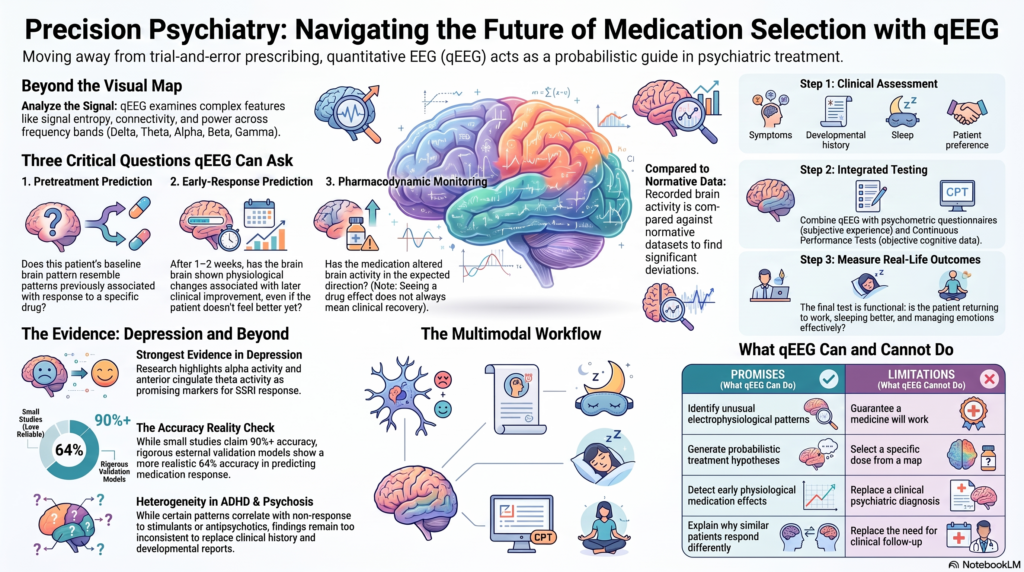 The emerging role of brain-wave biomarkers in precision psychopharmacology
One of the most frustrating parts of psychiatric treatment is uncertainty.
A patient may ask:
“Doctor, how do you know this medicine will work for me?”
The honest answer is that medication selection still depends largely on diagnosis, symptom pattern, physical health, previous treatment response, family history, side-effect vulnerability and clinical judgement.
Two people with apparently similar depression may respond very differently to the same antidepressant. One may improve substantially with sertraline. Another may experience side effects without meaningful benefit. A third may respond better to a medication acting on a different neurotransmitter system.
Conventionally, the psychiatrist selects the most appropriate treatment, starts cautiously and monitors the patient over the following weeks.
But could we obtain useful biological information before waiting several weeks?
Could electrical brain activity indicate whether a person is more likely to respond to an SSRI, an SNRI, bupropion, a stimulant or an antipsychotic?
This is the central promise of quantitative electroencephalography, or qEEG, in precision psychiatry.
The science is promising—particularly in depression—but it must be explained responsibly.
qEEG cannot currently guarantee that a particular medicine will work. It can potentially identify patterns associated with a greater or lower probability of response, especially when combined with clinical assessment, diagnostic psychometry, cognitive testing and early follow-up measurements.
What is qEEG?
A conventional EEG records the electrical activity generated by groups of brain cells through sensors placed on the scalp.
qEEG takes the recorded signal and applies mathematical analysis to examine features such as:
- Delta, theta, alpha, beta and gamma activity
- Absolute and relative power
- Peak frequency
- Left–right asymmetry
- Coherence and connectivity
- Signal complexity or entropy
- Changes between eyes-open and eyes-closed states
- Responses during cognitive tasks
- Changes after medication begins
These measurements can be compared across brain regions, across time or with carefully selected normative data.
The resulting coloured maps are only visual representations of mathematical measurements. They are not photographs of depression, ADHD or anxiety.
The value lies in the underlying signal—not in how impressive the map looks.
Three different questions qEEG can ask
Discussions about medication prediction often mix together three separate ideas.
1. Pretreatment prediction
This asks:
“Before starting the medicine, does the person’s baseline EEG pattern resemble patterns previously associated with response or non-response?”
Possible pretreatment markers include alpha peak frequency, frontal alpha asymmetry, anterior cingulate theta activity, connectivity and multivariate combinations of several EEG features.
2. Early-response prediction
This asks:
“After a few days or one or two weeks of treatment, has the brain shown the type of early change that has previously been associated with later clinical improvement?”
The patient may not yet feel substantially better, but the EEG may show an early physiological response.
Researchers have studied measures such as:
- Changes in prefrontal theta cordance
- Alterations in alpha and theta power
- Changes in connectivity
- Changes in signal complexity
- Antidepressant Treatment Response Index-type measures
- Transient frontal spectral events
A 2026 study, for example, investigated brief frontal EEG spectral events rather than relying only on average power across a long recording to predict subsequent response to sertraline. This reflects a broader movement towards studying the brain’s dynamic activity rather than compressing an entire recording into one average value.
3. Pharmacodynamic monitoring
This asks:
“Has the medication altered brain activity in the expected direction?”
Many psychotropic medicines change EEG patterns.
But detecting a drug effect is not the same as predicting clinical recovery.
A medicine may clearly affect brain-wave activity without adequately reducing depression, psychosis or inattention. Conversely, a person may improve clinically even when the measured EEG change is modest.
A 2025 systematic review found that SSRIs, SNRIs and vortioxetine repeatedly altered EEG spectral activity, but the direction and location of changes differed across medications and studies. The literature remained heterogeneous in sample size, dose, treatment duration and EEG methodology.
Depression: where the evidence is strongest
Most research on qEEG-guided medication selection has focused on major depressive disorder.
Several EEG features have repeatedly attracted attention.
Alpha activity
Alpha activity is commonly observed when a relaxed, awake person sits with their eyes closed.
Researchers have studied:
- Overall alpha power
- Posterior alpha activity
- Alpha peak frequency
- Frontal alpha asymmetry
- Changes in alpha following medication
Some studies have found that particular alpha patterns are associated with response to SSRIs. However, the findings have not always been consistent across populations, medications, sexes and recording methods.
This inconsistency is important. It means that a simple statement such as:
“High alpha means sertraline will work”
would not be scientifically justified.
The most promising prediction models now combine alpha with several other features rather than depending upon one brain-wave measurement.
Anterior cingulate theta activity
The rostral anterior cingulate cortex is involved in emotion regulation, attention, conflict monitoring and the integration of emotional and cognitive information.
Several studies have associated greater pretreatment theta activity in this region with better subsequent antidepressant response.
However, the marker may partly reflect a general capacity to improve rather than a specific response to one particular medication. Some markers also predict improvement with placebo or psychotherapy, making it necessary to distinguish a general prognostic marker from a treatment-specific predictive marker.
A useful biomarker should ideally tell us not merely who is likely to improve, but who is more likely to improve with treatment A rather than treatment B.
Theta cordance
Cordance combines information from absolute and relative EEG power.
Early reductions in prefrontal theta cordance have been associated in several studies with later antidepressant response. The appeal is obvious: the EEG may begin changing before the patient experiences the full clinical effect.
However, cordance findings have varied across medications, study designs and processing methods. It remains a research-informed biomarker rather than a universally accepted clinical rule.
Connectivity and signal complexity
Modern prediction models increasingly examine interactions between brain regions rather than analysing each electrode separately.
They may assess:
- Functional connectivity
- Phase relationships
- Network organisation
- Multiscale entropy
- Non-linear signal features
- Combinations of power and asymmetry
- Machine-learning-derived signatures
This is more realistic because depression is unlikely to arise from one abnormal electrode or one frequency band. It involves distributed networks associated with mood, reward, attention, sleep and cognitive control.
What have prediction studies actually found?
A 2023 systematic review and meta-analysis examined 15 EEG prediction studies involving 479 patients. The pooled results appeared highly encouraging, with an area under the curve of 0.91, sensitivity of 83% and specificity of 86%. However, the studies were small, methodologically heterogeneous and lacked external validation. The authors warned that the apparent accuracy may therefore have been overestimated.
This illustrates a common difficulty in artificial-intelligence research.
A model can perform extremely well when tested on data resembling the sample from which it was developed. The more important question is:
“Will it continue to work in a completely different hospital, population and recording system?”
A more rigorous 2023 study developed an EEG model in 125 patients receiving escitalopram and externally tested it in an independent group of 105 patients receiving sertraline. The model achieved approximately 64% balanced accuracy in both the development and external-validation samples. It did not meaningfully predict improvement in the placebo group, suggesting some medication specificity.
Sixty-four per cent is not accurate enough to allow a computer to prescribe medication independently.
But it is scientifically more credible than a 90–95% figure obtained from a small dataset without independent testing.
The study also found that combinations of power, entropy and asymmetry were more useful than relying on one isolated EEG marker.
Can qEEG help choose between antidepressants?
There is preliminary evidence that it may.
A 2021 prospective feasibility study used three pretreatment EEG features—frontal alpha asymmetry, alpha peak frequency and paroxysmal EEG activity—to inform selection among escitalopram, sertraline and venlafaxine.
The study showed that implementing EEG-informed prescription in clinical practice was feasible and was associated with greater symptom improvement than treatment as usual. However, it was an open-label, non-randomised feasibility design rather than a large blinded definitive trial.
This distinction matters.
The study supports the idea that qEEG can contribute to medication planning.
It does not establish that these rules should automatically be applied to every patient.
As of July 2026, no widely accepted qEEG system can reliably tell an individual patient:
“Sertraline will work, but escitalopram will not.”
“Venlafaxine is definitely the correct medication.”
“This antidepressant has an 87% chance of success.”
The evidence is moving towards probabilistic guidance—not certainty.
Antipsychotic medication and qEEG
Antipsychotics produce measurable changes in EEG activity, and researchers have investigated whether baseline patterns or early medication-induced changes predict improvement in schizophrenia.
A 2023 systematic review identified 22 studies examining resting EEG, task-related measures, connectivity, microstates and evoked potentials. Certain pretreatment patterns—including altered theta, high alpha activity or connectivity and reduced beta activity—were associated in some studies with poorer response. During treatment, changes in theta, beta, alpha and coherence were associated with favourable outcomes in some samples.
However, the findings were heterogeneous and sometimes contradictory, preventing a reliable pooled prediction model.
Clozapine deserves particular caution because it frequently alters EEG activity. A systematic review found that clozapine was more strongly associated with EEG slowing and epileptiform discharges than other antipsychotics. These changes may reflect pharmacological effects and seizure vulnerability; they should not be interpreted automatically as evidence that clozapine is either working or failing.
At present, qEEG may add useful neurophysiological information in selected psychosis cases, but it cannot reliably choose risperidone, olanzapine, aripiprazole or clozapine for an individual patient.
Can qEEG predict stimulant response in ADHD?
There is also research on methylphenidate response.
A large prospective study involving 336 children and adolescents with ADHD investigated whether EEG features could predict response to methylphenidate. Some EEG patterns appeared more useful for predicting non-response than identifying definite responders.
Other studies have examined theta activity, alpha peak frequency, event-related potentials and cortical-source activity.
But ADHD is highly heterogeneous.
A child’s response to methylphenidate may also be influenced by:
- Sleep
- Anxiety
- Learning disorders
- Autism
- Dose and formulation
- Duration of effect
- Family structure
- School demands
- Medication adherence
- Coexisting emotional or behavioural difficulties
qEEG should therefore not replace a developmental history, parent and teacher reports, functional assessment or an appropriately supervised medication trial.
In our workflow, qEEG becomes more meaningful when interpreted alongside Continuous Performance Testing, executive-function measures and evidence of impairment at school, college, work and home.
Bipolar disorder, lithium and mood stabilisers
The evidence is substantially weaker for predicting response to lithium, valproate, lamotrigine or other mood stabilisers.
Lithium can affect EEG activity, and small studies have investigated possible markers of response. However, contemporary reviews conclude that no sufficiently validated biomarker can currently identify who will respond well to lithium.
Clinical factors therefore remain central, including:
- Classic episodic mania
- Family history of lithium response
- Pattern and frequency of episodes
- Psychotic features
- Inter-episode recovery
- Previous treatment history
- Comorbidities and safety considerations
qEEG may contribute to broader neurophysiological assessment, but it cannot replace standard clinical selection or safety monitoring.
Ketamine and rapid-acting antidepressants
Ketamine produces rapid and noticeable changes in EEG oscillations.
Studies have investigated baseline theta activity, alpha power, gamma activity, connectivity and early post-infusion changes as potential markers of antidepressant response.
These findings are scientifically interesting because ketamine acts more rapidly than conventional antidepressants. Researchers can examine EEG changes occurring within minutes or hours and compare them with clinical improvement.
However, the available studies remain relatively small and use different doses, recording systems and analysis methods. No universally validated qEEG rule currently determines whether an individual should receive ketamine or predicts with certainty whether they will respond.
Why psychiatric medication prediction is so difficult
A diagnosis contains several biological pathways
“Major depression” is a clinical syndrome, not one uniform brain condition.
One person may have prominent anxiety and insomnia.
Another may have severe anhedonia and psychomotor slowing.
Another may have inflammatory, hormonal, sleep-related or bipolar-spectrum contributors.
These people may meet the same diagnostic criteria while having different neurobiological profiles.
Response is not a simple yes-or-no event
A patient may experience:
- Improved sleep but persistent low mood
- Reduced anxiety but continuing anhedonia
- Better concentration but emotional blunting
- Partial improvement with unacceptable side effects
- Early response followed by relapse
- Symptom improvement without recovery of functioning
A prediction model must define exactly what it is predicting: response, remission, tolerability, cognitive improvement or long-term recovery.
The EEG itself changes from day to day
EEG measurements are influenced by:
- Sleep quantity and quality
- Caffeine
- Nicotine
- Alcohol and substances
- Current medications
- Drowsiness
- Anxiety during recording
- Menstrual and hormonal factors
- Eye movements
- Facial and jaw-muscle activity
- Poor electrode contact
- Time of day
Without standardised recording and careful artefact management, a mathematical model may analyse noise rather than meaningful brain activity.
Medicines change the EEG
Once a person is already taking antidepressants, benzodiazepines, stimulants, mood stabilisers or antipsychotics, the recording reflects both the person’s neurophysiology and the effects of medication.
This does not make qEEG useless.
But the clinician must know whether they are examining:
- A baseline trait
- A disorder-related state
- A medication effect
- Withdrawal
- Sedation
- Sleep deprivation
- An early therapeutic response
The most responsible clinical use of qEEG
qEEG should not be used as a vending machine that converts a brain map into a prescription.
A better model is multimodal precision psychiatry.
1. Begin with the person
The assessment starts with:
- Symptoms and chronology
- Strengths
- Education and occupation
- Developmental history
- Physical health
- Sleep
- Substance use
- Previous medications
- Family treatment response
- Current functioning
- Patient preference
2. Define the clinical question
Examples include:
“Is there any neurophysiological information that may support SSRI versus non-SSRI selection?”
“Does this patient show an early EEG change after beginning treatment?”
“Is cognitive slowing more consistent with depression, poor sleep, medication sedation or another process?”
“Are attention difficulties objectively demonstrable under sustained demand?”
Testing without a clear question can produce a great deal of data without improving treatment.
3. Combine qEEG with diagnostic psychometry
Psychometric measures can document:
- Depression severity
- Anxiety
- ADHD symptoms
- Mania
- Sleep
- Emotional regulation
- Medication side effects
- Functional impairment
- Quality of life
The qEEG shows electrical activity.
Psychometry shows the patient’s subjective and behavioural experience.
Neither should be interpreted alone.
4. Add performance-based assessment when appropriate
A Continuous Performance Test can examine:
- Missed targets
- Impulsive responses
- Reaction time
- Response variability
- Sustained attention
- Resistance to distraction
- Decline over time
This helps determine whether a physiological pattern corresponds with actual performance.
With frontal fNIRS, it may also be possible to study how much cognitive effort is recruited during an active task. The combination does not create a definitive psychiatric diagnosis, but it offers a richer functional profile than a resting recording alone.
5. Monitor early change
A research-informed workflow may compare baseline findings with an early follow-up recording after medication begins.
The question is not merely:
“Did alpha increase?”
It is:
“Did the EEG change in a potentially favourable direction, and is this accompanied by better sleep, reduced symptoms, improved cognition or improved functioning?”
An isolated EEG change without clinical improvement should not automatically justify continuing an ineffective treatment.
6. Measure real-life outcomes
The final test of medication response is not the brain map.
It is whether the person is:
- Returning to work or college
- Sleeping consistently
- Completing tasks
- Reconnecting with family
- Experiencing fewer panic attacks
- Thinking more clearly
- Managing emotions more effectively
- Remaining free of psychosis or mania
- Functioning with acceptable side effects
Brain-based measurements should strengthen clinical care—not distract from the person’s life.
What qEEG can reasonably offer today
qEEG may help to:
- Characterise baseline brain activity
- Identify unusual or potentially relevant electrophysiological patterns
- Generate probabilistic treatment hypotheses
- Support antidepressant selection in carefully interpreted cases
- Detect early physiological medication effects
- Monitor change over time
- Explain why apparently similar patients may respond differently
- Guide neurofeedback and cognitive-regulation training
- Strengthen a multimodal treatment formulation
What qEEG cannot currently promise
It cannot reliably:
- Guarantee that a medicine will work
- Select the exact medication from a coloured map
- Determine the ideal dose
- Replace a psychiatric diagnosis
- Replace blood tests or physical monitoring
- Predict all side effects
- Prove that a patient has ADHD, depression or bipolar disorder
- Replace clinical follow-up
- Remove all trial and error from psychiatry
Professional guidance has not established a sufficiently validated stand-alone EEG or neuroimaging biomarker for routinely selecting a specific psychiatric treatment for an individual patient.
The latest direction: from one biomarker to an integrated prediction model
The future is unlikely to depend on one value such as theta power or frontal asymmetry.
More accurate prediction will probably combine:
- qEEG
- Task-based EEG
- fNIRS or other functional measures
- CPT and cognitive testing
- Symptom pattern
- Sleep
- Previous treatment response
- Medication side-effect vulnerability
- Clinical and demographic variables
- Genetics and blood biomarkers
- Longitudinal digital information
The 2023 externally validated SSRI study already demonstrated that combining power, entropy and asymmetry was more useful than relying upon a single EEG feature.
The latest research is also shifting from static averages to transient events, connectivity and personalised machine-learning models. These approaches may ultimately help psychiatrists estimate:
“This patient appears more likely to respond to an SSRI.”
“This profile suggests a lower probability of response and justifies closer early monitoring.”
“The medicine is altering brain activity, but functional improvement is insufficient.”
That is very different from saying:
“The scan has selected your medicine.”
The central message
qEEG-based medication prediction is one of the most promising areas in precision psychiatry.
The strongest evidence currently concerns antidepressant treatment, particularly SSRI response. Externally validated studies and prospective feasibility trials suggest that EEG could provide useful information beyond symptoms alone. However, present accuracy is not sufficient for qEEG to prescribe medication independently.
The scientifically responsible position is:
qEEG can support treatment selection and early-response monitoring, but it must be integrated with clinical diagnosis, psychometry, cognitive performance, physical health, patient preference and close follow-up.
The brain recording provides biological information.
The questionnaires document symptoms.
The cognitive tests demonstrate performance.
The patient’s life reveals whether treatment is truly working.
The psychiatrist brings these different forms of evidence together.
That is the real pathway from trial-and-error prescribing towards measurement-informed, personalised psychopharmacology.
About the Author
Dr. Srinivas Rajkumar T
MD Psychiatry — AIIMS, New Delhi
Senior Consultant Psychiatrist
Mind & Memory Clinic
Apollo Clinic, Velachery, Chennai
Opposite Phoenix Marketcity
At Mind & Memory Clinic, qEEG is not used as an isolated diagnostic label or an automatic medication selector. When clinically appropriate, it can be integrated with diagnostic psychometry, Continuous Performance Testing, EEG–fNIRS assessment, detailed psychiatric interviewing and longitudinal monitoring.
The aim is to understand not only which treatment may be suitable, but also whether the brain, symptoms and real-world functioning are moving in the right direction after treatment begins.