Closed Loop Meditation With Muse S Athena
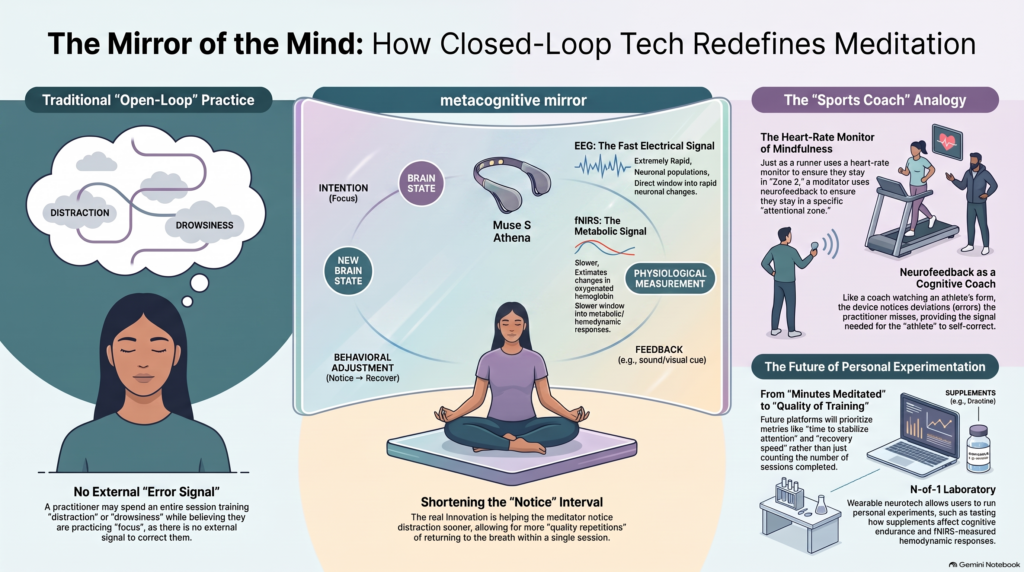 Meditation has traditionally been an unusually open-loop form of training.
A person sits down, focuses on the breath, scans the body, observes thoughts or practises another attentional technique. Twenty minutes later, the session ends. The meditator may feel relaxed, restless, sleepy or unusually clear—but there is often remarkably little objective information about what actually happened during those twenty minutes.
Was sustained attention maintained for most of the session?
Did the mind repeatedly wander without the meditator noticing?
Was the apparent “deep meditation” actually progressive drowsiness?
How rapidly could attention be recovered after distraction?
Did the practitioner spend twenty minutes training attentional stability—or twenty minutes repeatedly drifting into unrelated thought?
Experienced meditators become considerably better at recognising these distinctions internally. Nevertheless, introspection remains imperfect.
This is where devices such as Muse S Athena represent an interesting change in the philosophy of consumer neurotechnology.
Athena combines EEG with functional near-infrared spectroscopy, or fNIRS. Muse describes the device as using seven EEG sensors together with frontal fNIRS measurements, allowing electrical brain activity and changes related to cortical blood oxygenation to contribute to different forms of biofeedback.
The significance is not merely that another physiological variable can be measured.
The more important development is the creation of a closed feedback loop between mental state, physiological measurement and behavioural correction.
From Meditation as Practice to Meditation as Training
Consider conventional meditation.
A practitioner receives an instruction:
Focus on the breath.
The brain then attempts to perform the task.
Attention fluctuates. Thoughts arise. Awareness narrows or broadens. Drowsiness develops. Attention eventually returns.
But the system largely lacks an external error signal.
Even guided meditation does not completely solve this problem. A recorded instructor can say, “If your mind has wandered, gently return to the breath,” but the recording has no idea whether the listener’s attention actually wandered five seconds earlier.
It is instruction rather than feedback.
Neurofeedback introduces something fundamentally different.
The training loop becomes:
Intention → brain state → physiological measurement → feedback → behavioural adjustment → new brain state.
That distinction is important.
In motor learning, strength training, music and sport, rapid feedback is one of the major mechanisms through which performance becomes refined. The learner performs an action, detects an error and adjusts the next attempt.
Neurofeedback attempts to apply the same logic to states that are normally much more difficult to observe.
Research on mindfulness-based neurofeedback is still developing, but systematic reviews suggest that EEG- and imaging-based feedback can help participants interact with neural correlates of meditation rather than relying solely on subjective awareness. The evidence is promising rather than definitive, and protocols remain heterogeneous.
The Real Innovation May Be Metacognitive Feedback
The most useful effect may therefore be surprisingly simple.
The device tells the meditator:
You are no longer doing what you think you are doing.
That information is powerful.
During an ordinary meditation session, several phenomenologically similar states can occur:
focused attention,
open monitoring,
body-focused awareness,
discursive thinking,
mind wandering,
relaxation,
drowsiness,
and the transition toward sleep.
Subjectively, particularly when attention becomes dull, some of these states can blur into one another.
EEG-based feedback potentially provides an additional signal that helps the practitioner recognise transitions between them.
Over repeated sessions, the objective is not necessarily dependence on the device.
Quite the opposite.
The external feedback may progressively teach the brain to recognise its own internal states more accurately.
In learning theory terms, the feedback functions somewhat like operant conditioning of attentional regulation. A desired brain-behaviour state produces a favourable signal; loss of that state changes the signal; the person experiments until the desired state is recovered.
Over time, the physiological feedback may become paired with increasingly subtle internal cues.
The practitioner begins to recognise:
This is what stable attention feels like.
And perhaps even more importantly:
This is what the moment immediately before distraction feels like.
That is potentially far more useful than simply receiving a meditation score at the end.
Why Experienced Meditators May Notice the Difference More
Interestingly, neurofeedback may not necessarily be most impressive to someone meditating for the first time.
An experienced meditator already possesses a vocabulary of internal states.
They know that one session can contain periods of unusually stable attention, superficial concentration, body scanning, spontaneous thought, absorption, fatigue and near-sleep.
What has historically been missing is an independent signal against which those subjective states can be compared.
This creates an interesting process of interoceptive calibration.
The meditator experiences a state internally while simultaneously receiving information generated from physiology. Repeated pairings may improve discrimination between productive attentional states and states that merely feel quiet.
This could explain why some experienced meditators describe neurofeedback sessions as more efficient—not necessarily because the device produces some entirely new mental state, but because it shortens the cycle:
wander → notice → recover.
If distraction is detected sooner and the desired state is reacquired more rapidly, the percentage of a twenty-minute session spent in effective practice may rise considerably.
The “Quality Repetitions” Model
A useful comparison comes from exercise physiology.
A person can certainly run without a heart-rate monitor.
Millions of people do.
But suppose the aim is Zone 2 aerobic conditioning. Without measurement, the athlete estimates intensity from breathing, perceived exertion and pace.
That can work reasonably well.
Add a reliable heart-rate monitor and something changes.
Instead of simply asking:
Did I run for 45 minutes?
the athlete can ask:
How much of those 45 minutes was actually spent in the physiological zone I intended to train?
The duration of the workout has not changed.
The density of useful training may have.
Meditation neurofeedback can be understood in a similar way.
The relevant variable may not simply be:
How many minutes did I meditate?
but rather:
How many minutes contained stable, appropriately alert attentional practice?
This concept of quality repetitions is arguably one of the most compelling ways to understand consumer neurofeedback.
Thirty minutes of poorly regulated training is not necessarily equivalent to thirty minutes of well-regulated training.
The same principle applies to cognitive training.
Athena’s Second Dimension: fNIRS
Athena becomes particularly interesting because EEG is not its only signal.
EEG measures electrical activity with excellent temporal resolution. fNIRS operates differently. Near-infrared light is used to estimate changes in oxygenated and deoxygenated haemoglobin associated with cortical haemodynamics.
In Athena, the fNIRS sensors are positioned over the frontal region and are used during the device’s cognitive “Strength” training. Muse’s owl task translates measured changes associated with cognitive effort into the behaviour of an animated owl—the stronger the appropriate signal, the better the owl performs.
This is essentially a simplified brain-computer feedback interface.
The participant attempts to generate and sustain an appropriate cognitive state.
The device measures a haemodynamic correlate.
The game transforms that measurement into an immediately understandable external consequence.
The brain then attempts to reproduce whatever strategy produced success.
Laboratory fNIRS-neurofeedback research supports the broader feasibility of this principle. Participants can learn to modulate prefrontal haemodynamic activity, and studies have reported changes in cognitive performance, brain activation and connectivity following training. However, this remains an active research field rather than an established cognitive treatment.
A systematic review of fNIRS neurofeedback studies similarly concluded that voluntary regulation of haemodynamic signals appears feasible while emphasising the need for larger and more rigorous trials.
Why EEG and fNIRS Together Are Interesting
EEG and fNIRS observe different parts of the same biological process.
Neuronal populations change their electrical activity extremely rapidly.
When cortical regions remain active, their metabolic requirements change. Local blood flow subsequently adjusts through neurovascular coupling, altering concentrations of oxygenated and deoxygenated haemoglobin.
EEG therefore provides a relatively direct window into electrophysiology, whereas fNIRS provides a slower window into neurovascular and metabolic responses associated with cortical activity.
Combining them conceptually provides two different perspectives:
What is the electrical system doing?
and
What haemodynamic response accompanies sustained cortical activity?
This multimodal approach is scientifically attractive because neither signal tells the entire story.
It also explains why fNIRS should not be described simplistically as directly measuring “how hard the brain is working.” It measures haemodynamic changes that can correlate with cognitive workload, but those measurements are influenced by neurovascular coupling and systemic physiology.
The Curious Creatine Observation
This brings us to a particularly interesting observation that deserves investigation rather than premature explanation.
Some individuals using fNIRS-based cognitive training report substantially better performance after taking creatine approximately an hour before training.
There is a biologically plausible connection between creatine and brain energetics.
The phosphocreatine system acts as a rapidly accessible energy buffer, helping regenerate ATP during periods of increased cellular energy demand. Creatine supplementation has been investigated for effects on cognition, mental fatigue and cerebral energy metabolism.
A classic human experiment by Watanabe and colleagues found that creatine supplementation reduced mental fatigue during repeated cognitive tasks and altered the task-associated cerebral oxygenated-haemoglobin response. Intriguingly, oxygenated haemoglobin increased less, rather than more, following supplementation despite improved resistance to mental fatigue.
That finding is important when interpreting consumer fNIRS observations.
Better performance in an fNIRS-controlled game after creatine does not automatically mean that creatine increased cerebral oxygenation.
Several alternative mechanisms are possible.
Improved cerebral energy buffering might allow a cognitive task to be sustained more efficiently.
Perceived mental effort could change.
Attention or motivation could change.
Systemic circulation, respiration or autonomic physiology could alter the optical signal.
There may also simply be normal session-to-session variation.
Consequently, an observation such as “the owl performs dramatically better after creatine” is scientifically interesting precisely because it generates a hypothesis.
It should not yet be considered evidence for an acute nootropic effect.
It Is Almost a Ready-Made N-of-1 Experiment
Wearable neurotechnology makes experiments possible that would previously have required laboratory equipment.
A motivated individual could perform repeated Athena sessions under relatively standardised conditions and compare creatine with placebo.
Time of day could be fixed.
Sleep duration could be recorded.
Caffeine intake could be controlled.
The cognitive task could remain identical.
Creatine and placebo days could be randomised and ideally blinded.
Heart rate and perhaps blood pressure could be recorded.
Multiple sessions would be required rather than comparing one particularly good day with one particularly bad day.
The interesting outcome would then not merely be the game score.
One could examine whether the intervention changes:
cognitive endurance,
time to fatigue,
fNIRS response,
performance consistency,
subjective effort,
and the relationship between physiological activity and task performance.
Suddenly a consumer neurofeedback device becomes more than a wellness gadget.
It becomes a crude but potentially fascinating personal experimental platform.
Neurofeedback as the Cognitive Equivalent of a Sports Coach
Perhaps the best conceptual analogy for Athena is therefore not a medical device.
It is a coach.
A good coach does not perform the exercise for the athlete.
The coach watches the performance.
The coach notices deviations the athlete may not notice.
The coach provides an external error signal.
The athlete corrects the movement.
Eventually the athlete develops enough internal awareness that fewer corrections are required.
Heart-rate monitors perform a similar function in endurance exercise.
Power meters do it in cycling.
Video analysis does it in racquet sports.
Force plates do it in strength and conditioning.
Neurofeedback attempts to bring the same principle to cognitive and attentional training.
Without measurement, meditation remains valuable.
Without measurement, cognitive training remains possible.
But measurement can potentially answer a different question:
How well am I performing the thing that I believe I am practising?
That is the real promise of neurofeedback.
From “Minutes Meditated” to “Quality of Mental Training”
The future of meditation technology may therefore become less concerned with counting sessions and more concerned with characterising them.
A meditation app can easily report:
20 minutes completed.
A neurotechnology platform can potentially move toward questions such as:
How rapidly did attention stabilise?
How frequently was attentional control lost?
How quickly was it recovered?
Was the session characterised by alert calmness or progressive drowsiness?
How reproducible was the state?
How does performance change with sleep, exercise, stress, caffeine or other physiological variables?
Does the individual become better at entering the desired state without feedback?
Those questions transform meditation from an activity that is largely quantified by duration into one that can at least partially be studied through training quality.
And that may ultimately be the more important contribution of devices such as Muse S Athena.
The breakthrough is not simply putting EEG and fNIRS into a wearable headband.
It is introducing an increasingly sophisticated feedback loop between the subjective mind and measurable physiology.
The person still has to meditate.
The person still has to concentrate.
The person still has to learn.
But for the first time, consumer technology is beginning to provide something mental training has historically lacked:
a mirror.
About The Author :
Dr. Srinivas Rajkumar T, MD (AIIMS, New Delhi), DNB, MBA (BITS Pilani)
Senior Consultant Psychiatrist
Mind & Memory Clinic
Apollo Clinic, Velachery, Chennai
Opposite Phoenix Marketcity
Appointments: +91 85951 55808
Website: srinivasaiims.com
My broader clinical interest is in bringing objective, technology-assisted psychiatry into routine practice—combining careful clinical diagnosis with cognitive testing, QEEG, neurofeedback and emerging tools such as fNIRS where they can genuinely add useful information.