How CBT Works in the Brain: The Neurobiology of Cognitive Behavioural Therapy
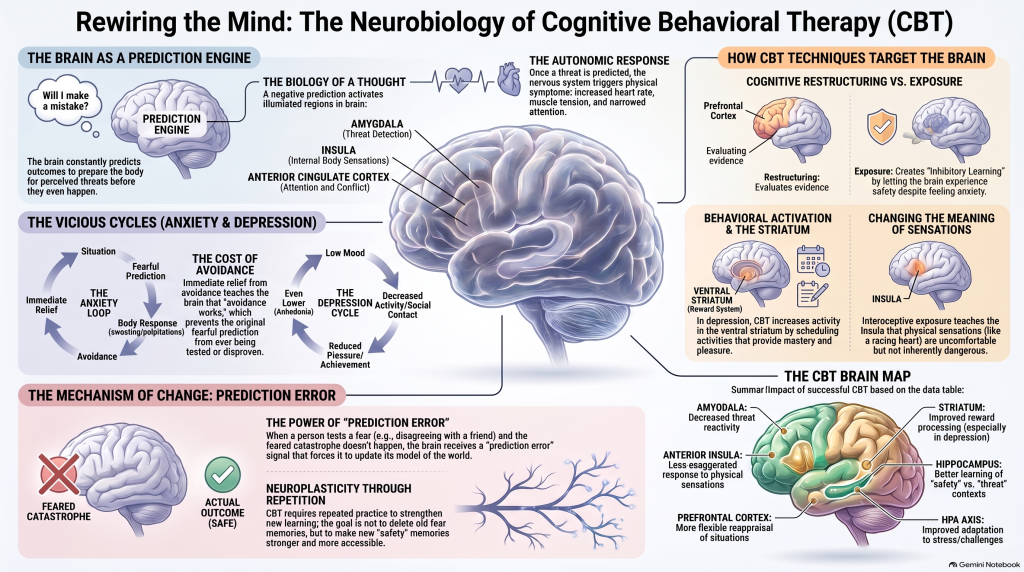 Cognitive Behavioural Therapy (CBT) is often described as a “talking therapy.” But biologically, something much more interesting is happening.
When a person repeatedly identifies an automatic thought, tests a prediction, approaches something they have been avoiding, or behaves differently despite low mood, the brain is learning.
And learning changes brain function.
Modern neuroimaging studies show that successful CBT is associated with measurable changes in brain systems involved in threat detection, emotional regulation, attention, body awareness and reward processing. In depression, a 2024 systematic review of longitudinal fMRI studies found reduced limbic reactivity, altered prefrontal and cingulate activity, and changes in striatal reward processing after CBT.
So CBT is not simply:
“Thinking positively.”
A better way of understanding it is:
CBT changes the way the brain predicts, interprets, responds to and learns from experience.
The Brain Is Constantly Making Predictions
Suppose you are about to give a presentation.
Before anything has actually gone wrong, your brain may predict:
“I will make a mistake.”
“Everyone will notice.”
“I won’t be able to cope.”
That prediction is not merely a sentence in the mind.
It can activate systems involved in threat and salience.
The amygdala helps identify emotionally important or potentially threatening information.
The insula helps represent what is happening inside the body—heartbeat, breathing, tension and other internal sensations.
The anterior cingulate cortex participates in attention, conflict monitoring and emotional processing.
The autonomic nervous system then produces the familiar bodily response:
Heart rate ↑
Muscle tension ↑
Sweating ↑
Attention narrows towards threat
The thought, body and behaviour become part of the same biological loop.
The Anxiety Loop
A simplified sequence is:
Situation
“I have to speak in front of people.”
↓
Prediction
“I’ll embarrass myself.”
↓
Threat networks activate
Amygdala + insula + salience network
↓
Body responds
Palpitations, sweating, tension
↓
The brain notices those sensations
“My heart is racing—I really can’t handle this.”
↓
Anxiety increases
↓
Avoidance
“I’ll find an excuse not to present.”
↓
Immediate relief
And that relief teaches the brain something important:
“Avoidance worked.”
The feared prediction was never properly tested.
This is one reason anxiety can persist.
What Does CBT Change?
Different CBT techniques influence different components of this system.
A useful neurobiological model is:
Cognitive restructuring
changes interpretation
Exposure
changes threat learning
Behavioural experiments
change predictions through experience
Behavioural activation
changes reward and motivation
Attention training and emotional regulation
change how information is selected and processed
All of these depend on learning and neuroplasticity.
1. Cognitive Restructuring: Strengthening Regulation of Emotional Responses
Consider the thought:
“My heart is racing. Something terrible is happening.”
CBT does not simply replace it with:
“Everything is fine.”
Instead, the person learns to examine the evidence.
Could the increased heart rate be anxiety?
Has this happened before?
Did the predicted catastrophe actually occur?
What is the probability of the feared outcome?
This requires brain systems involved in:
- reasoning
- attention
- cognitive control
- reappraisal
- inhibition of automatic responses
These functions involve regions of the prefrontal cortex and anterior cingulate cortex.
At the same time, the significance assigned to signals coming from the amygdala and insula can change.
It is tempting to describe this simply as:
“The prefrontal cortex switches off the amygdala.”
But the real neurobiology is more complex.
CBT appears to alter the functioning and interaction of distributed prefrontal–limbic networks, rather than operating through one simple on/off pathway. Neuroimaging findings across disorders also vary according to the task and type of CBT being studied.
2. Exposure Therapy: Teaching the Brain a New Prediction
Exposure is one of the clearest examples of CBT as biological learning.
Imagine someone who fears lifts.
The brain predicts:
“If I enter the lift, something terrible will happen.”
Avoiding lifts prevents that prediction from being properly tested.
Exposure does something different.
The person enters the lift.
Anxiety increases.
But the feared catastrophe does not happen.
The brain receives new information:
Prediction: Danger
Experience: I remained safe and could cope
The difference between what the brain predicted and what actually happened creates a powerful learning signal—often discussed in terms of prediction error.
Repeated experiences help create new learning:
“A lift can trigger anxiety without actually being dangerous.”
Fear Is Not Necessarily Erased
An older explanation of exposure emphasized habituation:
Stay with the fear long enough and anxiety gradually falls.
Habituation can certainly occur.
But modern learning models emphasize something broader: inhibitory learning.
The original fear memory may remain.
The person develops a new competing memory:
Old learning:
Lift → Danger
New learning:
Lift → Anxiety may occur, but catastrophe does not follow and I can cope
This distinction explains why fear can occasionally return during stress even after successful therapy.
The aim is not necessarily to delete the old memory.
It is to make the new learning stronger and more accessible.
Brain research on anxiety treatment repeatedly implicates networks involving the amygdala, insula, prefrontal cortex, cingulate cortex and striatum, although the precise direction of prefrontal changes varies across studies.
3. The Insula: Changing What Bodily Sensations Mean
The insula is especially relevant to panic and anxiety.
It helps construct our awareness of internal bodily states—known as interoception.
You notice:
Heart beating quickly.
That is a sensation.
But then the brain interprets it:
“This is dangerous.”
Now the sensation itself becomes frightening.
More anxiety follows.
Heart rate rises further.
The person becomes even more focused on the heartbeat.
This produces a feedback loop:
Body sensation
↓
Catastrophic interpretation
↓
Fear
↓
More autonomic activation
↓
Stronger body sensation
CBT teaches the person to reinterpret and sometimes deliberately experience these sensations.
For example, in panic treatment, carefully designed interoceptive exposure can allow someone to discover:
“A racing heart is uncomfortable, but it does not necessarily mean that I am having a heart attack.”
Across anxiety-related disorders, treatment-associated reductions in amygdala and anterior insula activation are among the more consistent neuroimaging findings.
4. Behavioural Activation: Re-engaging the Brain’s Reward System
Depression produces a different vicious cycle.
Low mood
↓
Less activity
↓
Less social contact
↓
Less achievement
↓
Less pleasure
↓
Even lower mood
A depressed person may say:
“When I feel motivated, I’ll start exercising again.”
Behavioural activation often reverses the order:
Activity first → motivation and reward may follow
The brain’s reward system includes structures such as the ventral striatum, including the nucleus accumbens, together with interconnected cortical regions.
Depression is commonly associated with altered reward processing and anhedonia—reduced anticipation or experience of pleasure.
Interestingly, longitudinal neuroimaging studies of CBT for depression have reported increased striatal activity during reward processing following treatment.
So scheduling:
- exercise
- social contact
- hobbies
- meaningful work
- pleasurable activities
- achievable tasks
is not simply “keeping busy.”
Repeated engagement creates new opportunities for reward, mastery and reinforcement.
5. CBT Changes Attention
An anxious brain is often biased towards threat.
Walk into a room containing ten neutral faces and one person frowning, and attention may immediately lock onto the frown.
A depressed brain may preferentially notice:
- mistakes
- rejection
- failure
- negative memories
while positive or neutral information receives less weight.
CBT teaches people to examine these biases rather than automatically accepting them.
Over time, this can change how attention is allocated and how emotionally significant information is processed.
This involves interconnected prefrontal, cingulate, insular and limbic networks.
Notably, activity in networks concerned with salience and interoception, particularly fronto-insular and fronto-cingulate regions, has also been associated with subsequent response to CBT in anxiety disorders.
6. CBT Changes the Meaning of Thoughts
An important stage in therapy occurs when a person begins to recognise:
“A thought is a mental event—not necessarily a fact.”
Before therapy:
“Everyone thinks I’m incompetent.”
may be processed almost as though it were objective reality.
After repeated cognitive work:
“I notice that I’m having the thought that everyone thinks I’m incompetent.”
There is now psychological distance between the person and the thought.
This allows higher-order cognitive systems to evaluate rather than automatically obey the thought.
The result is not the elimination of negative thinking.
It is a change in how much control an automatic thought has over subsequent emotion and behaviour.
7. Behavioural Experiments Give the Brain New Data
This may be one of the most important mechanisms of CBT.
Imagine someone believes:
“If I disagree with someone, they will reject me.”
Talking about the belief may help.
But a behavioural experiment is even more powerful.
The person respectfully disagrees with someone.
Then observes what actually happens.
Perhaps the relationship remains perfectly intact.
Now the brain has received real-world evidence contradicting the old model.
This creates:
Prediction
“If I disagree, I will be rejected.”
↓
Experiment
Express a reasonable disagreement.
↓
Outcome
No rejection occurs.
↓
Prediction error
“My expectation was inaccurate.”
↓
New learning
“I can disagree without automatically losing relationships.”
CBT therefore works not only by thinking differently, but by repeatedly experiencing something different.
8. Neuroplasticity: Practice Matters
Neuroplasticity refers to the nervous system’s capacity to change with experience.
Every time we repeatedly practise a response, the brain learns.
Unfortunately, maladaptive patterns can also be practised.
Repeated avoidance teaches:
“Avoid this.”
Repeated checking can teach:
“I need checking to feel safe.”
Repeated rumination teaches attention to repeatedly return to the same negative material.
CBT deliberately creates different repetitions:
Approach instead of avoidance.
Test instead of assume.
Act instead of withdraw.
Observe instead of catastrophise.
Tolerate uncertainty instead of repeatedly seeking reassurance.
Over many repetitions, the new response becomes increasingly available.
Human imaging studies demonstrate changes in neural activity and connectivity after psychotherapy. We should, however, be cautious about saying that an fMRI scan directly shows CBT “rewiring individual synapses.” That level of microscopic plasticity is largely inferred from what we know about learning rather than directly visualized during clinical CBT.
9. Does CBT Change Cortisol?
Possibly—but this part of the story is less straightforward than brain imaging.
The hypothalamic–pituitary–adrenal (HPA) axis regulates cortisol and is an important component of the stress response.
Psychological treatment can influence stress physiology, and some studies have demonstrated changes in cortisol responses following CBT.
However, the evidence is heterogeneous.
A systematic review of cortisol and autonomic biomarkers during psychotherapy found considerable differences between studies and measurement techniques, making a simple universal “CBT lowers cortisol” conclusion inappropriate.
One randomized study found that CBT enhanced habituation of the cortisol response to repeated stress, without simply reducing total cortisol output.
So a better description is:
Successful therapy may change how the stress system responds and adapts to challenge—not simply lower every stress hormone.
What Happens Before and After Successful CBT?
A simplified model would look like this.
Before CBT
Trigger
↓
Threat prediction
↓
Amygdala / insula / salience systems activate
↓
Autonomic arousal
↓
Catastrophic interpretation
↓
Avoidance / reassurance / withdrawal
↓
Immediate relief
↓
Old prediction strengthened
During CBT
Trigger
↓
Notice automatic prediction
↓
Question or test it
↓
Approach rather than automatically avoid
↓
Experience anxiety without catastrophe
↓
Prediction error
↓
New learning
↓
Repeat
After Repeated Practice
Trigger
↓
More flexible appraisal
↓
Less exaggerated threat processing
↓
Better regulation of emotional responses
↓
Less avoidance
↓
Greater behavioural freedom
↓
Symptoms reduce
The Brain Regions in One Simple Map
| Brain system | Broad function | What may change with CBT |
|---|---|---|
| Amygdala | Threat/emotional relevance | Threat reactivity may decrease |
| Anterior insula | Body awareness and salience | Less exaggerated response to threatening sensations |
| Prefrontal cortex | Evaluation, cognitive control, reappraisal | More flexible regulation and appraisal |
| Anterior cingulate cortex | Conflict, attention, emotion regulation | Altered regulation of emotional information |
| Hippocampus | Context and memory | Better contextual learning around safety/threat |
| Striatum | Reward, motivation and learning | Reward processing may improve, particularly in depression |
| Autonomic nervous system | Physical stress response | Physiological responses may become less exaggerated |
| HPA axis | Stress-hormone regulation | Stress adaptation may change in some patients |
These are networks, not isolated switches. CBT does not work by changing one single “anxiety centre” or “depression centre.”
The Most Important Neurobiological Idea
The brain develops models of the world:
“This is dangerous.”
“I cannot cope.”
“People will reject me.”
“Nothing I do will make a difference.”
CBT repeatedly creates experiences that allow those models to be updated.
That is why one of the most useful ways to describe CBT biologically is:
Prediction → Experience → Prediction Error → New Learning → Repetition → Neuroplastic Change
CBT therefore does not merely teach someone to talk differently about a problem.
It gives the brain repeated opportunities to learn that another response is possible.
And with sufficient repetition, what initially requires deliberate effort can gradually become the brain’s more automatic response.
A Note From Author :
In clinical practice, I find this neurobiological perspective particularly useful because it removes the misconception that psychological treatment means symptoms are “just in the mind.”
Thoughts, emotions, bodily responses, attention, learning and behaviour arise from interacting brain systems. Effective psychological treatment can therefore produce meaningful changes in both experience and measurable brain function.
The important step is selecting the right intervention for the individual’s pattern—whether the maintaining mechanism is avoidance, catastrophic interpretation, behavioural withdrawal, repetitive worry, reassurance seeking or another cycle.
Dr. Srinivas Rajkumar T
Senior Consultant Psychiatrist, Apollo Hospitals
Assistant Professor of Psychiatry, SBMCH, Chennai
ATTN Clinic — Attention. Understood.
Apollo Clinic, opposite Phoenix Market City, Velachery, Chennai
Appointments: +91 85951 55808
Website: srinivasaiims.com
Medical disclaimer: This article is intended for education. CBT techniques should be individualized according to the clinical problem and do not replace appropriate psychiatric or psychological assessment.