Smartphone Use and Borderline Personality Disorder: WhatsApp, Netflix and Emotional Regulation
 Borderline personality disorder (BPD) is characterised by marked emotional instability, intense interpersonal sensitivity, rapid shifts in inner tension, impulsivity and, in some people, episodes of dissociation. These symptoms can fluctuate considerably within the same day, often in response to interpersonal situations.
In modern life, many of these interpersonal interactions now happen through the smartphone.
A message arrives. A reply is delayed. WhatsApp is opened again. Someone appears online but does not respond. The app is checked repeatedly. Meanwhile, another person may use the same phone to watch a familiar YouTube video or Netflix programme to calm down.
Both are technically “screen time”.
Psychologically, however, they may be very different.
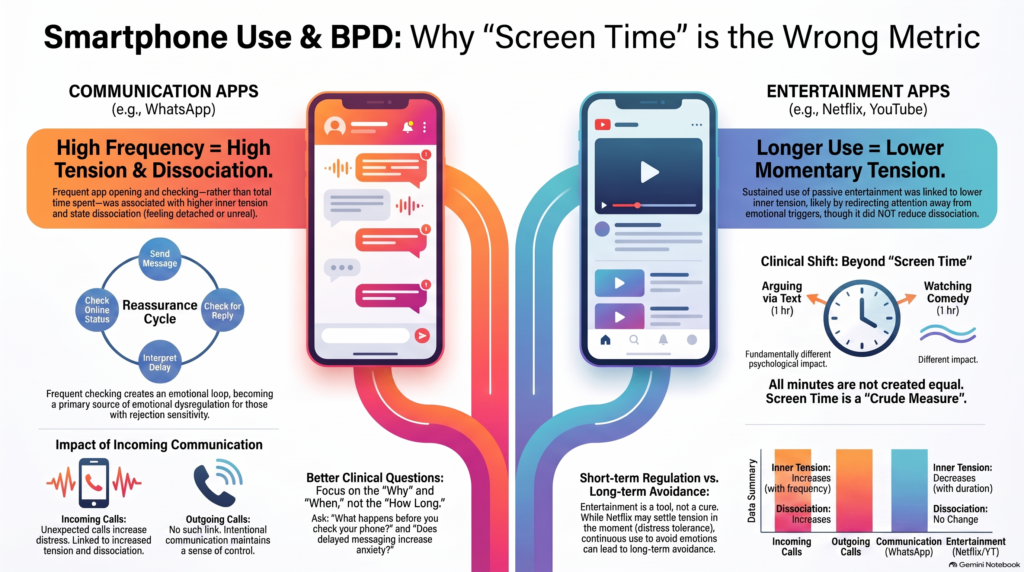
A 2026 study published in Comprehensive Psychiatry examined exactly this question and found an interesting contrast: frequent use of communication apps such as WhatsApp was associated with greater inner tension and dissociation, while longer passive entertainment use was associated with lower momentary inner tension.
Why Smartphone Use May Matter in BPD
Interpersonal stress is particularly relevant in borderline personality disorder.
Difficulties involving perceived rejection, reassurance seeking, unstable relationships and heightened emotional reactions can rapidly increase distress. Smartphones have made interpersonal communication almost continuously available.
This means emotional triggers can now occur through:
- messages
- notifications
- delayed replies
- repeated checking
- incoming calls
- online-status cues
The researchers therefore asked an important question:
Does the type and pattern of smartphone use relate to moment-to-moment changes in BPD symptoms?
What Did the Study Do?
Researchers studied 49 individuals with BPD undergoing inpatient Dialectical Behaviour Therapy (DBT).
Instead of asking participants to estimate their phone use, smartphone behaviour was objectively tracked.
The researchers recorded:
- communication-app use
- WhatsApp use
- entertainment-app use
- YouTube and Netflix use
- how often apps were opened
- how long apps were used
- incoming and outgoing calls
Participants simultaneously rated their inner tension and state dissociation throughout treatment.
Smartphone behaviour was monitored for up to 56 treatment days, while detailed within-person analyses examined how smartphone use and symptoms varied hour by hour during the first 21 days.
This is important because the study did not merely compare “heavy phone users” with “light phone users”.
It examined whether changes in the same person’s smartphone behaviour were associated with changes in that person’s emotional state. These within-person fluctuations were an important part of the findings.
Frequent WhatsApp Checking Was Linked With More Inner Tension
One of the most interesting findings concerned frequency of checking communication apps.
More frequent communication-app use was associated with increased inner tension.
The same pattern appeared specifically with WhatsApp.
This suggests that the clinically meaningful behaviour may not simply be the total amount of time spent messaging.
Instead, repeated checking may matter more.
A common pattern may look like:
Send message → check for reply → no reply → check again → interpret the delay → check online status → check again.
For someone already vulnerable to rejection sensitivity or interpersonal uncertainty, this repetitive cycle may become part of the emotional dysregulation itself.
The authors suggest that frequent app opening may reflect behaviours such as:
- reassurance seeking
- insecurity
- fear of missing out
- habitual checking
They also note that frequent checking may fragment attention and increase cognitive load, potentially contributing to short-term stress and tension.
Communication-App Checking Was Also Linked With Dissociation
The association was not limited to tension.
More frequent communication-app use was also related to higher state dissociation, including in the WhatsApp analysis.
State dissociation may involve:
- feeling detached from oneself
- feeling that the surroundings are unreal
- depersonalisation
- derealisation
The study does not prove that WhatsApp causes dissociation.
The relationship could work in several directions. A distressed person may check the phone more frequently, repeated checking may amplify distress, or both may occur together as part of the same emotional cycle.
What makes the finding interesting is that smartphone behaviour was objectively recorded rather than simply recalled later.
Incoming Calls Were Associated With More Distress
Another striking observation concerned phone calls.
A greater average number of incoming calls, but not outgoing calls, was associated with higher inner tension and state dissociation.
The distinction may be psychologically meaningful.
An outgoing call is generally intentional.
An incoming call is externally initiated and potentially unexpected.
The authors suggest that unexpected communication may sometimes produce a sense of reduced control, which could be particularly stressful in vulnerable individuals.
This again points toward an important theme:
interpersonal unpredictability may matter more than simple phone exposure.
Netflix and YouTube Showed the Opposite Pattern
The entertainment findings were very different.
Longer use of passive entertainment apps was associated with lower momentary inner tension.
The same pattern was seen when researchers examined Netflix and YouTube.
Why might this happen?
Passive entertainment may temporarily:
- redirect attention away from an emotional trigger
- reduce rumination
- provide distraction
- create predictable stimulation
- absorb attention
- give emotional arousal time to settle
In DBT, carefully chosen distraction can sometimes function as a short-term distress-tolerance strategy.
The authors therefore suggest that entertainment apps might, in some situations, serve as a temporary self-regulation strategy.
Does This Mean Netflix Is a Treatment for BPD?
No.
The study found an association between entertainment use and short-term lower inner tension.
It did not show that watching Netflix improves the long-term course of borderline personality disorder.
The researchers themselves caution that prolonged passive entertainment may become emotional avoidance or suppression.
The useful distinction is:
short-term regulation versus long-term avoidance.
Watching something familiar during a period of intense distress may sometimes help.
Using entertainment continuously to avoid emotions, relationships or responsibilities is a very different pattern.
Entertainment Reduced Tension—but Not Dissociation
Passive entertainment was associated with reduced inner tension, but not with reduced state dissociation.
That distinction is clinically important.
A video may distract someone from escalating emotional arousal.
But dissociation may require more active strategies such as:
- grounding
- sensory orientation
- deliberate attention to the environment
- cognitive engagement
The authors suggest that future research should examine whether more interactive activities may be better able to interrupt dissociative states.
“Screen Time” May Be the Wrong Question
Perhaps the most useful lesson from this study is that screen time is too crude a measure.
One hour spent:
- repeatedly checking WhatsApp
- arguing through messages
- watching a documentary
- talking to a supportive friend
- studying
- watching comedy
- attending an online therapy session
cannot reasonably be treated as the same psychological exposure.
The content, purpose, frequency and emotional context of smartphone use matter.
The study also suggests that frequency and duration are different behavioural signals. Frequent checking may reflect a different psychological process from sustained, purposeful use.
A Better Clinical Question
Instead of asking only:
“How many hours do you spend on your phone?”
a psychiatrist may ask:
“What happens immediately before you check your phone?”
Other useful questions include:
- Do you repeatedly check whether someone has replied?
- Does delayed messaging increase your anxiety?
- Do you repeatedly check online status?
- Do unexpected calls increase your distress?
- Do you use messaging apps for reassurance when upset?
- Which digital activities actually help your tension settle?
These questions transform smartphone use from a vague lifestyle variable into something much more clinically useful:
a behavioural pattern linked to emotional regulation.
Could Smartphone Behaviour Become a Digital Marker?
The study also highlights the emerging field of digital phenotyping.
Smartphones can objectively capture behavioural signals such as:
- app-opening frequency
- communication patterns
- timing of device use
- activity patterns
- changes from an individual’s usual behaviour
This does not mean diagnosing BPD from WhatsApp behaviour.
The study does not support that.
But changes from a person’s own baseline may eventually become useful as a complementary measure of fluctuating symptoms.
That is one direction in which psychiatry may become increasingly longitudinal, personalised and measurement-based.
Important Limitations
The study involved only 49 participants and the sample was predominantly female.
Only Android users were included.
Although researchers knew which apps were opened, how often and for how long, they did not know the actual content of individual communications.
They therefore could not determine whether a WhatsApp session involved conflict, reassurance, supportive communication, reading old messages or simply viewing media.
The study also demonstrates association rather than causation.
It should therefore not be interpreted as evidence that WhatsApp itself causes worsening of borderline personality disorder.
The Take-Home Message
Smartphone use in borderline personality disorder appears to be more nuanced than simply “too much screen time”.
The study suggests:
Frequent communication-app and WhatsApp checking → greater inner tension and dissociation.
Longer passive entertainment use such as Netflix or YouTube → lower short-term inner tension, but not lower dissociation.
Perhaps the most useful clinical insight is this:
The problem may not be how long someone is looking at the phone. It may be what they are repeatedly looking for every time they unlock it.
Understanding these patterns may eventually help clinicians identify triggers, improve emotion-regulation strategies and integrate digital behaviour more intelligently into psychiatric assessment.
Reference
Macchia A, Lochner D, Haag AC, Montag C, Abler B. A dialectical perspective on smartphone use in borderline personality disorder: Communication fosters inner tension and dissociation, while entertainment provides momentary relief. Comprehensive Psychiatry. 2026;148:152717. doi:10.1016/j.comppsych.2026.152717.
Consultation in Chennai
Dr. Srinivas Rajkumar T is a Senior Consultant Psychiatrist in Chennai, with MD training from AIIMS New Delhi, and a clinical interest in evidence-based psychiatry, emotional dysregulation, objective psychiatric assessment and digital psychiatry.
Apollo Clinic (Opp. Phoenix Market City), Velachery, Chennai
Appointments: +91 85951 55808
Email: srinivasaiims@gmail.com